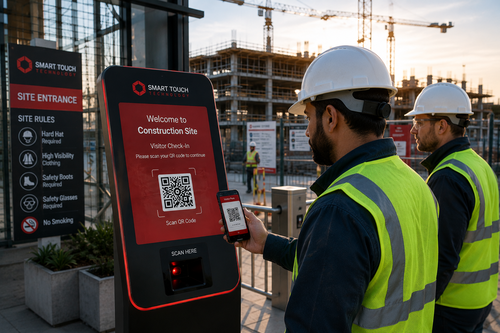
Modern construction sites are becoming larger, faster, more complex, and more demanding than ever before. Every day, contractors, subcontractors, consultants, suppliers, delivery drivers, engineers, safety officers, inspectors, clients, and visitors may enter and leave the site. Without a proper system, managing all these movements can become difficult, risky, and inefficient. This is why an All-in-One VMS Solution for Modern Construction Sites is now an essential part of professional site management.
A smart Visitor Management System, commonly known as VMS, helps construction companies control visitor registration, contractor access, worker verification, safety compliance, entry approval, attendance tracking, digital records, reporting, and real-time site visibility from one centralized platform. Instead of relying on paper logbooks, handwritten passes, manual checking, and scattered communication, a modern construction site can use a digital VMS to improve security, safety, accountability, and operational efficiency.
At Smart Touch technology pte ltd, our all-in-one VMS solution is designed to support construction sites that need smarter access control, stronger site security, faster registration, better visitor tracking, and reliable digital records for daily operations.
Why Construction Sites Need an All-in-One VMS Solution
Construction sites are high-activity environments. Unlike office buildings, where most visitors enter through a reception area, construction sites often involve multiple entry points, temporary workers, changing contractors, delivery vehicles, project teams, and strict safety rules. A visitor may be allowed to enter only for a certain purpose, a contractor may need access only to a specific zone, and a delivery driver may only be permitted to enter during scheduled hours.
When this process is managed manually, many problems can occur. Paper logbooks may be incomplete or difficult to read. Visitors may forget to sign out. Security guards may not have enough information to verify approval. Contractors may enter the site without proper safety induction. Management may not know exactly who is inside the site at a specific time. In an emergency, this lack of visibility can create serious safety and accountability issues.
An all-in-one VMS solution solves these problems by digitalizing the entire visitor and contractor access process. It allows the site team to know who is entering, why they are entering, who approved them, where they are going, and when they leave.
What Is a Construction Site VMS?
A construction site VMS is a digital visitor management system developed to handle the access needs of project sites, building sites, infrastructure projects, industrial construction areas, and remote work zones. It replaces manual visitor registration with a structured digital workflow.
Visitors can pre-register before arriving or register at the guardhouse using a kiosk, tablet, QR code, or assisted registration counter. Their identity, company name, purpose of visit, host details, safety status, entry time, exit time, and access permission can be recorded automatically. The system can also issue temporary visitor passes, QR codes, badges, or access credentials.
For contractors and workers, the system can be integrated with access control devices, full height turnstiles, facial recognition terminals, RFID cards, biometric attendance devices, and site attendance software. This creates a complete access control environment for both visitors and workforce movement.
A well-designed VMS is not just a sign-in system. It is a complete site access management platform.
The Importance of Visitor Control in Construction Site Safety
Safety is one of the most important priorities on every construction site. Visitors and contractors may be exposed to hazards such as heavy machinery, moving vehicles, restricted zones, falling object areas, excavation zones, electrical works, lifting operations, and temporary structures. Because of this, site access must be controlled carefully.
A smart VMS can support site safety by ensuring that visitors are properly registered, approved, and briefed before entry. The system can include safety declaration forms, digital induction acknowledgement, PPE requirement notices, and visitor terms and conditions. This helps remind every visitor of the rules before they enter the worksite.
The system can also help prevent unauthorized access to dangerous or restricted areas. When connected to access control equipment, only approved individuals can enter the site or specific zones. This reduces the risk of untrained or unauthorized people entering high-risk areas.
For construction companies that want to build a stronger safety culture, a digital VMS is a practical and professional tool.
Key Features of the Best All-in-One VMS Solution
The best all-in-one VMS solution for construction sites should be secure, user-friendly, flexible, and suitable for real site conditions. It should not only record visitor names, but also support the full workflow from pre-registration to exit reporting.
1. Digital Visitor Registration
Digital visitor registration allows visitors to check in without filling out paper forms. The system can capture visitor details, identity information, company details, vehicle number, purpose of visit, host person, visit location, and entry time.
This improves accuracy and saves time at the guardhouse. Instead of manually writing details in a logbook, visitors can complete registration through a tablet, kiosk, QR code form, or security counter system.
Digital registration also creates a searchable record. Site management can quickly review visitor history whenever needed.
2. Pre-Registration and Appointment Scheduling
Pre-registration helps construction sites prepare for expected visitors. A project manager, safety officer, engineer, or admin staff can pre-register visitors before they arrive. The visitor may receive a QR code or digital pass that can be scanned at the entrance.
This makes check-in faster and more organized. It is especially useful for consultants, inspectors, client representatives, subcontractor meetings, supplier visits, and scheduled deliveries.
Pre-registration also gives security guards clear information about who is expected, when they should arrive, and who approved the visit.
3. QR Code Visitor Pass
A QR code visitor pass is one of the most convenient tools for site entry. After registration or pre-approval, the visitor can receive a unique QR code. At the entrance, the code can be scanned to verify permission and record entry.
The QR code can be limited by date, time, purpose, or number of uses. Once expired, it cannot be reused. This helps prevent unauthorized repeat entry and strengthens visitor control.
For construction sites with high visitor traffic, QR code access can reduce waiting time and improve the professionalism of the entry process.
4. Contractor and Worker Access Control
Construction projects depend heavily on contractors and subcontractors. These workers may change frequently depending on project phase, work package, or schedule. A good VMS should be able to manage not only visitors, but also contractors and workers.
The system can store contractor profiles, company details, work permits, safety induction status, access validity, project assignment, and attendance records. When connected to access control devices, only approved and active contractors can enter.
This helps prevent expired workers, unregistered personnel, or unauthorized subcontractors from entering the site.
5. Safety Induction Tracking
Safety induction is a critical requirement for many construction sites. Before workers or visitors enter, they may need to complete safety training or acknowledge site safety rules.
A smart VMS can record induction status and validity period. If a contractor’s safety induction has expired, the system can block access or alert the security team. For visitors, the system can show digital safety instructions during registration and require acknowledgement before entry.
This creates a stronger link between access control and safety compliance.
6. Real-Time Site Occupancy Monitoring
Site management should always know who is currently inside the construction site. Real-time occupancy monitoring allows managers to view active visitors, contractors, workers, and staff who have checked in but not checked out.
This is extremely useful during emergency situations. If evacuation is required, management can generate a list of people currently on site to support roll call and emergency response.
Real-time occupancy also helps improve accountability because every entry and exit is recorded digitally.
7. Integration with Full Height Turnstiles and Access Devices
For stronger physical security, a VMS can be integrated with full height turnstiles, tripod turnstiles, flap barriers, swing gates, door access systems, facial recognition terminals, RFID card readers, QR code scanners, and biometric devices.
At construction sites, full height turnstiles are especially useful because they provide a strong pedestrian barrier and allow one-person-at-a-time entry. When connected to the VMS, only registered and approved individuals can pass through.
This reduces tailgating, prevents unauthorized entry, and creates a more controlled site perimeter.
8. Vehicle and Delivery Management
Construction sites often receive materials, equipment, tools, concrete trucks, delivery vehicles, and service vehicles. A complete VMS should support vehicle registration and delivery tracking.
The system can record vehicle number, driver details, delivery company, delivery purpose, destination area, entry time, exit time, and approval status. This helps security teams manage vehicle movement more clearly.
For large sites, vehicle management can be important for safety because uncontrolled vehicle movement can create congestion and risk near working areas.
9. Host Notification and Approval Workflow
When a visitor arrives, the person they are visiting should be notified quickly. A smart VMS can send notifications to the host through email, system alert, or mobile notification. The host can approve or reject the visit based on site rules.
Approval workflows can be customized. Some visits may require approval from a project manager, safety officer, admin officer, or security supervisor. This ensures that site access is not granted without proper authorization.
10. Digital Reports and Audit Trail
Digital reporting is one of the strongest benefits of a modern VMS. Management can generate reports by visitor type, company, date, time, host, purpose, contractor, site location, or access status.
These reports support audits, safety reviews, incident investigations, compliance checks, contractor management, and management reporting. Instead of searching through paper logbooks, the site team can retrieve accurate records quickly.
A complete audit trail also improves transparency and helps organizations maintain better control over site access.
How an All-in-One VMS Improves Construction Site Security
Security is a major concern for modern construction sites. Expensive materials, machinery, tools, cables, equipment, and temporary facilities are often stored on site. Unauthorized access can lead to theft, vandalism, safety incidents, and project delays.
An all-in-one VMS improves security by making every entry traceable. Visitors cannot simply walk in without registration. Contractors cannot enter if their access has expired. Drivers can be recorded before entering. Security guards can verify visitors using digital records instead of relying only on verbal confirmation.
When integrated with CCTV, access control, turnstiles, and alarm systems, the VMS becomes part of a complete construction site security solution. This gives management better control over people movement and reduces blind spots in daily operations.
How VMS Supports Emergency Response
In an emergency, every second matters. Construction sites need to know who is inside, where they may be located, and whether they have exited safely. Manual paper records may not be updated accurately, especially if visitors forget to sign out.
A digital VMS provides real-time information about active visitors and workers on site. During evacuation, the system can support emergency roll call by producing a list of people currently checked in. This helps the safety team respond more effectively and reduces confusion.
For high-risk environments, this feature is extremely valuable because it supports both safety management and duty-of-care responsibilities.
Reducing Manual Work for Security and Admin Teams
Manual visitor management creates extra work for guards, admin staff, and project teams. Guards must check identity, write records, call hosts, issue passes, collect passes, and update logbooks. Admin teams may need to compile reports manually. Project teams may be interrupted repeatedly to confirm visitor approvals.
A smart VMS automates many of these steps. Visitor information is entered digitally. Approval notifications are sent automatically. Passes can be generated by the system. Reports can be downloaded quickly. Entry and exit records are captured in real time.
This allows the security team to focus on monitoring and control instead of paperwork.
Better Experience for Visitors, Contractors, and Project Teams
A modern construction site should present a professional image from the entrance. When visitors arrive and see a structured digital check-in process, it creates confidence that the site is well managed.
A VMS makes the visitor journey smoother. Pre-registered visitors can check in faster. Contractors can use approved access credentials. Delivery drivers can be processed more clearly. Hosts can receive instant notifications. Security guards can work with better information.
This improves communication between visitors, contractors, project teams, and security personnel.
VMS for Large Construction Projects
Large construction projects may involve hundreds or thousands of workers and many contractor companies. Manual access control is not suitable for this scale. A digital VMS helps organize access by company, work package, zone, role, validity period, and approval level.
Management can review which contractors are active, which workers are present, which companies have visited, and how site traffic changes over time. This creates stronger control over large project environments.
For multi-phase construction projects, the system can also adapt as site access points, restricted areas, and contractor requirements change.
VMS for Remote and Outdoor Construction Sites
Remote sites have additional challenges. They may have limited administrative support, difficult communication conditions, temporary infrastructure, and stronger security concerns. A VMS designed for construction sites can support remote access control through cloud-based management, mobile devices, QR code registration, and integration with outdoor-rated access hardware.
When paired with full height turnstiles, face recognition devices, RFID readers, and network-enabled software, remote sites can maintain professional access control even with limited manpower.
This is especially useful for infrastructure projects, industrial construction sites, utility projects, energy sites, and large outdoor work zones.
Integrating VMS with Time Attendance System
Construction companies often need to track worker attendance for payroll, project costing, contractor billing, and manpower planning. When VMS is integrated with time attendance, the site can manage visitors and workers through a connected platform.
Workers can clock in using RFID cards, facial recognition, fingerprint devices, QR codes, or turnstile access. Their attendance records can be linked to project, company, department, or worksite. This helps HR and project teams prepare accurate reports.
For contractors, attendance records can support billing verification, safety compliance, and manpower tracking.
VMS and Contractor Compliance
Contractor compliance is a major concern in construction. Each contractor may need to submit worker details, identity documents, training records, work permits, insurance information, safety induction status, and access validity.
A smart VMS can help organize these records and prevent unauthorized or expired personnel from entering. This supports better contractor control and reduces administrative risk.
The system can also remind site administrators when documents are expiring, helping the project team take action before compliance issues occur.
Choosing the Best All-in-One VMS Solution
The best VMS solution for construction sites should be practical, scalable, and easy to use. It should support daily site operations, not slow them down. It should also be flexible enough to match different project sizes, access rules, security levels, and site layouts.
Important factors include visitor pre-registration, QR code check-in, contractor management, safety induction tracking, real-time occupancy, access control integration, vehicle management, approval workflow, reporting, and centralized management.
The system should also work well with site hardware such as tablets, kiosks, turnstiles, card readers, biometric devices, face recognition terminals, CCTV, and intercom systems.
Most importantly, the VMS should help the construction site improve safety, security, and accountability in a simple and reliable way.
Why Choose Smart Touch for Construction Site VMS
Smart Touch technology pte ltd provides practical and reliable smart security, access control, attendance, and visitor management solutions for modern organizations. Our all-in-one VMS solution is designed to support construction sites that need stronger visitor control, contractor management, worker verification, and real-time access visibility.
We understand that construction sites are dynamic environments. Access rules may change. Contractors may come and go. Safety requirements may be updated. Entry points may move as the project progresses. Our VMS solution is built to support this type of flexible and demanding environment.
With Smart Touch, construction companies can combine visitor management, contractor access, time attendance, full height turnstiles, facial recognition, RFID access, QR code check-in, reporting, and centralized management into one complete solution.
Building Smarter and Safer Construction Sites
The future of construction site management depends on digital control, real-time visibility, and better operational accountability. An All-in-One VMS Solution for Modern Construction Sites helps companies replace manual logbooks with a smarter, faster, and more secure system.
It improves visitor registration, contractor verification, safety induction tracking, access approval, emergency response, vehicle control, reporting, and site security. It also reduces manual work for guards and administrators while giving project managers better insight into daily site movement.
For construction companies that want to improve site safety, reduce unauthorized access, strengthen compliance, and create a more professional entry experience, a smart VMS is one of the most valuable systems to implement.
For more information about the product, please click here: https://www.smartouch.com.my/vms-mobile-kiosk/
Smart Touch technology pte ltd, www.smartouch.com.sg, +65-63964767, sales@smartouch.com.sg, www.smartouch.com.my, +607-3889903, sales@smartouch.com.my