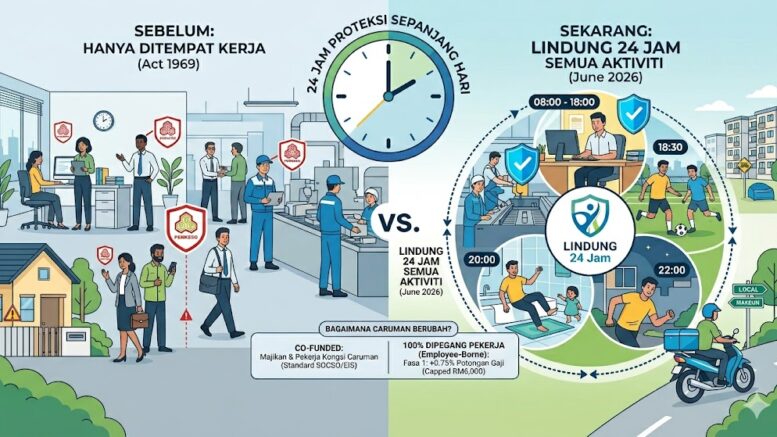
Keeping up with PERKESO rates 2026 is one of the most important compliance tasks for any Malaysian employer. PERKESO, also known as SOCSO (Pertubuhan Keselamatan Sosial), protects employees against workplace injuries, invalidity, and other social security risks. Because contribution amounts are tied directly to monthly wages, even a small miscalculation can lead to compliance issues, penalties, or unhappy employees.
In this guide, we break down exactly how PERKESO rates 2026 work, the difference between First Category and Second Category contributions, and how Malaysian businesses can stay compliant without adding extra administrative burden to their HR teams.
What Is PERKESO and Why Do the 2026 Rates Matter?
PERKESO administers two main protection schemes under the Employees’ Social Security Act 1969: the Employment Injury Scheme and the Invalidity Scheme. Every employer in Malaysia with at least one employee is legally required to register with PERKESO and contribute monthly on behalf of their staff.
Since 1 October 2024, PERKESO raised the monthly wage ceiling used to calculate contributions from RM5,000 to RM6,000. This means employees earning above RM6,000 now have their contributions calculated based on the RM6,000 ceiling rather than their actual salary. Foreign employees have also been brought into the Invalidity Scheme since July 2024, so contribution obligations for local and foreign staff are now aligned. Understanding these updates is essential for accurate payroll processing under the current PERKESO rates 2026 framework.
First Category vs. Second Category: What’s the Difference?
PERKESO contributions are divided into two categories, and knowing which one applies to each employee is the foundation of accurate SOCSO deductions.
First Category: Employment Injury Scheme and Invalidity Scheme
This category applies to employees below the age of 60 who have never been exempted from the Invalidity Scheme. Contributions are shared between employer and employee, with the employer paying a larger portion. This category funds both workplace injury protection and long-term invalidity benefits.
Second Category: Employment Injury Scheme Only
Employees aged 60 and above, or those who reach 60 while still employed, fall under the Second Category. Only the employer contributes, and the contribution solely covers Employment Injury Scheme benefits, since Invalidity Scheme protection no longer applies at this age.
PERKESO Rates 2026 Contribution Table (Sample Brackets)
PERKESO contributions are not a flat percentage; they follow a wage-bracket schedule under the Employees’ Social Security Act 1969 (Act 4). The table below illustrates how contributions scale with monthly wages.
| Monthly Wage | First Category – Employer | First Category – Employee | First Category – Total | Second Category – Employer Only |
|---|---|---|---|---|
| Up to RM30 | 40 sen | 10 sen | 50 sen | 30 sen |
| RM300 – RM400 | RM6.15 | RM1.75 | RM7.90 | RM4.40 |
| RM1,000 – RM1,100 | RM18.35 | RM5.25 | RM23.60 | RM13.10 |
| RM3,000 – RM3,100 | RM53.35 | RM15.25 | RM68.60 | RM38.10 |
| Above RM6,000 | RM104.15 | RM29.75 | RM133.90 | RM74.40 |
For the complete, up-to-date wage-bracket schedule, employers should always refer to PERKESO’s official contribution table, as amounts are adjusted incrementally between each wage bracket.
Why the Wage Ceiling Increase Matters for Employers
Raising the ceiling to RM6,000 means higher-earning employees now generate slightly larger PERKESO contributions than before. For businesses with a large workforce, this can add up across payroll cycles. It also means payroll systems and HR teams calculating contributions manually face a higher risk of error, particularly when staff move between wage brackets after increments, bonuses, or promotions.
Best Practices for Staying Compliant
- Classify employees correctly. Confirm each employee’s age and eligibility to determine First or Second Category status.
- Update payroll wage ceilings. Ensure your payroll system reflects the RM6,000 ceiling, not the older RM5,000 figure.
- Review foreign worker records. Make sure foreign employees are contributing under the same Invalidity Scheme rules as local staff.
- Reconcile monthly submissions. Cross-check PERKESO statements against payroll reports every month.
- Automate where possible. Manual calculations across dozens or hundreds of employees increase the chance of costly mistakes.
How Automated Payroll Reduces PERKESO Compliance Risk
Many Malaysian businesses are shifting away from manual SOCSO calculations toward integrated payroll and HR systems that automatically apply the correct PERKESO rates 2026 based on each employee’s wage and category. An automated system reduces the risk of underpayment or overpayment, keeps records audit-ready, and frees up HR teams to focus on higher-value work instead of repetitive calculations.
Smart Touch’s payroll and HR solutions are built to keep statutory contributions, including PERKESO, EPF, and EIS, accurate and up to date, so employers can stay compliant without chasing rate changes every year.
Common PERKESO Compliance Mistakes to Avoid
Even well-organised HR teams can make small errors that lead to bigger compliance issues down the line. Here are a few common mistakes employers should watch out for when applying PERKESO rates 2026.
- Using the old RM5,000 wage ceiling. Payroll templates that were not updated after October 2024 may still cap contributions at the previous ceiling, resulting in underpayment.
- Misclassifying employees near age 60. Failing to switch an employee from First Category to Second Category on their 60th birthday can lead to incorrect contribution amounts.
- Overlooking new hires in the first payroll cycle. New employees must be registered with PERKESO promptly so contributions start from their first month of employment.
- Inconsistent handling of allowances. Some allowances are included in the wage definition used for PERKESO calculations, while others are not, so it is important to apply the correct definition of “wages” consistently.
- Relying on outdated printed tables. Contribution schedules can be revised, so employers should always confirm they are working from the latest official version.
Avoiding these mistakes is far easier when PERKESO calculations are automated rather than tracked manually across spreadsheets.
Key Takeaways
- PERKESO rates 2026 are calculated using a wage-bracket schedule, not a flat percentage.
- First Category covers Employment Injury and Invalidity Schemes; Second Category covers Employment Injury only for employees aged 60 and above.
- The wage ceiling for contributions is RM6,000 per month, effective since October 2024.
- Foreign workers now receive the same Invalidity Scheme protection as local employees.
- Automated payroll tools help employers stay compliant as rates and ceilings change.
Conclusion
Staying on top of PERKESO rates 2026 protects both your employees and your business. By understanding the difference between First and Second Category contributions, applying the correct wage ceiling, and reviewing your payroll processes regularly, employers can avoid compliance headaches and ensure every employee receives the social security protection they are entitled to. For businesses managing a growing workforce, pairing this knowledge with a reliable, automated payroll system makes ongoing compliance far easier to maintain.
Frequently Asked Questions (FAQ)
1. What is the current PERKESO wage ceiling for 2026?
The wage ceiling used to calculate PERKESO contributions is RM6,000 per month, effective since 1 October 2024.
2. Who falls under the Second Category for PERKESO contributions?
Employees aged 60 and above, or those who turn 60 while still employed, are classified under the Second Category, where only the employer contributes.
3. Do foreign employees contribute at the same PERKESO rates as local employees?
Yes. Since July 2024, foreign employees are covered under the Invalidity Scheme on the same basis as local employees.
4. How often do PERKESO rates change?
PERKESO reviews its contribution schedule periodically. Employers should check the official PERKESO contribution table regularly or use payroll software that updates automatically.
5. Can payroll software calculate PERKESO contributions automatically?
Yes. Modern HR and payroll systems, such as those offered by Smart Touch, can automatically apply the correct wage-bracket contribution based on each employee’s category and monthly wage.
Smart Touch technology pte ltd , www.smartouch.com.sg +65-63964767, sales@smartouch.com.sg , www.smartouch.com.my +607-3889903 sales@smartouch.com.my