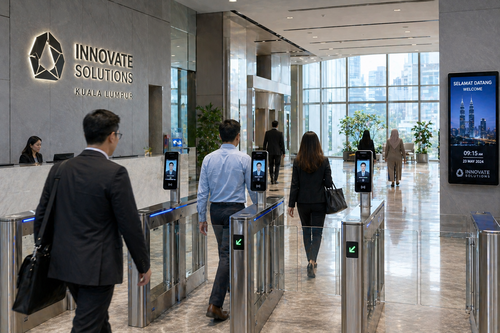
Time theft and buddy punching remain persistent problems for businesses relying on cards or PIN codes for attendance tracking. Facial clocking has emerged as one of the most reliable solutions to this challenge, offering a level of accuracy and security that traditional methods simply cannot match.
This article explains why facial recognition technology has become the safest bet for time attendance, how it compares to other methods, and what businesses should consider before adopting it.
What Is Facial Clocking?
Facial clocking uses facial recognition technology to verify an employee’s identity at the point of clock-in and clock-out. Instead of swiping a card or entering a PIN, employees simply look at a camera-equipped terminal, which matches their face against a stored profile in seconds.
How the Technology Works
Modern facial recognition terminals capture key facial features and convert them into an encrypted digital template. This template is compared against stored records each time an employee clocks in, ensuring only the actual employee can register attendance.
Why Facial Clocking Is the Safest Bet
Eliminates Buddy Punching
Unlike cards or PINs, a face cannot be shared, borrowed, or duplicated. This makes it virtually impossible for one employee to clock in on behalf of another.
Removes the Risk of Lost or Stolen Credentials
Cards can be lost, stolen, or forgotten, disrupting attendance records and creating administrative headaches. Facial recognition removes this dependency entirely.
Faster, Contactless Clocking
Employees simply walk up to the terminal, reducing queues during shift changes compared to card tapping or PIN entry, especially in busy environments.
Stronger Audit Trail
Every clock-in is tied directly to a verified identity, creating a more reliable and tamper-resistant attendance record for payroll and compliance purposes.
Comparing Time Attendance Methods
| Method | Risk of Buddy Punching | Convenience | Best For |
|---|---|---|---|
| Card / Fob | High | Fast but shareable | Low-risk environments |
| PIN Code | High | Moderate | Backup access |
| Fingerprint | Low | Moderate, contact required | Secure indoor environments |
| Facial Recognition | Very Low | Fast, contactless | High-traffic, security-conscious workplaces |
Industries That Benefit Most From Facial Clocking
- Manufacturing plants with large shift-based workforces
- Retail chains with multiple outlets and rotating staff
- Construction sites requiring strict attendance verification
- Corporate offices seeking a contactless, modern solution
- Warehouses and logistics hubs with high staff turnover
What to Look For in a Facial Clocking System
Not all facial recognition systems perform equally. Businesses should look for fast recognition speed even in low light, integration with existing payroll or HR software, secure encrypted storage of facial data, and reliable local technical support.
Addressing Common Concerns
Is Facial Data Secure?
Reputable systems store facial data as encrypted mathematical templates rather than actual images, making it extremely difficult to reverse-engineer or misuse.
Does It Work for Everyone?
Modern facial recognition systems are designed to accurately recognise a wide range of facial features and skin tones, though businesses should verify accuracy claims with a live demo before purchasing.
Steps to Implement Facial Clocking
- Assess your current attendance challenges and shift patterns
- Choose a supplier with proven facial recognition accuracy
- Pilot the system with one location or department
- Register employee facial profiles with proper consent
- Integrate the system with payroll for automatic calculations
Conclusion
Facial clocking offers a level of security and reliability that older attendance methods cannot match. By removing the possibility of shared credentials and buddy punching, businesses gain more accurate attendance data, stronger compliance records, and a faster clocking experience for employees.
For businesses serious about eliminating time theft and modernising their workforce management, facial recognition is quickly becoming the standard rather than the exception.
Frequently Asked Questions
Is facial clocking more accurate than fingerprint scanning?
Both methods are highly accurate, but facial recognition offers the added benefit of being contactless and faster in high-traffic environments.
Can facial recognition be fooled by photos?
Modern systems use liveness detection to distinguish between a real face and a photo or video, preventing spoofing attempts.
How long does it take to register an employee’s face?
Registration typically takes less than a minute per employee using a properly configured terminal.
Does facial clocking require special hardware?
Yes, a compatible camera-equipped terminal is required, though many systems are designed for straightforward installation.
Is employee consent required for facial recognition?
Yes, businesses should obtain clear employee consent before enrolling their facial data into any recognition system.
To see what makes this product unique, click here :https://www.smartouch.com.my/category/time-clock/biometric-facial/
Smart Touch technology pte ltd , www.smartouch.com.sg +65-63964767, sales@smartouch.com.sg , www.smartouch.com.my +607-3889903 sales@smartouch.com.my