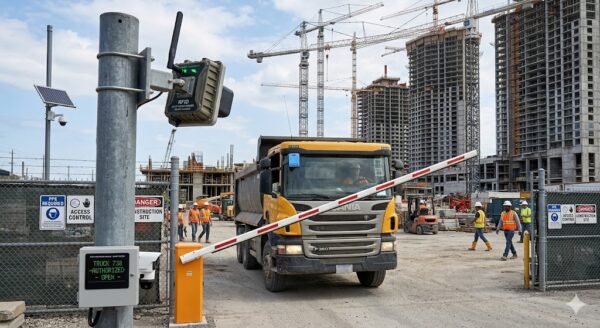
Warehouse security and vehicle access control are becoming top priorities for logistics and manufacturing companies across Malaysia. A long range RFID access control system allows vehicles and personnel to pass through gates automatically, without stopping to swipe a card or wait for a guard. For warehouse operators managing heavy truck traffic, forklifts, and staff vehicles, this technology delivers faster throughput, tighter security, and lower operating costs.
What Is Long Range RFID Access Control?
Long range RFID access control uses radio frequency identification tags mounted on vehicles, combined with a reader positioned at the entrance or gate. Unlike short range proximity cards that require close contact, a long range RFID system can detect a tagged vehicle from several metres away, automatically triggering the barrier or gate to open.
How the Technology Works
- An RFID tag is fixed to the vehicle windscreen or body
- A long range reader at the gate continuously scans for approved tags
- Once a valid tag is detected, the system verifies it against the access database
- The barrier or gate opens automatically for authorised vehicles
Typical Read Range
Depending on the reader and tag combination, long range RFID systems can detect vehicles from as far as 3 to 15 metres, giving vehicles enough time to slow down and pass through smoothly without stopping completely.
Why Malaysian Warehouses Need Long Range RFID
Warehouses and distribution centres in Malaysia face specific operational challenges that make long range RFID access control especially valuable.
Faster Vehicle Throughput
Large warehouses often experience truck queues during peak loading and unloading hours. Automatic detection removes the need for drivers to stop, present a card, and wait for manual verification, significantly reducing congestion at the gate.
Improved Security and Audit Trails
Every vehicle entry and exit is logged automatically with a timestamp, creating a complete digital audit trail. This is valuable for investigating security incidents, tracking delivery schedules, and verifying compliance with site access policies.
Reduced Manual Labour
With automated gate access, warehouses can reduce the number of security personnel needed to manually check and log vehicles, lowering long-term staffing costs.
Better Integration With Warehouse Management Systems
Long range RFID access control can be integrated with warehouse management and visitor management systems, allowing real-time visibility of which vehicles are on-site at any given time.
Key Features to Look For
| Feature | Benefit |
|---|---|
| Long detection range (3 to 15 metres) | Smooth, non-stop vehicle access |
| Weatherproof housing | Reliable operation in outdoor, tropical conditions |
| Barrier gate integration | Fully automated entry and exit |
| Cloud-based access logs | Remote monitoring and reporting |
| Multi-tag support | Manages large vehicle fleets efficiently |
Industries That Benefit From Long Range RFID
While warehouses are a primary use case, several other Malaysian industries rely on long range RFID access control for efficient site management.
Manufacturing Plants
Factories with continuous inbound and outbound truck traffic use long range RFID to manage supplier deliveries and reduce bottlenecks at loading bays.
Logistics and Distribution Hubs
Third-party logistics providers handling hundreds of daily vehicle movements rely on automated RFID gates to keep operations running smoothly around the clock.
Gated Industrial Parks
Industrial parks with multiple tenant companies use long range RFID to manage shared access points, ensuring only authorised vehicles from each tenant can enter.
Long Range RFID vs Traditional Access Methods
Compared to manual guard checks or short range card readers, long range RFID offers clear operational advantages.
| Method | Speed | Labour Required | Accuracy |
|---|---|---|---|
| Manual guard check | Slow | High | Prone to human error |
| Short range card reader | Moderate | Low | Reliable but requires stopping |
| Long range RFID | Fast | Minimal | Highly accurate, no stopping needed |
How to Implement Long Range RFID in Your Warehouse
Rolling out a long range RFID access control system involves a few practical steps.
Step 1: Assess Your Site Layout
Identify entry and exit points, traffic flow patterns, and the ideal mounting position for RFID readers to achieve maximum detection accuracy.
Step 2: Choose the Right Tags and Readers
Select active or passive RFID tags based on your required read range, and match them with readers rated for outdoor warehouse environments.
Step 3: Integrate With Existing Barrier Systems
Connect the RFID reader to your existing boom gates or barriers so that verified vehicles trigger automatic access without additional hardware changes.
Step 4: Test and Fine-Tune
Run a pilot phase to fine-tune detection range and sensitivity, ensuring the system reliably reads tags without false triggers from passing traffic.
Best Practices for Long Range RFID Access Control
- Register all fleet and staff vehicles in the access database before going live
- Position readers to avoid interference from metal structures or other electronic equipment
- Set up automated alerts for unauthorised access attempts
- Review access logs periodically to spot unusual patterns
- Keep tags and readers firmware updated for optimal performance
Key Takeaways
- Long range RFID access control automates vehicle entry and exit for warehouses and logistics sites.
- It improves throughput, security, and reduces reliance on manual gate checks.
- Detection ranges of 3 to 15 metres allow smooth, non-stop vehicle access.
- Successful implementation requires proper site assessment, tag selection, and integration with existing barriers.
Conclusion
A long range RFID access control system gives Malaysian warehouses a practical way to speed up vehicle movement while strengthening site security. By automating entry and exit, businesses reduce congestion, cut manual labour costs, and gain accurate, real-time records of every vehicle on site. As warehouse operations continue to scale, investing in a reliable long range RFID system is a smart step toward safer, more efficient facility management.
Frequently Asked Questions
What is the difference between long range and short range RFID?
Short range RFID requires the tag to be close to the reader, often within centimetres, while long range RFID can detect tags from several metres away, allowing vehicles to pass through without stopping.
Can long range RFID work with existing barrier gates?
Yes, most long range RFID systems are designed to integrate with existing boom gates and barriers, triggering them automatically once a valid tag is detected.
Is long range RFID suitable for outdoor warehouse environments?
Yes, quality RFID readers are built with weatherproof housing to withstand Malaysia’s tropical climate, including heat, humidity, and rain.
How many vehicles can a long range RFID system support?
Most systems can manage large vehicle fleets, from a handful of company vehicles to hundreds of registered tags, depending on the software and database capacity.
Does long range RFID access control improve security?
Yes, it creates a digital audit trail of every vehicle entry and exit, reduces reliance on manual checks, and can flag unauthorised access attempts in real time.
To explore more product details, please click here: https://www.smartouch.com.my/long-range-rfid-content/
Smart Touch technology pte ltd , www.smartouch.com.sg +65-63964767, sales@smartouch.com.sg , www.smartouch.com.my +607-3889903 sales@smartouch.com.my