Introduction
Every year, Malaysian employers and employees face updates to statutory contribution rates — from EPF and SOCSO to EIS and the Human Resources Development Fund (HRDF). In 2026, these changes are more significant than ever, with revised contribution tiers, updated income ceilings, and new compliance requirements that affect payroll calculations across the country.
For HR managers, payroll administrators, and business owners, staying on top of these changes is not just best practice — it is a legal obligation. This article provides a comprehensive deep dive into Malaysia’s 2026 statutory deduction landscape, helping you understand what has changed, what it means for your organisation, and how to ensure compliance.
Understanding Malaysia’s Statutory Deduction Framework
Statutory deductions in Malaysia are mandatory contributions that employers and employees must make to government-mandated funds and bodies. These include:
- EPF (Employees’ Provident Fund / KWSP) — Retirement savings fund for private sector employees.
- SOCSO (Social Security Organisation / PERKESO) — Provides social security protection including Employment Injury and Invalidity schemes.
- EIS (Employment Insurance System) — Provides temporary financial assistance to workers who lose their jobs.
- PCB / MTD (Monthly Tax Deduction) — Income tax deductions calculated and remitted monthly by employers on behalf of employees.
- HRDF / HRD Corp — Levy for eligible employers to fund employee training and development programmes.
Key Changes to Statutory Deduction Rates in 2026
EPF Contribution Rates
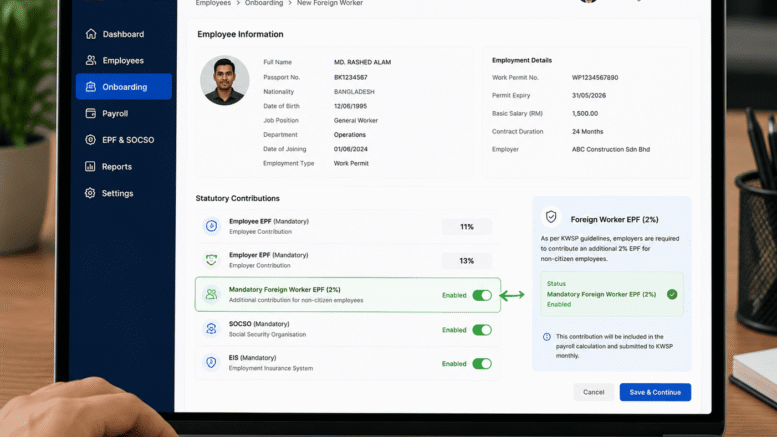
The EPF remains one of Malaysia’s most significant statutory deductions. For 2026, the standard contribution rates remain at 11% for employees and 13% for employers (for wages up to RM5,000), with a reduced employer rate of 12% for wages above RM5,000. However, flexible contribution options have been expanded, allowing members to opt for higher voluntary contributions to boost retirement savings.
Employers should note that EPF contribution calculations now incorporate updated wage definitions, including certain allowances and benefits that were previously excluded. HR teams must review their payroll systems to ensure accurate classification of wages subject to EPF deductions.
SOCSO Contribution Updates
SOCSO contributions in 2026 reflect adjustments to the wage ceiling for the Employment Injury scheme. Employers must contribute 1.75% of the employee’s monthly wage, while employees contribute 0.5%. The key change for 2026 is the revised wage ceiling — ensuring more employees across higher income brackets receive coverage under the Invalidity Pension Scheme.
Employers with foreign workers must also note updates to their SOCSO obligations, as regulatory coverage for non-Malaysian employees has been progressively expanded.
EIS Rate Adjustments
The Employment Insurance System continues at 0.4% of the employee’s monthly wage, split equally at 0.2% each between employer and employee. For 2026, the maximum insurable wage has been revised upward, meaning higher-income employees will now contribute and be eligible for greater EIS benefits in the event of job loss.
Monthly Tax Deduction (MTD/PCB) Changes
The Inland Revenue Board (LHDN) has updated the MTD schedule for 2026 to reflect revised personal tax reliefs and updated tax band thresholds. Employers must ensure their payroll systems are updated with the latest PCB tables to avoid over- or under-deducting income tax from employee salaries. Failure to deduct and remit the correct amount exposes employers to penalties under the Income Tax Act 1967.
HRDF/HRD Corp Levy
Eligible employers — generally those with 10 or more Malaysian employees in specific sectors — must contribute 1% of the monthly wage to HRD Corp. In 2026, the list of eligible sectors has been further expanded, bringing more industries under the mandatory levy requirement. Employers newly brought under this obligation must register immediately to avoid penalties.
Impact on Payroll Processing
The cumulative impact of 2026 statutory rate changes on payroll processing is significant. Here is a snapshot of how these changes affect employer costs:
| Statutory Body | Employee Rate | Employer Rate | Key 2026 Change |
|---|---|---|---|
| EPF | 11% | 12–13% | Expanded wage definition |
| SOCSO | 0.5% | 1.75% | Revised wage ceiling |
| EIS | 0.2% | 0.2% | Higher maximum insurable wage |
| PCB/MTD | Variable | — | Updated tax schedule |
| HRDF/HRD Corp | — | 1% | Expanded eligible sectors |
Best Practices for Compliance in 2026
To maintain full compliance with Malaysia’s evolving statutory deduction requirements, organisations should adopt the following best practices:
- Update Payroll Software — Ensure your payroll system reflects the latest 2026 contribution tables for EPF, SOCSO, EIS, and PCB. Manual spreadsheets are highly susceptible to error and should be replaced with automated payroll solutions.
- Conduct Regular Payroll Audits — Periodically review payroll calculations against official contribution schedules to identify and correct discrepancies before submission deadlines.
- Train HR and Payroll Staff — Keep your team updated on regulatory changes through HRD Corp-funded training programmes or internal briefings from qualified payroll consultants.
- File on Time — EPF contributions must be submitted by the 15th of the following month, while SOCSO and EIS follow the same deadline. PCB must be remitted by the 15th of each month. Late submissions attract compounding penalties.
- Consult a Compliance Specialist — For complex payroll situations — such as expatriate employees, flexible work arrangements, or businesses operating across multiple states — engage a payroll specialist to ensure full compliance.
Conclusion
Navigating Malaysia’s statutory deduction landscape in 2026 requires diligence, up-to-date knowledge, and the right payroll tools. With changes across EPF, SOCSO, EIS, PCB, and HRDF, organisations that fail to update their processes risk non-compliance, financial penalties, and reputational damage.
Investing in a reliable, automated payroll system is the most effective way to stay ahead of statutory changes — ensuring every deduction is calculated correctly, remitted on time, and fully compliant with Malaysian law.
Smart Touch technology pte ltd , www.smartouch.com.sg +65-63964767, sales@smartouch.com.sg , www.smartouch.com.my +607-3889903 sales@smartouch.com.my
Frequently Asked Questions (FAQ)
Q1: What are the main statutory deductions employers must make in Malaysia in 2026?
The main statutory deductions are EPF, SOCSO, EIS, Monthly Tax Deduction (PCB/MTD), and the HRDF levy for eligible employers. Each has specific rates, wage ceilings, and submission deadlines that must be followed.
Q2: Has the EPF contribution rate changed for 2026 in Malaysia?
The standard EPF rates remain at 11% (employee) and 12–13% (employer), but the definition of wages subject to EPF has been updated. Employers should review their payroll systems to ensure all applicable allowances and benefits are correctly included in EPF calculations.
Q3: When must EPF and SOCSO contributions be submitted each month?
Both EPF and SOCSO contributions must be submitted by the 15th of the following month. Late submission is subject to penalties and interest charges under the respective legislation.
Q4: Which employers are required to contribute to HRDF/HRD Corp in 2026?
Generally, employers in eligible sectors with 10 or more Malaysian employees are required to contribute 1% of monthly wages to HRD Corp. The list of eligible sectors was expanded in 2026, so employers should verify their obligations with HRD Corp directly.
Q5: How can I ensure my payroll calculations are correct for 2026?
The most reliable approach is to use a certified, automated payroll system that is regularly updated to reflect the latest statutory rates and contribution tables. Manual calculations using spreadsheets are prone to error, especially when multiple deductions interact.