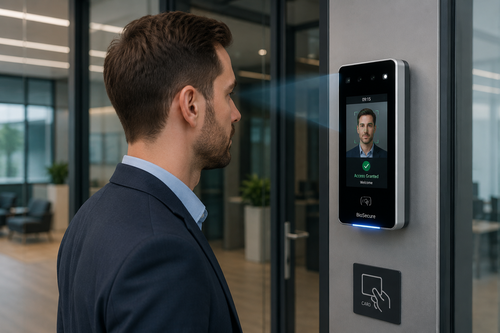
Corporate check-in processes are changing quickly. Traditional attendance books, punch cards, access cards, and manual receptionist records are no longer enough for companies that need accurate attendance, stronger security, faster entry, and better workforce visibility. As businesses continue to digitalise HR, payroll, visitor control, access management, and office administration, advanced biometric face recognition for corporate check-ins has become one of the most effective solutions for modern workplaces.
Face recognition technology allows employees, visitors, contractors, and authorised personnel to check in quickly without touching shared devices, carrying cards, or signing paper records. The system identifies a person through facial biometric verification and records the check-in or check-out automatically. For offices, factories, warehouses, schools, commercial buildings, construction sites, and corporate facilities, this creates a faster, cleaner, and more reliable way to manage daily entry.
What Is Biometric Face Recognition for Corporate Check-ins?
Biometric face recognition is a digital identification method that uses facial features to verify a person’s identity. In a corporate check-in environment, the employee or visitor stands in front of a face recognition terminal, camera, kiosk, or access device. The system compares the live face image with registered records and confirms whether the person is authorised.
Once verified, the system can record attendance, open a door, allow gate access, notify a host, update HR records, or trigger a check-in report. This process is usually completed within seconds.
Unlike manual signing or card tapping, face recognition reduces the risk of buddy punching, card sharing, forgotten badges, and inaccurate records. It creates a more secure and efficient check-in experience for both employees and administrators.
Why Corporate Check-ins Need Better Technology
Many companies still rely on outdated check-in methods. Employees may sign attendance sheets manually. Visitors may write names in a logbook. Staff may tap access cards that can be passed to another person. Receptionists may need to call hosts manually. HR teams may spend time correcting missing attendance records.
These methods create several problems. Manual records can be unclear or incomplete. Cards can be lost, damaged, shared, or forgotten. Paper logbooks can expose personal information. Long queues can form during peak entry hours. Payroll teams may receive inaccurate attendance data. Security teams may not have real-time visibility of who is on-site.
Advanced biometric face recognition helps solve these issues by making check-ins faster, more accurate, and more controlled.
Faster Employee Attendance Recording
One of the biggest advantages of face recognition check-ins is speed. Employees can check in simply by looking at the device. There is no need to search for an access card, touch a fingerprint scanner, sign a book, or wait for manual verification.
This is especially useful during peak hours when many employees arrive at the same time. In large offices, factories, call centres, logistics centres, and shift-based workplaces, faster check-ins can reduce congestion at entrances and help employees start work on time.
For HR teams, automatic attendance recording reduces manual data entry and improves timekeeping accuracy.
More Accurate Payroll and Attendance Data
Attendance records are closely connected to payroll. Late arrivals, early departures, overtime, shift work, no-pay leave, absenteeism, and allowance calculations may all depend on accurate time records.
When check-in data is captured automatically through biometric verification, payroll teams can rely on more accurate records. This reduces disputes and helps prevent salary calculation errors.
For businesses with shift employees, overtime workers, project teams, and multiple branches, accurate attendance data is essential. Biometric face recognition helps ensure that the person checking in is the actual employee, not someone using another employee’s card.
Preventing Buddy Punching and Card Misuse
Buddy punching happens when one employee clocks in or out on behalf of another. This can occur easily with punch cards, access cards, PIN codes, or manual attendance sheets. Over time, buddy punching can increase labour costs, reduce discipline, and damage workforce accountability.
Face recognition reduces this risk because the system verifies the individual’s face. Employees cannot simply pass a card to someone else or share a password.
This creates a stronger attendance control environment and supports fairer workforce management.
Contactless Check-ins for Better Workplace Hygiene
Face recognition is a contactless technology. Employees and visitors do not need to touch shared devices, buttons, pens, cards, or fingerprint scanners.
This is useful for workplaces that prioritise hygiene and safety, such as healthcare facilities, food production companies, laboratories, schools, offices, factories, and high-traffic commercial buildings.
A contactless check-in process also improves user convenience. People can complete entry verification quickly and naturally without physical contact.
Strengthening Corporate Access Control
Corporate check-ins are not only about attendance. They are also about security.
Face recognition systems can be integrated with doors, turnstiles, gates, lift access, restricted rooms, server rooms, laboratories, warehouses, and other controlled areas. This ensures that only authorised personnel can enter specific locations.
For example, general employees may access the main office area, while only authorised IT staff can enter the server room. Contractors may receive temporary access to a maintenance area. Visitors may only be allowed into the reception and meeting room zone.
This helps companies reduce unauthorised access and protect sensitive areas.
Better Visitor Check-in Experience
Advanced biometric face recognition can also improve visitor management. Visitors can be pre-registered before arrival, verify themselves at a kiosk or reception device, and receive approval faster.
For returning visitors, the process can be even smoother if the organisation allows secure repeat visitor recognition. Hosts can receive automatic notifications when their guests arrive. Reception staff can focus on hospitality instead of manual paperwork.
A professional visitor check-in experience creates a strong first impression. It shows that the company values security, technology, and efficiency.
Real-Time On-Site Visibility
Management and security teams need to know who is currently inside the premises. This is important for safety, emergency response, manpower planning, and facility control.
Face recognition check-in systems can provide real-time attendance and on-site reports. HR can see which employees have arrived. Security can see who entered the building. Management can view attendance trends. Emergency teams can generate on-site lists during evacuation situations.
This level of visibility is difficult to achieve with paper records or disconnected systems.
Supporting Multi-Branch and Multi-Site Operations
Many companies operate across several offices, factories, warehouses, outlets, project sites, or dormitory locations. Managing attendance and check-ins across multiple sites can be challenging.
A centralised face recognition check-in system can help management monitor all locations from one platform. Employee attendance, visitor logs, access records, and branch-level reports can be consolidated for easier review.
This is especially valuable for companies in manufacturing, retail, logistics, construction, education, healthcare, security services, cleaning services, and facilities management.
Suitable for Shift-Based Workplaces
Shift-based workplaces need accurate check-in and check-out control. Employees may work morning shifts, night shifts, rotating shifts, split shifts, overtime shifts, or weekend shifts. Manual records can become complicated when schedules change frequently.
Face recognition attendance systems can support shift rules and attendance tracking by recording actual entry and exit times. When integrated with HR or payroll software, this data can help calculate overtime, late arrival, early departure, shift allowances, and absenteeism more accurately.
For factories, warehouses, call centres, hospitals, security companies, and service operations, this is a major productivity advantage.
Integration with HR, Payroll, and Access Systems
The true value of biometric face recognition increases when it is connected with other business systems. Integration with HR software allows employee records to be managed centrally. Integration with payroll software helps convert attendance data into accurate salary calculations. Integration with access control systems helps manage doors and restricted areas. Integration with visitor management software improves guest registration and tracking.
A connected system reduces double entry and improves data accuracy. HR teams no longer need to collect attendance manually, export spreadsheets, and re-enter data into payroll. Security teams no longer need separate records for access logs. Management receives cleaner reports from one reliable source.
Face Recognition for Contractors and Temporary Workers
Companies often need to manage contractors, outsourced workers, part-time staff, project workers, vendors, and temporary employees. These groups may not always follow the same HR workflow as permanent staff, but their entry and attendance still need control.
Face recognition can help verify and track temporary personnel more effectively. Access can be configured based on validity period, work location, project assignment, or approval status. Once the work period ends, access can be removed from the system.
This is useful for construction sites, factories, commercial buildings, maintenance projects, and event operations.
Reducing Administrative Workload
Manual attendance and check-in processes consume time. HR staff may need to correct missing punches, verify late arrivals, check handwritten records, process attendance disputes, and prepare reports manually. Reception staff may need to handle visitor forms and call hosts repeatedly. Security guards may need to maintain paper logs.
Face recognition automation reduces these repetitive tasks. The system captures check-in data automatically, stores it digitally, and generates reports when needed.
This allows HR, administration, reception, and security teams to focus on higher-value responsibilities.
Improving Employee Accountability
A clear and reliable check-in system helps build accountability. Employees understand that attendance records are accurate and consistent. Managers can review attendance patterns fairly. HR can handle disputes with proper data.
This does not only support discipline. It also supports transparency. Employees are less likely to question records when the system captures entry times automatically and consistently.
Data Security and Responsible Biometric Management
Because face recognition uses biometric data, companies must manage it responsibly. A professional system should include secure data storage, authorised access control, user permission settings, audit trails, and clear internal policies.
Employees should understand why the system is used, how it improves attendance and security, and who can access the records. Responsible implementation helps build trust and supports proper data governance.
Companies should choose a provider that takes privacy, security, and system reliability seriously.
Choosing the Right Face Recognition Check-in Solution
When selecting advanced biometric face recognition for corporate check-ins, companies should consider accuracy, speed, usability, integration capability, reporting features, access control compatibility, and local support.
The system should work well in real workplace conditions, including different lighting environments, high-traffic entry points, multi-shift operations, and multiple branches. It should be easy for employees to use and simple for administrators to manage.
A good system should also support future expansion. As the company grows, the solution should be able to handle more employees, more devices, more locations, and more integration requirements.
Smart Touch Advanced Biometric Face Recognition Solutions
Smart Touch provides advanced biometric face recognition solutions for corporate check-ins, attendance tracking, access control, visitor management, HR, and payroll integration. The system is designed to help Malaysian and regional businesses improve workplace security, reduce manual administration, and create a faster check-in experience.
With Smart Touch solutions, companies can manage employee attendance, visitor registration, contractor access, multi-site check-ins, and payroll-ready reports more efficiently. The technology supports a more professional workplace by combining speed, accuracy, and stronger control.
Whether your organisation is a corporate office, factory, warehouse, school, commercial property, construction site, or service company, Smart Touch can help modernise check-in operations with reliable biometric face recognition technology.
Building a Smarter and More Secure Workplace
Advanced biometric face recognition for corporate check-ins is more than a modern entry device. It is a complete improvement to attendance accuracy, workplace security, employee accountability, visitor experience, and HR productivity.
Companies that still depend on manual attendance sheets, shared cards, and paper visitor books should consider upgrading to a smarter check-in system. A digital face recognition solution helps reduce queues, prevent buddy punching, strengthen access control, improve payroll accuracy, and provide real-time visibility across the organisation.
For businesses that want a faster, cleaner, and more secure workplace, Smart Touch advanced biometric face recognition solutions offer a practical and future-ready path toward better corporate check-in management.
Click here for more product information: https://www.smartouch.com.my/face-recognition-system-2/
Smart Touch technology pte ltd , www.smartouch.com.sg +65-63964767, sales@smartouch.com.sg , www.smartouch.com.my +607-3889903 sales@smartouch.com.my