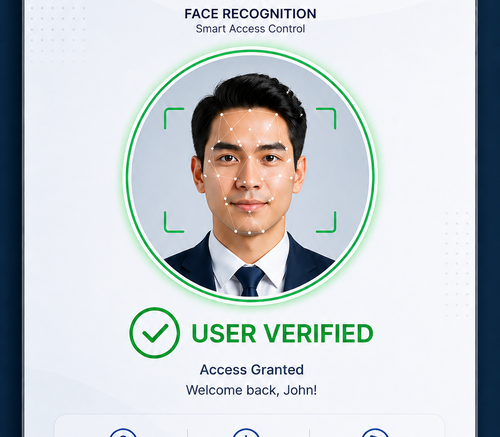
High-security offices require more than a basic door lock, visitor book, or traditional access card system. In modern business environments, companies must protect sensitive information, confidential documents, restricted departments, server rooms, research facilities, finance offices, management floors, and high-value assets. At the same time, offices must remain convenient and efficient for authorized employees, approved contractors, and registered visitors.
A contactless face recognition entry system gives our organization a smarter, faster, and more secure way to manage office access. Instead of relying only on keys, cards, PIN codes, or manual reception checks, our office can verify identities through facial recognition technology. This creates a seamless access control experience where authorized users can enter designated areas without touching a device, carrying a card, or remembering a password.
For high-security offices, contactless face recognition entry is not only about convenience. It is about strengthening identity verification, reducing unauthorized access, improving audit trails, and building a more professional workplace security environment.
What Is Contactless Face Recognition Entry?
Contactless face recognition entry is an access control solution that uses a person’s facial features to verify identity before allowing entry. When an authorized person approaches the device, the system captures facial data, compares it with enrolled records, and grants or denies access based on configured permissions.
Unlike fingerprint readers, keypad systems, or card-based access systems, face recognition does not require physical contact. Employees do not need to press buttons, scan fingers, or tap a card. The entry process can be completed quickly and hygienically, making it highly suitable for corporate offices, government-linked facilities, financial institutions, technology companies, laboratories, legal firms, data centers, and other sensitive workplaces.
A well-designed face recognition entry system can be connected with electric locks, magnetic locks, turnstiles, flap barriers, lift access systems, attendance systems, visitor management platforms, and centralized access control software. This allows our company to manage both security and workforce movement from one structured platform.
Why High-Security Offices Need Contactless Access Control
High-security offices often operate with strict access rules. Not every employee should be allowed to enter every area. A finance department may need limited access. A server room may require stronger identity verification. A management floor may be restricted to directors and selected staff. A document storage room may need controlled entry logs.
Traditional access cards can be lost, borrowed, stolen, or shared. PIN codes can be forgotten, exposed, or passed to another person. Manual checking depends heavily on human attention and can be inconsistent during busy periods. These weaknesses can create security gaps.
Contactless face recognition entry reduces these risks by linking access to the actual person. Since the system verifies the user’s face, it becomes much harder for one employee to use another employee’s access credential. This makes the entry process more accountable and more suitable for areas where identity assurance is important.
For offices that manage confidential business information, customer data, financial records, intellectual property, legal files, contracts, or strategic planning documents, stronger access control is a practical necessity.
Key Benefits of Contactless Face Recognition Entry
1. Stronger Identity Verification
The biggest advantage of face recognition entry is that access is based on a person’s identity instead of a physical item. Cards and keys can change hands, but a face-based system verifies the individual directly.
This is especially valuable for high-security offices where our company needs to know exactly who entered a restricted area and when. Every access event can be recorded, giving management and security teams a clearer view of office movement.
2. Contactless and Hygienic Entry
A contactless system supports a cleaner and more modern workplace. Employees do not need to touch keypads, fingerprint scanners, door handles, or shared devices to verify their identity. This reduces contact points and creates a more comfortable entry experience.
For offices with many employees, contractors, or visitors, contactless access can also improve entry speed during peak hours. Staff can move through approved entry points smoothly without queues caused by manual card tapping or fingerprint scanning.
3. Reduced Risk of Card Sharing
Access card sharing is one of the most common weaknesses in traditional office security. An employee may lend a card to a colleague, forget to return a temporary card, or accidentally lose a card outside the building. Once a card is lost, the company must disable it immediately and issue a replacement.
Face recognition entry greatly reduces this problem. Since access is connected to an authorized face profile, another person cannot simply take a card and enter. This helps our organization maintain stronger control over restricted zones.
4. Faster Access for Authorized Staff
In high-security offices, security should be strong but not slow. Employees still need to enter the office, meeting rooms, laboratories, server rooms, and restricted departments efficiently. A face recognition device can verify users quickly, allowing smooth access without unnecessary delay.
For busy corporate environments, this creates a better user experience. Staff do not need to search for cards, type passwords, or repeat fingerprint scans. The system recognizes authorized users and grants access based on permissions.
5. Better Audit Trail and Accountability
Security teams need reliable records. A contactless face recognition entry system can record entry times, user identities, access points, and access results. This provides a useful audit trail for internal review, investigation, compliance checks, and security reporting.
If an incident occurs, management can review access logs to understand who entered a certain area at a specific time. This improves accountability and supports better decision-making.
Ideal Areas for Face Recognition Entry in High-Security Offices
Contactless face recognition entry can be used at many access points inside a secure office. The main entrance is usually the first control point, allowing only authorized employees and approved visitors to enter. Beyond the main door, face recognition can also protect specific high-risk areas.
Server rooms are one of the most important locations for controlled access. These rooms may contain network infrastructure, data storage, communication equipment, and business-critical systems. Only authorized IT personnel should be allowed to enter.
Finance and accounting departments may also require restricted access because they handle payroll records, payment information, invoices, tax files, banking details, and confidential company documents. Legal departments, HR offices, boardrooms, executive rooms, archives, and research departments can also benefit from identity-based access control.
For buildings with multiple tenants or multiple floors, face recognition can be connected to lift access. This allows users to access only approved floors. It prevents unauthorized movement and helps strengthen overall building security.
Face Recognition Entry with Multi-Layer Security
For high-security offices, face recognition can be used together with other security methods. This is known as multi-factor or multi-layer access control. For example, the office may require face recognition plus access card verification for server rooms, or face recognition plus administrator approval for extremely sensitive zones.
Different areas can have different security levels. A general office entrance may use face recognition only. A restricted archive room may require face recognition and PIN. A data center entry point may require face recognition, card verification, and security guard confirmation.
This flexible approach allows our organization to balance convenience and protection. Not every door needs the same level of security. The best access control design depends on the risk level of each area.
Integration with Attendance and Workforce Management
A contactless face recognition entry system can also support attendance tracking. When employees enter the office, the system can record clock-in and clock-out data. This helps HR teams manage attendance, working hours, lateness, early departure, overtime, and shift records more efficiently.
For companies that already use HR or payroll systems, face recognition attendance data can be integrated into payroll processing. This reduces manual attendance checking and improves salary calculation accuracy.
High-security offices often need both access control and attendance monitoring. With the right system, our company can combine both functions into one efficient workflow. This reduces duplicated work and improves operational visibility.
Visitor Management for Secure Offices
High-security offices must manage visitors carefully. Visitors may include clients, vendors, auditors, consultants, maintenance teams, interview candidates, delivery personnel, and temporary contractors. Without a proper visitor management process, unauthorized people may enter restricted areas or remain inside the premises without clear tracking.
Face recognition entry can be part of a visitor management solution. Approved visitors can be pre-registered and assigned limited access for a specific date, time, entrance, meeting room, or host. Once the visit ends, access can expire automatically.
This is much safer than issuing a visitor card without proper tracking. It also creates a more professional reception experience. Visitors can be verified quickly, while security teams maintain better control over who is inside the office.
Contactless Face Recognition for Modern Workplace Safety
Modern office security must support both safety and convenience. Employees expect a smooth experience, while management expects strong protection. Contactless face recognition entry meets both needs by allowing fast, secure, and touch-free access.
In addition, the system can support emergency management. Access records can help security teams understand occupancy patterns and user movement. When combined with proper safety procedures, this improves workplace readiness and response planning.
A secure office is not only protected from outside threats. It is also well organized internally. The right entry system helps ensure that employees, visitors, and contractors move only where they are authorized to go.
What to Consider Before Installing Face Recognition Entry
Before implementing a contactless face recognition entry system, our company should review the office layout, number of access points, employee count, visitor flow, restricted areas, and security requirements. Each door may need a different access rule.
The company should also consider device placement. Face recognition devices should be installed at suitable height and angle for easy scanning. Lighting conditions should be reviewed because strong backlight, dark corridors, or reflective surfaces may affect recognition performance. For high-traffic entrances, the system should be fast enough to avoid bottlenecks.
Data security is another important factor. Since face recognition involves biometric data, our organization should manage enrollment, storage, access rights, and system administration responsibly. Only authorized personnel should be allowed to manage user records. Clear internal policies should be established for employee enrollment, visitor registration, access log review, and data retention.
Why Smart Touch Is the Right Partner for Face Recognition Entry
At Smart Touch, we understand that high-security offices need reliable, practical, and professional access control solutions. Our focus is to help businesses improve workplace security through smart technology that is easy to use and suitable for real office operations.
Our face recognition entry solutions can support controlled access, attendance tracking, visitor management, and integration with office security infrastructure. Whether our company needs a single secure entrance or a complete multi-door access control system, Smart Touch can help design a solution that fits the office environment.
We support companies that need better protection for server rooms, finance departments, management offices, restricted floors, confidential workspaces, and sensitive operation areas. Our solutions are designed to help our business reduce manual checking, improve user convenience, and strengthen accountability.
Building a Safer and Smarter High-Security Office
A contactless face recognition entry system is a powerful upgrade for any high-security office. It replaces outdated access methods with a smarter, more accountable, and more hygienic solution. It helps reduce card sharing, improve identity verification, create useful access records, and support a modern workplace experience.
For small offices, it provides professional security from the beginning. For medium and large offices, it supports scalable access control across departments, doors, floors, and branches. For high-security environments, it gives management greater confidence that only authorized people can enter protected areas.
As businesses handle more data, more sensitive information, and more complex operations, office access control must become stronger. Contactless face recognition entry helps our organization stay ready for the future by combining security, convenience, and operational efficiency in one intelligent system.
For more information about the product, please click here: https://www.smartouch.com.my/face-recognition-system-2/
Smart Touch technology pte ltd , www.smartouch.com.sg +65-63964767, sales@smartouch.com.sg , www.smartouch.com.my +607-3889903 sales@smartouch.com.my