Hospitalisation leave is one of the most important — and most frequently misunderstood — entitlements under Malaysia’s Employment Act 1955. Since amendments took effect in January 2023, hospitalisation leave has operated as a separate entitlement from ordinary outpatient sick leave, meaning employers need to track and calculate it differently. Getting this wrong can lead to underpayment, incorrect leave records, or compliance disputes.
This guide explains what hospitalisation leave covers, how much employees are entitled to, and what employers need to get right in their HR and payroll processes.
What Is Hospitalisation Leave?
Hospitalisation leave is paid leave granted to an employee who requires hospital admission or is certified by a registered medical practitioner as needing hospital-level medical care, even if not formally admitted overnight. <cite index=”8-1″>This leave is available to almost all professionals working in Malaysia, with the entitlement structure taking effect from 1 January 2023.</cite>
How Many Days Are Employees Entitled To?
<cite index=”3-1″>Employees are entitled to up to 60 days of hospitalisation leave in a calendar year when hospitalisation is medically necessary.</cite> <cite index=”4-1″>Following the Employment (Amendment) Act 2022, which took effect on 1 January 2023, the 2023 amendment separated outpatient sick leave from hospitalisation leave entirely, changing the entitlement structure from how it worked previously.</cite>
Importantly, <cite index=”4-1″>since 1 January 2023, both entitlements run completely independently — using outpatient medical leave days does not reduce hospitalisation leave, and vice versa.</cite>
Who Is Eligible for Hospitalisation Leave?
<cite index=”8-1″>Hospitalisation leave applies to all professionals working in Malaysia, with domestic servants being the main exclusion.</cite> <cite index=”8-1″>This includes employees who are still on probation, as the Employment Act 1955 covers probationary and confirmed employees equally, with no waiting period before the entitlement begins.</cite>
Common Misconceptions About Hospitalisation Leave
“Hospitalisation leave comes out of my sick leave quota.” <cite index=”4-1″>Not since 1 January 2023 — both entitlements now operate independently, so spending hospitalisation days does not reduce outpatient sick leave balance.</cite>
“Unused hospitalisation leave rolls over to next year.” <cite index=”4-1″>Medical leave entitlement, including hospitalisation leave, resets every year, and unused days do not carry forward or convert to cash upon resignation or termination.</cite>
“Hospitalisation leave can be deducted from annual leave.” <cite index=”8-1″>No — hospitalisation leave cannot be deducted from annual leave, as both are separate, distinct entitlements.</cite>
What Employees Need to Provide
To qualify for paid hospitalisation leave, employees generally need to:
- Be examined and certified as requiring hospitalisation by a registered medical practitioner or dentist
- <cite index=”5-1″>Provide a medical certificate (MC) from a registered doctor, whether from a company panel clinic, government clinic, or dentist</cite>
- <cite index=”8-1″>Provide a discharge slip alongside the admission slip to confirm the actual number of days of hospitalisation, which may also reflect recommended recovery days</cite>
- Inform the employer promptly, following the same notification requirements that apply to standard sick leave under the Employment Act
How Employers Should Pay Hospitalisation Leave
<cite index=”8-1″>Employers must legally pay the employee during hospitalisation leave at their ordinary rate of pay, meaning the employee should receive their normal daily pay as stated in their employment contract.</cite> This is treated as fully paid leave, not a reduced-pay arrangement, provided the entitlement conditions are met.
How Hospitalisation Leave Interacts with Other Leave Types
| Leave Type | Relationship to Hospitalisation Leave |
|---|---|
| Outpatient Sick Leave | Fully separate entitlement since 2023 — does not reduce hospitalisation leave |
| Annual Leave | Cannot be deducted to cover hospitalisation leave |
| Maternity Leave | Separate entitlement; not combined with hospitalisation leave |
| Unpaid Leave | Not applicable if hospitalisation leave entitlement has not been exhausted |
Employer Compliance Checklist
| Requirement | Action |
|---|---|
| Record hospitalisation leave separately from sick leave | Update HR system categorisation |
| Apply correct 60-day annual cap | Track usage per calendar year, per employee |
| Verify MC and admission/discharge documentation | Confirm before approving leave |
| Pay at ordinary rate of pay | Ensure payroll applies full, not reduced, pay |
| Apply to probationary staff | Do not withhold entitlement during probation |
| Reset entitlement annually | Do not carry forward unused days |
Why Accurate Record-Keeping Matters
<cite index=”9-1″>Hospitalisation leave needs to be recorded separately from sick, maternity, and annual leave — without clear categorisation in the HR system or company policy, it becomes easy to misclassify leave types, leading to inaccurate records or confusion.</cite> This is particularly important given that hospitalisation leave and outpatient sick leave now carry different annual caps and no longer offset one another.
How Smart Touch Technology Supports Leave Compliance
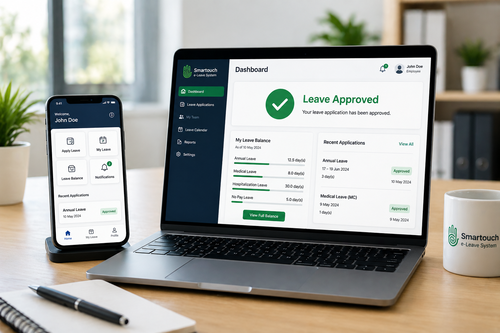
Smart Touch Technology’s PAL (Payroll, Attendance and Leave) system, part of the Smartgogo platform, is built to manage leave applications, approval status, and balances as part of a connected HR and payroll workflow. Leave categories — including hospitalisation leave, outpatient sick leave, annual leave, and other statutory entitlements — can be tracked separately with the correct annual caps applied, reducing the risk of misclassification that manual spreadsheet-based leave tracking often creates.
Because leave records connect directly to attendance and payroll processing within PAL, approved hospitalisation leave reflects accurately in payroll without manual cross-checking, helping ensure employees are paid correctly at their ordinary rate of pay during hospitalisation leave.
Conclusion
Hospitalisation leave in Malaysia is a distinct, fully paid entitlement of up to 60 days per calendar year, separate from outpatient sick leave since the 2023 Employment Act amendments. Employers need to record it correctly, apply the right annual cap, and ensure it is paid at the employee’s ordinary rate of pay without deducting it from annual leave or sick leave balances. A well-structured leave management system reduces the compliance risk that comes with manually tracking multiple, independently-capped leave types. Smart Touch Technology’s PAL system gives Malaysian employers a structured way to manage hospitalisation leave alongside the rest of their statutory leave obligations.
This article is provided for general informational purposes and does not constitute legal advice. Employers should refer to the Employment Act 1955 (as amended) and consult a qualified HR or legal professional for guidance specific to their situation.
Smart Touch Technology, 36-02 & 36-03, Jalan Permas 10, Bandar Baru Permas Jaya, 81750 Masai, Johor, Malaysia. +607-388 9903 / +6011-5354 9903, sales@smartouch.com.my, www.smartouch.com.my