Managing maternity leave correctly is an important responsibility for every employer in Malaysia. HR teams need to understand the statutory maternity leave entitlement, eligibility requirements, notice procedures, maternity allowance, and employment protection provided under Malaysian employment law.
For businesses, having a clear Maternity Leave Policy Malaysia Employment Act framework helps HR departments process leave applications consistently while ensuring employees understand their rights and responsibilities.
Following the amendments to the Employment Act 1955, the statutory maternity leave period was increased from 60 days to 98 consecutive days. The current Employment Act 1955 provides for an eligible period of maternity leave of not less than 98 consecutive days.
This guide explains the key maternity leave requirements Malaysian employers and HR teams should understand and how digital HR software can simplify maternity leave administration.
What Is Maternity Leave Under the Malaysia Employment Act?
Maternity leave is a statutory period of leave provided to eligible female employees for childbirth and recovery.
Under the Employment Act 1955, the eligible period is at least 98 consecutive days. The increase from 60 to 98 days was introduced through the Employment (Amendment) Act 2022.
For HR departments, this means maternity leave should be managed separately from ordinary annual leave or other types of employee leave.
A proper HR system should record:
- Maternity Leave Start Date
- Expected Delivery Date
- Actual Delivery Date
- Maternity Leave End Date
- Leave Approval
- Remaining Leave
- Relevant Supporting Documents
Who Is Covered by the Maternity Leave Provisions?
The Employment Act 1955 applies to employees within its scope, including female employees covered by the Act’s maternity provisions.
However, employers should note that employment legislation differs between Peninsular Malaysia, Sabah, and Sarawak. The Employment Act 1955 applies principally to Peninsular Malaysia, while Sabah and Sarawak have their own labour ordinances.
HR teams managing employees across Malaysia should therefore verify the applicable legislation for each employee’s workplace rather than automatically applying one policy nationwide.
How Many Days of Maternity Leave Are Employees Entitled To?
The statutory maternity leave entitlement under the Employment Act 1955 is:
98 Consecutive Days
The law defines the eligible period as a period of maternity leave of not less than 98 consecutive days.
The word “consecutive” is important because maternity leave is not simply calculated as a number of working days.
Employers should therefore configure their HR and leave management systems to calculate maternity leave according to the applicable statutory rules rather than treating it like ordinary annual leave.
When Can Maternity Leave Begin?
Maternity leave does not simply have to begin on the day of childbirth.
The Employment Act contains provisions concerning when maternity leave may commence. In particular, a female employee generally cannot be required to commence maternity leave earlier than the period permitted under the Act.
The legislation also provides for circumstances where a medical officer or registered medical practitioner appointed by the employer certifies that, because of the employee’s advanced stage of pregnancy, she is unable to perform her duties satisfactorily. In such circumstances, maternity leave may be required to commence during the permitted period before confinement.
Because maternity leave dates can depend on the circumstances surrounding the pregnancy and confinement, HR teams should maintain accurate documentation and apply the statutory rules carefully.
Maternity Allowance in Malaysia
Maternity leave and maternity allowance are related but should not be treated as exactly the same thing.
The Employment Act provides conditions governing entitlement to maternity allowance. The legislation sets out eligibility requirements and circumstances affecting whether an employee qualifies for the allowance.
Employers should therefore check the employee’s:
- Employment history
- Eligibility requirements
- Number of surviving children
- Relevant maternity leave dates
- Salary and payroll information
before processing maternity-related payroll.
The Act also contains a specific provision stating that a female employee is not entitled to maternity allowance if, at the time of confinement, she has five or more surviving children.
Maternity Leave and Payroll Processing
Maternity leave can affect payroll administration, especially when HR teams manage a large workforce.
Payroll personnel may need to coordinate:
- Maternity Leave
- Maternity Allowance
- Salary Processing
- Attendance Records
- Leave Balances
- Statutory Contributions
- Payslip Information
Using separate spreadsheets for each process can increase the risk of inconsistent records.
An integrated HRMS can connect leave management with payroll so approved maternity leave information is available to the payroll module.
How Employees Should Apply for Maternity Leave
Companies should establish a clear internal maternity leave application process.
Employees may be required to provide information such as:
- Employee Name
- Employee ID
- Expected Delivery Date
- Requested Leave Start Date
- Supporting Medical Documentation, where required
- Contact Information During Leave
HR can then verify the request and process the maternity leave according to the company’s policy and applicable legislation.
A digital leave management system makes this process easier because employees can submit their applications electronically instead of completing paper forms.
Why HR Teams Should Digitise Maternity Leave Management
Managing maternity leave manually can create several challenges.
HR personnel may need to:
- Check eligibility manually
- Calculate leave dates
- Update employee records
- Notify payroll
- Track return-to-work dates
- Maintain supporting documents
A digital HR system can automate many of these administrative tasks.
Benefits of Digital Maternity Leave Management
1. Accurate Leave Calculations
A digital HRMS can calculate maternity leave dates based on configured company and statutory rules.
This reduces the risk of manually entering incorrect leave periods.
2. Faster Leave Approval
Employees can submit maternity leave applications electronically, while managers and HR personnel can review requests through the system.
This reduces paperwork and speeds up approval workflows.
3. Centralised Employee Records
HR teams can keep maternity leave information together with other employee records, including:
- Employment Details
- Attendance
- Leave History
- Payroll
- Payslips
This provides a clearer employee profile.
4. Payroll Integration
Approved maternity leave information can flow into payroll processing.
This reduces duplicate data entry and helps HR teams maintain consistency between leave and payroll records.
5. Employee Self-Service
Employees can use an Employee Self-Service platform to:
- Apply for Maternity Leave
- Check Leave Status
- View Leave History
- Check Leave Balances
- Receive Approval Notifications
This provides employees with greater visibility over their leave applications.
Maternity Leave and Employee Attendance
Attendance systems should also recognise approved maternity leave.
Once HR approves maternity leave, the leave record should be reflected in the employee’s attendance calendar so the employee is not incorrectly marked as absent.
An integrated HRMS can connect:
Leave Management → Attendance → Payroll
This reduces manual reconciliation between different HR systems.
Managing Maternity Leave for Multiple Branches
Large Malaysian organisations may have employees working across multiple offices, factories, branches, or project sites.
A centralised HRMS allows HR administrators to manage maternity leave across multiple locations.
HR teams can:
- View maternity leave applications
- Track employees currently on leave
- Monitor upcoming leave
- Manage branch-level approvals
- Generate leave reports
- Synchronise payroll information
This is particularly useful for companies with large workforces.
Maternity Leave Policy Best Practices for Malaysian Employers
Employers can make maternity leave administration easier by establishing a clear internal policy.
A good maternity leave policy should clearly explain:
Eligibility
State who is covered by the company’s maternity leave policy and the applicable statutory requirements.
Leave Entitlement
Specify the statutory entitlement applicable to employees.
Application Procedure
Explain how employees should apply for maternity leave and what information or documents are required.
Notice Requirements
Clearly state the company’s process for notifying HR about the expected maternity leave period, while ensuring the internal process does not conflict with statutory rights.
Payroll Treatment
Explain how maternity allowance and payroll processing are handled according to applicable law.
Return-to-Work Process
Provide employees with clear instructions regarding their expected return date and any internal procedures.
HR Contact
Provide a designated HR contact for maternity leave questions and documentation.
A clear policy reduces misunderstandings and helps HR teams apply leave procedures consistently.
Protecting Employee Information
Maternity-related records may contain personal and employment information that should be handled securely.
Businesses should ensure that access to employee records is limited to authorised personnel.
Digital HR systems should include appropriate controls for:
- Employee Data Access
- Leave Records
- Payroll Information
- Supporting Documents
- Approval Records
HR teams should also ensure that personal data is handled in accordance with applicable Malaysian data protection requirements.
Why Choose Smart Touch HRMS for Maternity Leave Management?
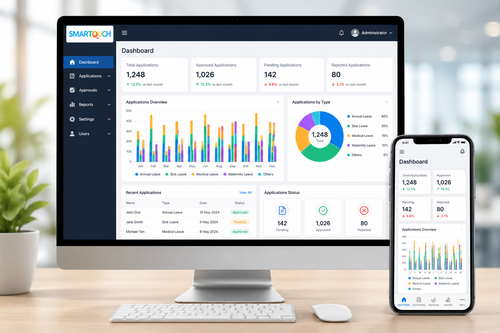
Smart Touch Technology provides an integrated HRMS and Leave Management System designed to help Malaysian businesses simplify employee leave administration.
The system can connect employee leave management with:
- Time Attendance
- Payroll
- Overtime
- Claims
- Employee Self-Service
- Digital Payslips
- HR Reporting
Employees can use the Smart GoGo Mobile App to access HR functions conveniently, while HR administrators can manage employee information and leave records through the centralised HR system.
Key capabilities include:
- Digital Leave Applications
- Maternity Leave Management
- Leave Approval Workflow
- Leave History
- Leave Balance
- Attendance Integration
- Payroll Integration
- Employee Self-Service
- Smart GoGo Mobile Access
- Digital Payslips
- Multi-Branch HR Management
- HR Reports
By connecting leave and payroll processes, Smart Touch helps businesses reduce manual HR administration and maintain more consistent employee records.
Stay Updated with Malaysia’s Employment Requirements
Maternity leave requirements are an important part of Malaysian employment compliance. The Employment Act 1955 currently provides an eligible maternity leave period of at least 98 consecutive days, following the amendments that increased the previous 60-day entitlement.
However, employers should not rely solely on a static maternity leave policy. HR teams should regularly review official government sources and applicable legislation, particularly when managing employees across different Malaysian jurisdictions.
For businesses, combining accurate statutory knowledge with an integrated HRMS can make maternity leave administration significantly easier.
Conclusion
Understanding the Maternity Leave Policy Malaysia Employment Act is essential for HR teams and employers that want to manage employee leave fairly and consistently. The current Employment Act 1955 provides an eligible maternity leave period of 98 consecutive days, while also setting out rules relating to maternity allowance and the commencement of maternity leave.
For HR departments, the challenge is not only understanding the legislation but also applying it accurately throughout the employee’s leave, attendance, and payroll records.
A digital HRMS can simplify this process by connecting maternity leave applications with attendance, payroll, employee self-service, and HR reporting.
For Malaysian businesses looking to modernise HR operations, Smart Touch provides an integrated solution that helps streamline leave management while supporting a more efficient and connected workforce.
For a complete breakdown of features and modules, visit our product page here: https://www.smartouch.com.my/e-leave-system/.
Smart Touch technology pte ltd , www.smartouch.com.sg +65-63964767, sales@smartouch.com.sg , www.smartouch.com.my +607-3889903 sales@smartouch.com.my