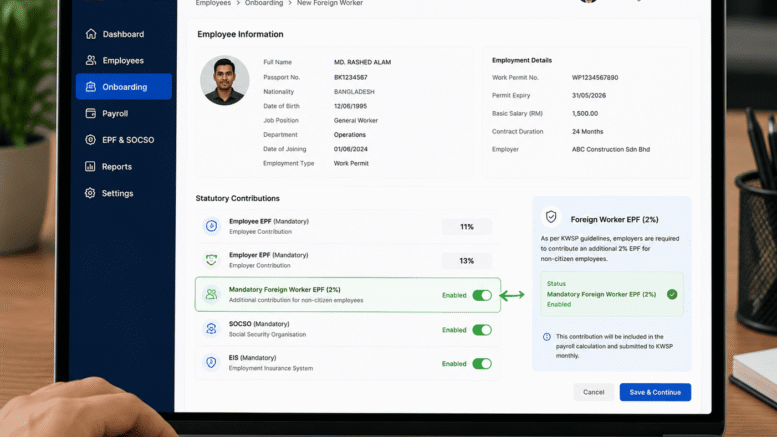
Payroll compliance in Malaysia is not a one-time setup. Statutory rates change, reporting deadlines shift, and new obligations are introduced from time to time. Many companies only discover a compliance gap after receiving a penalty notice. This Malaysia payroll checklist walks through the key areas every business should review to make sure their payroll practices remain fully compliant in 2026.
Why Payroll Compliance Matters
Non-compliance with Malaysian payroll regulations can result in fines, back-payments, and reputational damage. Beyond the legal risk, payroll errors directly affect employee trust. Getting payroll right is one of the most important operational responsibilities any employer has.
The Complete Malaysia Payroll Checklist
1. EPF Contributions
Confirm that Employees Provident Fund contributions are calculated correctly for both employer and employee portions, based on the latest contribution rate tables.
2. SOCSO and EIS Contributions
Verify that SOCSO (Social Security Organisation) and EIS (Employment Insurance System) deductions match current wage brackets and are submitted on time each month.
3. Monthly Tax Deduction (PCB)
Ensure PCB calculations reflect each employee’s tax category, reliefs, and any updates issued by the Inland Revenue Board (LHDN).
4. Overtime and Allowance Calculations
Check that overtime pay follows the Employment Act requirements and that allowances are taxed or exempted correctly based on their classification.
5. Payslip Transparency
Confirm that payslips clearly itemize gross pay, deductions, and net pay, giving employees full visibility into their earnings.
6. Statutory Filing Deadlines
Late submissions for EPF, SOCSO, EIS, or PCB can result in penalties. A clear internal calendar helps avoid missed deadlines.
Payroll Compliance Checklist Table
| Area | What to Verify |
|---|---|
| EPF | Correct employer and employee contribution rates |
| SOCSO / EIS | Accurate wage bracket classification |
| PCB | Updated tax tables and employee tax categories |
| Overtime | Compliance with Employment Act rules |
| Filing Deadlines | Submissions made before statutory due dates |
| Record Keeping | Payroll records retained as required by law |
Common Payroll Mistakes to Avoid
- Using outdated EPF or SOCSO contribution tables
- Manually calculating PCB without accounting for the latest reliefs
- Missing statutory filing deadlines due to lack of automated reminders
- Failing to update payroll systems when regulations change
- Inconsistent overtime calculations across departments
Best Practices for Staying Compliant
- Automate statutory calculations with payroll software rather than manual spreadsheets
- Assign a compliance owner responsible for monitoring regulatory updates
- Conduct quarterly payroll audits to catch errors early
- Keep payroll software updated with the latest contribution rate tables
- Maintain clear documentation for every payroll cycle
Building an Internal Payroll Compliance Calendar
One of the most effective ways to stay ahead of Malaysia’s payroll obligations is to maintain a dedicated compliance calendar. This calendar should list every statutory filing deadline, including EPF, SOCSO, EIS, and PCB submissions, along with internal review dates leading up to each one. Assigning clear ownership for each task prevents the common problem of deadlines being missed simply because no single person felt responsible.
Many businesses also build in a buffer period before each deadline, allowing time to correct errors discovered during a final review rather than rushing submissions at the last minute.
The Role of Payroll Software in Reducing Risk
While a checklist provides structure, payroll software does the heavy lifting of turning compliance requirements into automated calculations. Modern systems update contribution tables automatically when rates change, reducing the chance of using outdated figures. This is particularly valuable for growing companies, where manual processes become increasingly difficult to manage accurately as headcount increases.
Choosing software with built-in reporting also makes it easier to respond quickly if LHDN or other statutory bodies request supporting documentation during an audit.
Training HR and Finance Teams on Compliance
Even the best payroll system relies on knowledgeable staff to configure it correctly. Regular training sessions for HR and finance teams help ensure everyone understands current statutory requirements and knows how to interpret payroll reports accurately. This is especially important when regulations change, as staff need to understand not just what changed, but why it matters for day-to-day payroll processing.
What to Do If You Discover a Compliance Gap
If a review uncovers a past payroll error, such as an incorrect EPF calculation or a missed filing, the best course of action is to address it proactively rather than waiting for a statutory audit to catch it. Most authorities are more lenient when businesses voluntarily correct errors and make good on outstanding contributions, compared to cases where non-compliance is only discovered externally. Documenting the correction process also demonstrates good faith and strengthens your compliance record going forward.
Ultimately, treating payroll compliance as an ongoing discipline rather than a once-a-year task is what separates businesses that stay penalty-free from those that get caught off guard by a regulatory update.
A few minutes of proactive review each month is far less costly than resolving a compliance issue after the fact.
Key Takeaways
- Payroll compliance requires ongoing monitoring, not a one-time setup
- Automation significantly reduces the risk of statutory calculation errors
- Missed deadlines are one of the most common and avoidable compliance failures
- Regular audits help identify gaps before they become costly penalties
Frequently Asked Questions
How often do EPF and SOCSO rates change in Malaysia?
Rates are reviewed periodically by the respective statutory bodies, so payroll systems should be updated whenever new rate tables are issued.
What happens if a company misses a payroll filing deadline?
Late submissions can result in penalties, interest charges, or compliance notices from the relevant authorities.
Can payroll software guarantee full compliance?
Good payroll software significantly reduces errors, but businesses still need to ensure the system is kept updated and properly configured.
How often should businesses review their payroll checklist?
A quarterly review is recommended, with an additional check whenever new regulations are announced.
Conclusion
Staying compliant with Malaysia’s payroll regulations requires consistent attention to EPF, SOCSO, EIS, PCB, and statutory filing deadlines. Using this Malaysia payroll checklist as a regular review tool helps businesses avoid penalties, protect employee trust, and keep payroll operations running smoothly. Automating these processes with a reliable payroll system is one of the most effective ways to stay ahead of regulatory changes.
Smart Touch technology pte ltd , www.smartouch.com.sg +65-63964767, sales@smartouch.com.sg , www.smartouch.com.my +607-3889903 sales@smartouch.com.my