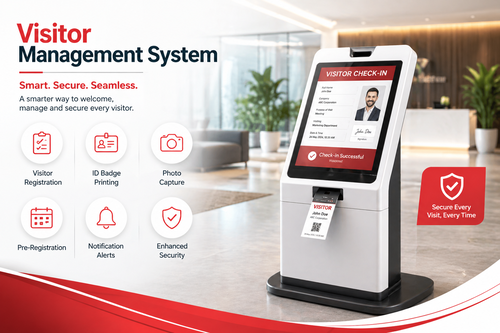
Front desks in Subang Jaya’s business parks and office towers still rely heavily on paper logbooks to register guests, contractors, and delivery personnel. A modern visitor management system replaces that logbook with a self-service kiosk that checks visitors in within seconds, verifies identity, notifies the host, and prints a badge automatically. This article looks at how a visitor management system works, why Subang Jaya businesses are adopting them, and what features matter most when choosing one.
The Problem with Manual Visitor Logbooks
Paper-based visitor registers create several operational and security issues for busy offices and industrial parks:
- Handwriting is often illegible, making records difficult to search later.
- Receptionists must manually call or message hosts to announce arrivals.
- There is no reliable way to verify a visitor’s identity at the point of entry.
- In an emergency, it is hard to quickly determine who is on-site.
A digital visitor management system solves all of these problems by digitising the entire check-in process and keeping accurate, searchable records automatically.
How a Visitor Management System Works
Self-Service Kiosk Check-In
Visitors arriving at the lobby use a touchscreen kiosk to register their details, take a photo, and state the purpose of their visit. The process typically takes under a minute, removing the need for a receptionist to manually log every guest.
Instant Host Notification
As soon as a visitor checks in, the system automatically sends a notification to the host employee via SMS, email, or an internal messaging app, so meetings can start on time without delays.
Badge Printing and Access Control
Many visitor management systems print a temporary badge with the visitor’s name, photo, and host details. Some systems also integrate with door access control to grant temporary, time-limited entry to specific areas.
Digital Visitor Records
Every check-in and check-out is logged digitally, giving building management a searchable, exportable record of everyone who has entered the premises, which is especially useful for compliance and emergency evacuation counts.
Why Subang Jaya Businesses Are Adopting Visitor Management Systems
| Benefit | Impact |
|---|---|
| Faster check-in | Visitors register themselves in under a minute at the kiosk |
| Improved security | Photo capture and ID verification reduce unauthorised access |
| Professional first impression | A digital kiosk signals a modern, well-run office to guests |
| Accurate records | Digital logs are searchable and easy to export for audits |
| Reduced receptionist workload | Self-service check-in frees up front desk staff for other tasks |
What to Look for in a Visitor Management System
1. Ease of Use for Walk-In Guests
The kiosk interface should be intuitive enough for first-time visitors to complete check-in without assistance from staff.
2. Integration with Access Control
Look for a system that can connect with your existing door access hardware to issue temporary, auto-expiring access for visitors and contractors.
3. Customisable Workflows
Different visitor types, such as contractors, interviewees, or VIP guests, may require different check-in steps, such as NDA signing or safety briefings.
4. Reporting and Compliance Features
Choose a system that generates exportable visitor logs to support audits, security reviews, and emergency evacuation procedures.
Key Takeaways
- A visitor management system replaces slow, error-prone paper logbooks with fast digital check-in.
- Automatic host notifications reduce waiting time for guests and improve professionalism.
- Integration with access control adds an extra layer of building security.
- Digital visitor logs make compliance and emergency reporting far easier.
Conclusion
A modern visitor management system gives Subang Jaya offices and industrial parks a faster, safer, and more professional way to handle guest check-in. From self-service kiosks to automatic host notifications and digital record-keeping, the technology removes the friction and security gaps of manual logbooks. Businesses that upgrade typically see shorter lobby wait times, stronger security compliance, and a much better first impression for visiting clients and partners.
If your building still relies on a paper visitor book, it may be time to explore a visitor management system suited to your lobby traffic and security requirements.
Frequently Asked Questions
What is a visitor management system?
It is a digital solution that replaces paper visitor logbooks, allowing guests to check in via a self-service kiosk while automatically notifying the host and recording visit details.
Can a visitor management system integrate with access control?
Yes. Many systems can connect with door access hardware to issue temporary, auto-expiring access badges for visitors and contractors.
Is a visitor management system suitable for small offices?
Yes. Visitor management systems scale from small offices with occasional guests to large business parks with high daily visitor traffic.
How does a visitor management system notify the host?
Once a visitor checks in at the kiosk, the system automatically sends a notification to the host via SMS, email, or an internal messaging platform.
Are visitor records kept securely?
Yes. Digital visitor logs are stored securely and can be exported for compliance audits or emergency evacuation counts, unlike easily lost paper logbooks.
Want to see how this fits your organization? Click here to request a free demo: https://www.smartouch.com.my/vms-visitor-management-system/.
Smart Touch technology pte ltd , www.smartouch.com.sg +65-63964767, sales@smartouch.com.sg , www.smartouch.com.my +607-3889903 sales@smartouch.com.my