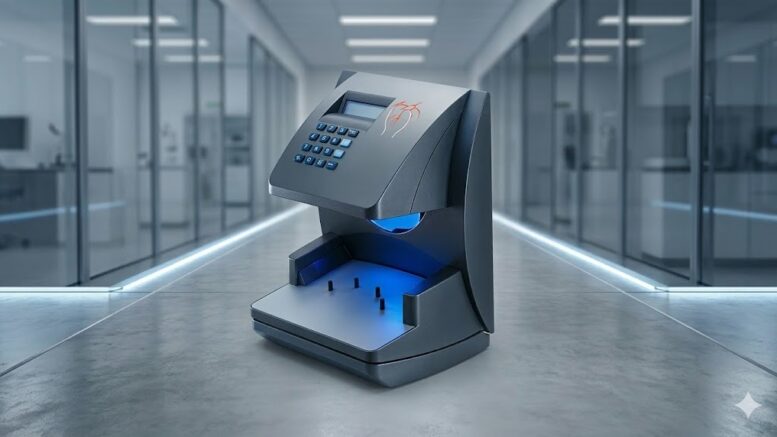
Buddy punching, where one employee clocks in on behalf of another, quietly drains payroll budgets in businesses that still rely on cards or PIN codes for attendance. A biometric fingerprint time attendance solution closes this loophole completely by tying every clock-in to a unique physical identifier that cannot be shared, borrowed, or forgotten at home.
For Malaysian businesses looking to tighten payroll accuracy and improve accountability, fingerprint-based attendance has become one of the most trusted and cost-effective technologies available. This article explains how it works, its key benefits, and what to consider before implementation.
Why Businesses Are Moving to Biometric Fingerprint Attendance
Cards can be shared. PINs can be given to a colleague over text message. Fingerprints cannot. This simple fact is why so many businesses are replacing card-based or manual systems with a biometric fingerprint time attendance solution, particularly in industries where payroll accuracy and workforce accountability directly affect the bottom line.
How a Biometric Fingerprint Time Attendance Solution Works
The Clock-In Process
- Enrollment: each employee’s fingerprint is scanned once and stored as an encrypted template, not an actual image.
- Daily verification: employees place their finger on the scanner to clock in and out, with the system matching it against the stored template.
- Instant sync: attendance data is transmitted to a central system or cloud dashboard in real time.
- Automated reporting: the system compiles hours worked, late arrivals, and absences without manual calculation.
Key Benefits of Biometric Fingerprint Attendance
| Benefit | Description |
|---|---|
| Eliminates buddy punching | Fingerprints cannot be shared or transferred between employees. |
| Improves payroll accuracy | Attendance data is tied directly to verified individuals, reducing disputes. |
| Fast clock-in process | Verification typically takes less than a second per employee. |
| No cards or tokens to replace | Removes the ongoing cost and hassle of lost or damaged access cards. |
| Detailed audit trail | Every clock-in is logged with a precise timestamp for compliance purposes. |
Best Practices for Implementing Fingerprint Attendance
Step-by-Step Implementation Guide
- Choose scanner placement carefully: install devices at natural entry and exit points to avoid bottlenecks.
- Enroll employees properly: capture multiple finger positions during enrollment to reduce recognition errors later.
- Integrate with payroll software: ensure attendance data flows directly into your payroll calculations.
- Set clear policies: communicate how the system will be used and address any employee privacy concerns upfront.
- Plan for backup verification: have a manual override process for the rare case of scanner malfunction or injury.
Card-Based vs Biometric Fingerprint Attendance
| Feature | Card-Based System | Biometric Fingerprint System |
|---|---|---|
| Risk of buddy punching | High | Virtually eliminated |
| Ongoing costs | Card replacement fees | No physical tokens required |
| Verification speed | Fast but easily bypassed | Fast and individually verified |
| Data accuracy | Dependent on card holder | Tied to a unique biological identifier |
Key Takeaways
- A biometric fingerprint time attendance solution eliminates buddy punching and improves payroll accuracy.
- Fingerprint templates are stored as encrypted data, not raw images, addressing common privacy concerns.
- Successful implementation depends on proper scanner placement, employee enrollment, and payroll integration.
Conclusion
A biometric fingerprint time attendance solution offers Malaysian businesses a straightforward way to close one of the most common gaps in payroll accuracy. By replacing cards and manual logs with unique biological verification, companies gain faster clock-ins, cleaner audit trails, and far greater confidence that attendance records reflect who was actually on-site and when.
Frequently Asked Questions
Is fingerprint data stored securely?
Yes, reputable systems store fingerprint data as encrypted mathematical templates rather than actual images, making it very difficult to reverse-engineer.
What happens if an employee’s fingerprint is not recognized?
Most systems allow multiple scan attempts and offer a manual override or backup verification method, such as a PIN, for rare recognition issues.
Can fingerprint scanners work in industrial or outdoor environments?
Yes, many fingerprint scanners are designed with rugged casings suitable for factories, warehouses, and semi-outdoor installations.
Is biometric attendance compliant with Malaysian data privacy regulations?
Reputable providers design their systems to comply with the Personal Data Protection Act, including secure storage and limited access to biometric templates.
How long does enrollment take per employee?
Enrollment typically takes less than a minute per employee, including capturing backup finger positions for reliability.
Click here to find out how the product works: https://www.smartouch.com.my/category/time-clock/biometric-fingerprint/
Smart Touch technology pte ltd , www.smartouch.com.sg +65-63964767, sales@smartouch.com.sg , www.smartouch.com.my +607-3889903 sales@smartouch.com.my