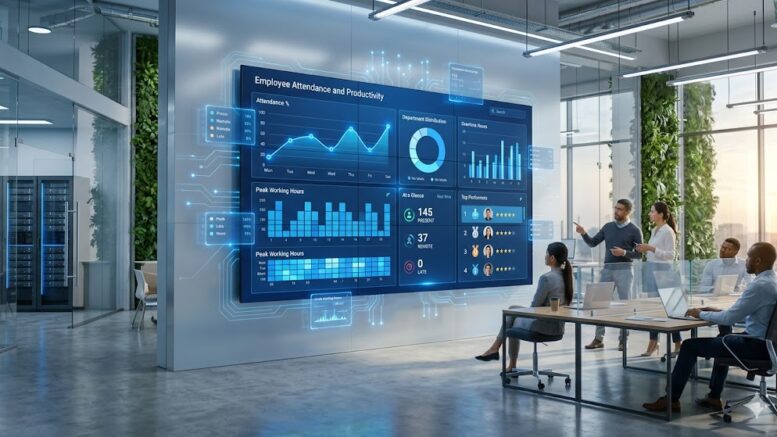
Legacy fingerprint scanners and card readers have served their purpose, but they still require physical contact and can be slowed down by dirt, moisture, or worn ridges. Facial clocking technology offers a faster, contactless alternative, verifying an employee’s identity in a fraction of a second using high-accuracy facial recognition.
This article explains how modern facial clocking tools work, why they are becoming the preferred choice for time attendance, and what employers should look for when adopting the technology.
Why Facial Clocking Is Replacing Older Time Attendance Methods
Employers want attendance systems that are fast, accurate, and easy to maintain across a large workforce. High-accuracy facial clocking tools meet all three requirements while eliminating the physical contact required by fingerprint or card-based systems.
Speed and Convenience
Facial recognition can verify an employee’s identity in under a second, reducing queues at the clock-in point during busy shift changes.
Contactless and Hygienic
Because there is no physical contact required, facial clocking is well suited to industries such as food production and healthcare where hygiene is a priority.
Key Features of High-Accuracy Facial Clocking Systems
Liveness Detection
Advanced systems include liveness detection to prevent employees from using a photo or video to spoof the system, ensuring only a real, present person can clock in.
Low-Light and Mask Recognition
Modern facial clocking terminals are designed to perform reliably in varied lighting conditions and can often recognize employees even while wearing masks, which is valuable in manufacturing and healthcare settings.
Instant Payroll Integration
Verified clock-in and clock-out data feeds directly into payroll and attendance reports, removing the need for manual data transfer between systems.
Benefits of Facial Clocking for Time Attendance
| Benefit | Impact on Your Business |
|---|---|
| Faster clock-ins | Reduces queues during shift changes |
| Improved hygiene | No physical contact required at the terminal |
| Stronger fraud prevention | Liveness detection blocks photo or video spoofing attempts |
| Accurate payroll data | Verified attendance flows directly into payroll calculations |
How to Choose the Right Facial Clocking System
Step 1: Test Accuracy Under Real Conditions
Evaluate the system under your actual lighting and environmental conditions before committing, since accuracy can vary between vendors and hardware models.
Step 2: Confirm Data Privacy Compliance
Facial recognition involves biometric data, so confirm the vendor’s storage and processing practices comply with Malaysia’s Personal Data Protection Act (PDPA).
Step 3: Check Integration with Existing HR Systems
Choose a system that connects directly with your payroll and attendance software to avoid manual data reconciliation between platforms.
Best Practices for Deploying Facial Clocking Technology
- Communicate clearly with employees about how facial data is captured, stored, and protected.
- Position terminals in well-lit areas to maximize recognition accuracy.
- Offer an alternative clocking method for employees who opt out of facial recognition.
- Regularly review recognition error logs to catch and resolve hardware issues quickly.
Common Mistakes to Avoid
Skipping a Pilot Phase
Rolling out facial clocking across an entire organization without first piloting it in one location can amplify hardware or process issues before they are identified.
Ignoring Employee Consent Requirements
Biometric data collection requires clear, documented employee consent. Skipping this step creates compliance risk regardless of how accurate the technology is.
Facial Clocking vs Traditional Attendance Methods
| Aspect | Card or Fingerprint | Facial Clocking |
|---|---|---|
| Contact required | Yes, physical touch needed | No, fully contactless |
| Speed | A few seconds per employee | Under one second per employee |
| Fraud prevention | Moderate | High, with liveness detection |
Industries Leading the Shift to Facial Clocking
Manufacturing plants with strict hygiene requirements were early adopters of facial clocking, since contactless verification reduces the risk of contamination on shared equipment. Healthcare facilities have followed closely behind for similar reasons, alongside the added benefit of not requiring staff to remove gloves between tasks. Large retail and hospitality operators with high staff turnover also favor facial clocking because it eliminates the administrative burden of issuing and reclaiming physical cards for every new hire. As hardware costs continue to decline, adoption is increasingly extending to small and medium-sized businesses that previously viewed the technology as too expensive.
Planning a Smooth Transition from Legacy Hardware
Organizations moving away from fingerprint or card systems benefit from running both technologies in parallel for a short overlap period. This allows IT and HR teams to validate that facial recognition data is syncing correctly with payroll before fully retiring the old hardware. Clear signage at the clock-in terminal, along with a short demonstration during the rollout, helps employees feel confident using the new system from day one rather than defaulting back to old habits out of uncertainty.
Key Takeaways
- High-accuracy facial clocking offers a faster, contactless alternative to fingerprint and card-based attendance systems.
- Liveness detection and low-light recognition make modern facial clocking tools reliable across varied work environments.
- Successful adoption depends on employee communication, PDPA compliance, and payroll integration.
Conclusion
Facial clocking technology gives employers a fast, hygienic, and highly accurate way to modernize time attendance without the drawbacks of physical contact required by older systems. By choosing a solution with strong liveness detection, reliable low-light performance, and seamless payroll integration, businesses can improve both employee experience and attendance accuracy.
If your current time attendance system relies on outdated hardware, it is worth exploring how facial clocking technology could modernize your workplace.
Frequently Asked Questions
Is facial clocking data secure?
Reputable systems store facial data as encrypted mathematical templates rather than actual images, in line with data protection regulations.
Does facial clocking work with employees wearing masks?
Many modern systems are designed to recognize employees even while wearing masks, though accuracy can vary by vendor.
Can facial clocking replace fingerprint systems entirely?
Yes, many organizations are transitioning fully to facial clocking, though some keep a backup method for edge cases.
How accurate is facial clocking technology?
High-quality systems achieve very high accuracy rates, especially when combined with liveness detection and proper lighting conditions.
Read the product overview here: http://www.smartouch.com.my/tms-time-management-system-singapore-malaysia/
Smart Touch technology pte ltd , www.smartouch.com.sg +65-63964767, sales@smartouch.com.sg , www.smartouch.com.my +607-3889903 sales@smartouch.com.my