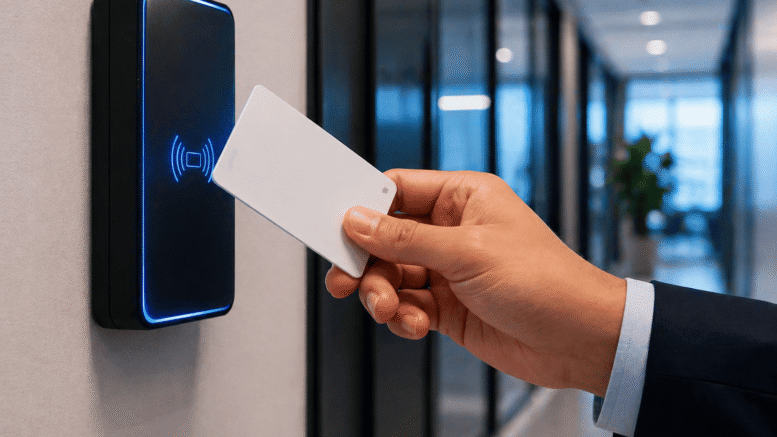
As Malaysian businesses grow beyond a handful of staff, how employees get in and out of the building starts to matter more than most owners expect. A shared PIN code that everyone remembers, a security guard manually checking names against a list, or a single set of keys passed between shift supervisors all create bottlenecks and blind spots. Proximity card access control replaces these ad hoc methods with a single tap-and-go system that speeds up entry while giving management a clear record of who came in and when.
Why Traditional Entry Methods Slow Teams Down
Manual sign-in books, shared door codes, and physical keys were manageable when a company had ten employees and one entrance. As headcount grows and shift patterns multiply, these methods start working against the business. Staff queue at a single turnstile during shift changes, security guards spend their morning cross-checking names instead of watching for real issues, and nobody can say with certainty who unlocked a door at 2 a.m. last Tuesday. When an employee resigns, the PIN code often stays the same for months because changing it means retraining everyone who uses it, and that gap is exactly where security incidents happen.
What a Proximity Card System Does
A proximity card system uses RFID or NFC technology embedded in a small plastic card to unlock doors and turnstiles with a simple tap or wave near a reader. Each card is registered to one employee, so every entry is tied to a specific person rather than a code that anyone could be using. Access rights are managed centrally through software, which means granting or removing access to a specific door, floor, or building takes a few clicks rather than a locksmith visit or a company-wide announcement to change the PIN.
Key Features of a Proximity Card System
Contactless Tap Access
Employees tap their card against a reader mounted at the door, and the lock releases within a second. There is no need to insert a key, remember a code, or wait for a guard to buzz them in, which keeps entry points moving even during the morning rush.
Integration with Time Attendance
The same tap that opens the door can also log a clock-in or clock-out event when the system is linked to time attendance software. This removes the need for a separate fingerprint scanner or manual timesheet at the entrance, and it means attendance records are captured automatically as part of a routine employees already do.
Multi-Door and Multi-Site Access Control
One card can be configured to open different combinations of doors depending on role, shift, or department. A warehouse supervisor might have access to the loading bay and office floor, while a part-time staff member is limited to the main entrance and pantry, all managed from the same system across multiple branches if needed.
Real-Time Access Logs
Every tap is recorded with a timestamp and door identifier, creating a searchable audit trail. If an incident occurs, management can pull an exact record of who entered a specific area and when, rather than relying on guesswork or CCTV footage alone.
Benefits for Malaysian Businesses
Faster Entry During Peak Hours
Retail outlets, factories, and offices with shift changes all face the same crunch: dozens of employees trying to clock in within the same fifteen-minute window. A tap-based reader processes each person in under a second, clearing queues that a manual sign-in sheet or single key would never keep up with.
Reduced Security Risks
A lost card or a departing employee no longer means changing a shared code that everyone else has to relearn. HR or security can deactivate a single card in the system immediately, closing the gap that shared PINs and physical keys leave open.
Lower Administrative Overhead
There are no physical keys to track, duplicate, or collect when staff leave. Combined with time attendance, one card and one system handle both building security and payroll-ready attendance data, cutting down on the separate tools HR would otherwise need to manage.
Conclusion
Proximity cards turn building entry from a daily bottleneck into a routine that takes a second and leaves a clear record behind. For growing Malaysian businesses juggling multiple shifts, doors, or branches, that combination of speed, security, and built-in attendance tracking is a practical upgrade over keys, codes, and sign-in sheets. Click here to unlock the full product details: https://www.smartouch.com.my/category/time-clock/proximity-card/
FAQ
Can proximity cards replace fingerprint or facial recognition systems?
For most doors and general staff entry, yes, proximity cards are sufficient on their own. Businesses that need an extra layer of security for sensitive areas, such as server rooms or cash-handling zones, often pair a card reader with biometric verification for those specific points while leaving standard entrances on card-only access.
What happens if a proximity card is lost or stolen?
The card can be deactivated in the access control software within minutes, and a replacement can be issued the same day. Unlike a shared PIN or a master key, disabling one lost card has no effect on anyone else’s access, so there is no need to reissue credentials to the entire team.
Can proximity card systems integrate with existing payroll or HR software?
Most proximity card and time attendance systems can export or sync attendance data directly to payroll software, so hours worked flow through to payroll calculations without manual re-entry. This is worth confirming with your vendor if you already use a specific payroll or HR platform.
Is proximity card technology secure against cloning or duplication?
Modern encrypted proximity cards are significantly harder to clone than older, unencrypted low-frequency cards. Businesses evaluating a system should confirm it uses current encrypted card technology rather than legacy formats that are more vulnerable to duplication.