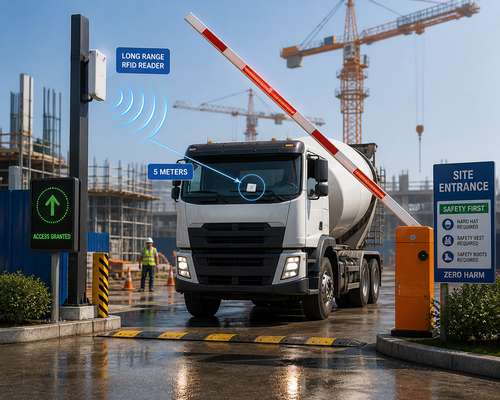
Construction sites are among the most active and complex working environments. Every day, contractors, subcontractors, engineers, consultants, suppliers, lorry drivers, equipment operators, security guards, project managers, and workers move in and out of the site. At the same time, construction companies must protect valuable machinery, materials, tools, temporary facilities, project documents, and restricted working zones.
Because of this, Construction Long Range RFID for Secure Entry Management has become an important solution for modern construction projects. It helps site management control vehicle entry, monitor authorised access, reduce manual checking, improve movement records, and create a more organised security process at the site entrance.
For construction companies that want better safety, stronger control, and faster site movement, long range RFID provides a practical and professional way to upgrade traditional gate management.
Why Construction Sites Need Long Range RFID Entry Management
A construction site entrance is not just a gate. It is the first layer of site security, workforce control, logistics coordination, and safety management. If the entrance is poorly managed, unauthorised vehicles may enter, delivery records may become unclear, workers may access restricted zones, and security guards may struggle to manage peak-hour movement.
Traditional entry methods often depend on manual verification, paper logbooks, verbal confirmation, phone calls, printed passes, or short-range access cards. These methods can be slow and inconsistent, especially when many vehicles arrive at the same time.
Long range RFID helps solve this problem by allowing authorised vehicles or personnel to be identified automatically from a distance. When an approved RFID tag is detected, the system can trigger the barrier gate or notify the guard. This allows site entry to become faster, more controlled, and easier to record.
What Is Long Range RFID for Construction Site Access?
Long range RFID is a wireless identification system that uses RFID readers and RFID tags to recognise registered vehicles, equipment, or authorised users. In construction site access control, RFID tags are usually placed on vehicle windscreens, machinery, staff passes, contractor passes, or site access cards.
When a registered vehicle approaches the site entrance, the long range RFID reader detects the tag. The system then checks whether the tag is valid, active, and permitted to enter the site. If access is approved, the barrier gate can open automatically. If access is not approved, entry can be blocked and security staff can be alerted.
This process helps reduce manual delays while keeping access controlled. It is especially useful for construction sites with high vehicle traffic, multiple contractors, temporary workers, heavy equipment, and frequent deliveries.
Faster Entry for Authorised Construction Vehicles
Construction projects often involve many vehicles, including staff cars, contractor vans, delivery lorries, concrete trucks, cranes, excavators, forklifts, dump trucks, project vehicles, and supplier vehicles. When every vehicle must stop for manual checking, long queues can form at the gate.
Delays at the entrance can affect project productivity. Concrete deliveries may be time-sensitive. Materials may need to arrive before a scheduled work activity. Workers may need to clock in before toolbox meetings. Site engineers may need fast access during inspections or urgent coordination.
Long range RFID helps authorised vehicles enter more efficiently. The reader can detect registered tags before the vehicle reaches the barrier, allowing the gate to open faster for approved access. This supports smoother logistics and reduces congestion at the site entrance.
Better Security Against Unauthorised Entry
Construction sites contain many valuable assets. Steel, cables, cement, fuel, tools, machinery parts, electrical items, and construction equipment can be costly and difficult to replace. Unauthorised entry can create theft risk, safety risk, and project disruption.
Long range RFID improves site security by ensuring that only registered vehicles or authorised personnel can pass through designated access points. Each RFID tag can be linked to a specific contractor, company, vehicle number, worker profile, equipment ID, or project team.
If a contractor’s work period has ended, the RFID tag can be disabled. If a vehicle is no longer approved, its access can be removed. If a subcontractor is only allowed to enter during certain hours, access rules can be configured according to project requirements.
This gives site management better control compared with manual gate lists that may become outdated or misplaced.
Digital Entry Records for Construction Site Accountability
Accurate entry records are extremely important for construction projects. Management may need to know which supplier entered the site, when a delivery vehicle arrived, which contractor accessed the project area, or whether a particular vehicle entered outside normal working hours.
Long range RFID systems can create digital records for every access event. These records may include date, time, RFID tag number, vehicle registration number, contractor name, entry point, exit point, and access status.
Digital records are more reliable than handwritten logbooks because they reduce missing entries, unclear handwriting, and manual recording mistakes. They also help project managers, site administrators, safety officers, and security teams review movement history when necessary.
Supporting Site Safety and Emergency Management
Construction safety depends on knowing who and what is on site. During emergencies, site management may need to identify registered workers, contractor vehicles, heavy equipment, and authorised personnel quickly.
Long range RFID supports better site visibility by improving entry and exit tracking. When combined with proper site procedures, it can help management understand movement patterns and maintain more organised access records.
For example, during a site evacuation, management can use access data as part of the review process. During safety investigations, entry logs can help determine whether a vehicle or contractor was present at a specific time. During restricted activity periods, access rules can help limit unnecessary movement in controlled areas.
Managing Contractors and Subcontractors More Efficiently
Most construction projects involve many subcontractors. Each subcontractor may have different workers, vehicles, tools, schedules, and authorised work zones. Without a structured access system, it becomes difficult to control who is allowed to enter.
Long range RFID helps site administrators assign access rights based on contractor type, project phase, vehicle category, work schedule, or approval period. A subcontractor’s tag can be valid only during the contract period. Temporary delivery tags can be issued with limited validity. Special access can be granted to management vehicles, emergency vehicles, or approved suppliers.
This improves access discipline and reduces the chance of unauthorised persons using outdated passes.
Long Range RFID for Heavy Equipment and Machinery Control
Construction sites often use expensive equipment such as excavators, loaders, cranes, generators, compressors, welding machines, and material handling vehicles. Managing the movement of these assets is important for cost control and security.
Long range RFID can be used to identify registered equipment or machinery moving through access points. This helps management keep better records of when equipment enters or leaves the site. It can also reduce the risk of equipment being removed without authorisation.
For large projects with multiple gates, RFID tracking can help improve visibility across different access points. This is useful for project teams that need better control over machinery movement, rental equipment returns, and asset accountability.
Integration with Barrier Gates, Boom Gates, and CCTV
A construction long range RFID solution becomes more effective when integrated with physical security systems. RFID readers can work with boom gates, barrier gates, sliding gates, turnstiles, access control panels, CCTV cameras, visitor management systems, and guardhouse monitoring software.
When an authorised tag is detected, the barrier can open automatically. When an invalid tag is detected, the system can keep the gate closed. CCTV can help security teams visually confirm vehicles and review incidents. Guardhouse monitors can display access information so guards can take action when needed.
This creates a complete secure entry management system that combines automation, visibility, and human supervision.
Reducing Guard Workload at Construction Entrances
Security guards play an important role on construction sites, but they should not have to manually check every authorised vehicle repeatedly. When guards spend too much time verifying routine vehicles, they may have less time to focus on suspicious activity, visitor control, safety observation, and emergency response.
Long range RFID reduces repetitive checking by automating the identification of registered vehicles. Guards can focus more on exceptions, such as unregistered vehicles, expired tags, unexpected visitors, suspicious movement, or vehicles entering restricted areas.
This improves the efficiency of the security team while still maintaining strong entry control.
Better Control for Deliveries and Supplier Vehicles
Construction projects depend on timely deliveries. Cement, steel bars, tiles, glass, piping, electrical items, formwork, machinery, and finishing materials must arrive according to project schedules. However, delivery access must still be controlled.
Long range RFID can help manage approved supplier vehicles. Regular supplier vehicles can be registered with specific access permissions. Temporary RFID tags can be issued for selected deliveries. Access can be limited to certain dates, times, or gates.
This helps reduce confusion at the entrance and allows the site team to maintain better delivery movement records.
Suitable for Large Construction Sites and Multi-Gate Projects
Large construction projects may have several entrances for workers, contractors, materials, heavy vehicles, and management personnel. Manual control across multiple gates can be difficult, especially when communication between guardhouses is not consistent.
Long range RFID helps centralise entry management. Each gate can be equipped with RFID readers, and access records can be managed through a connected system. This gives management better visibility across the entire site.
For multi-phase developments, infrastructure projects, high-rise buildings, industrial plants, and large commercial construction projects, this can significantly improve access coordination.
Improving Professional Image and Project Governance
A well-managed construction site creates confidence. Developers, consultants, clients, auditors, safety officers, and authorities expect organised access control, proper records, and strong security discipline.
Using long range RFID for secure entry management helps demonstrate that the project team takes site control seriously. It creates a more professional first impression at the site entrance and supports better governance throughout the project.
Instead of relying only on manual gate checking, the site can operate with a more modern and accountable entry process.
Why Choose Smart Touch for Construction Long Range RFID
Smart Touch provides practical long range RFID solutions for construction sites, commercial premises, industrial facilities, residential developments, and secure access environments. Our solutions are designed to support real site conditions where speed, security, and reliability matter.
We understand that construction sites need systems that are easy to manage, suitable for changing contractor lists, and reliable for daily vehicle movement. Smart Touch long range RFID solutions can help project teams improve entrance control, reduce manual work, and maintain better access records.
Whether the site needs RFID for vehicle access, contractor management, equipment movement, boom gate integration, or guardhouse monitoring, Smart Touch can support a secure and efficient access control setup.
Construction Long Range RFID for a Safer and More Efficient Site
Construction projects require coordination, discipline, and security. A weak entry management process can create delays, confusion, unauthorised access, and poor accountability. Long range RFID helps solve these issues by giving project teams a smarter way to manage site access.
With automatic identification, digital records, controlled permissions, faster vehicle movement, and integration with access barriers, long range RFID improves both security and productivity.
For construction companies, developers, main contractors, subcontractors, project managers, and site security teams, Construction Long Range RFID for Secure Entry Management is a valuable investment. It supports safer operations, better logistics flow, stronger access control, and a more professional construction site environment.
Click here for more product information: https://www.smartouch.com.my/long-range-rfid-content/
Smart Touch technology pte ltd , www.smartouch.com.sg +65-63964767, sales@smartouch.com.sg , www.smartouch.com.my +607-3889903 sales@smartouch.com.my