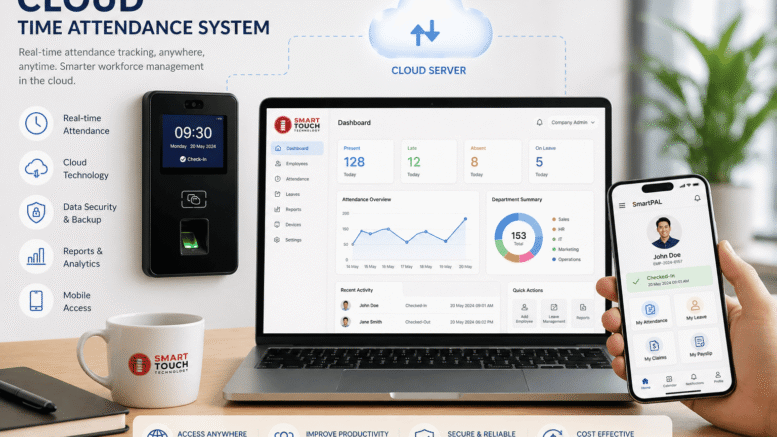
Managing employee attendance and payroll can be challenging for small business owners. As a company grows, tracking clock-in times, working hours, overtime, leave, and salary calculations using spreadsheets or manual records can consume valuable time and increase the risk of payroll errors.
A Time Attendance and Payroll Sync solution provides a more efficient way to connect employee attendance records directly with payroll processing. Instead of entering attendance information manually, businesses can automatically transfer working hours, overtime, and attendance adjustments into their payroll system.
For Malaysian small businesses, this integrated approach can reduce administrative work, improve payroll accuracy, and give business owners better visibility over workforce costs.
What Is Time Attendance and Payroll Sync?
Time Attendance and Payroll Sync refers to the integration between an employee attendance system and payroll software.
The attendance system records information such as:
- Clock In
- Clock Out
- Working Hours
- Late Arrivals
- Early Departures
- Overtime
- Shift Attendance
- Attendance Exceptions
The payroll system then uses this information when calculating employee salaries.
Instead of maintaining separate attendance and payroll records, both systems work together through an integrated HRMS platform.
Why Small Businesses Need Integrated Attendance and Payroll
Small businesses often have limited HR resources. In many cases, the business owner, administrator, or a small HR team handles several responsibilities at the same time.
Manual attendance and payroll processing can create problems such as:
- Incorrect working hours
- Missed overtime
- Duplicate data entry
- Spreadsheet formula errors
- Payroll delays
- Difficulty tracking employee attendance
- Time-consuming monthly reconciliation
By synchronising attendance with payroll, businesses can automate many of these repetitive processes.
How Time Attendance and Payroll Sync Works
A typical workflow looks like this:
Employee Clock In/Out → Attendance System → Working Hours → Payroll Calculation → Digital Payslip
Step 1: Employee Records Attendance
Employees record their attendance using an approved method such as:
- Fingerprint
- Facial Recognition
- RFID Card
- PIN
- Mobile Attendance
The system records the employee’s attendance automatically.
Step 2: Attendance Data Is Processed
The system calculates relevant attendance information, including:
- Total Working Hours
- Late Attendance
- Early Departure
- Overtime
- Shift Records
This eliminates the need for HR staff to manually calculate every employee’s working hours.
Step 3: Attendance Is Synced with Payroll
The processed attendance information is transferred into the payroll module.
The payroll system can then use the data to calculate salary-related items such as overtime and applicable attendance adjustments.
Step 4: Payroll Is Processed
Once attendance information has been reviewed, payroll can calculate:
- Basic Salary
- Overtime
- Allowances
- Bonuses
- Claims
- Statutory Deductions
- Other Payroll Adjustments
Step 5: Digital Payslip Is Generated
After payroll is completed, employees can access their digital payslips through the HRMS or Employee Self-Service platform, depending on the system configuration.
Key Benefits for Small Business Owners
1. Reduce Manual Data Entry
One of the biggest benefits is eliminating repetitive data entry.
Instead of copying attendance records from a spreadsheet into payroll, the information can flow automatically between the systems.
This saves time and reduces the possibility of typing errors.
2. Improve Payroll Accuracy
Payroll accuracy depends heavily on accurate attendance information.
When attendance is automatically synchronised, payroll administrators can reduce errors involving:
- Working Hours
- Overtime
- Late Attendance
- Shift Work
- Attendance Adjustments
This helps employees receive more accurate salaries.
3. Save Time Every Month
Small business owners do not need to spend hours manually checking attendance records before preparing payroll.
Automation allows the system to process attendance information much faster.
This gives business owners more time to focus on:
- Customers
- Sales
- Operations
- Business Growth
- Employee Management
4. Manage Overtime More Efficiently
Overtime can be difficult to track manually, especially when employees work different schedules.
An integrated attendance and payroll system can use recorded working hours and approved overtime information to support payroll calculations.
This provides a more consistent process for managing overtime.
5. Improve Employee Transparency
Employees can access their attendance and payroll information through Employee Self-Service.
Depending on the system configuration, employees can view:
- Attendance History
- Overtime
- Leave Records
- Leave Balance
- Digital Payslips
This gives employees greater visibility into their payroll information and can reduce routine questions to HR.
Integration with Leave Management
Attendance and payroll should not operate independently from employee leave.
When an employee’s leave is approved, the information should be reflected in the attendance and payroll records.
A connected HRMS can link:
Leave → Attendance → Payroll
This helps reduce manual adjustments and keeps employee records consistent.
Common leave types may include:
- Annual Leave
- Medical Leave
- Emergency Leave
- Unpaid Leave
- Maternity Leave
- Other Company Leave
Mobile Attendance for Small Businesses
Not every small business has employees working from a single office.
Sales representatives, technicians, construction workers, delivery teams, and field employees may work at different locations.
The Smart GoGo Mobile App provides mobile HR and attendance capabilities that can support employees who need to record attendance using their smartphones.
Depending on the configured solution, employees can:
- Clock In & Clock Out
- Use GPS Attendance
- Verify Approved Wi-Fi Locations
- View Attendance
- Apply Leave
- Submit Claims
- Check Overtime
- Access Payslips
This provides small businesses with greater flexibility when managing employees across different work locations.
Time Attendance for Different Small Businesses
Retail Businesses
Retail businesses can manage attendance across outlets and shifts while connecting employee working hours with payroll.
Restaurants and Food Services
Businesses with different shifts can monitor working hours, attendance, and overtime more efficiently.
Construction Companies
Site workers can use suitable attendance methods to record working time while HR teams manage payroll centrally.
Small Manufacturing Businesses
Manufacturers can manage shift schedules, overtime, and attendance while reducing manual payroll calculations.
Logistics and Delivery Businesses
Employees working across different locations can use mobile attendance solutions while their records remain connected to the central HRMS.
What Should Small Businesses Look for in an Integrated System?
When choosing a Time Attendance and Payroll System Malaysia, small business owners should consider:
- Automated Attendance Recording
- Payroll Integration
- Overtime Management
- Leave Management
- Facial Recognition
- Fingerprint Attendance
- RFID Card Support
- Mobile Attendance
- GPS Attendance
- Employee Self-Service
- Digital Payslips
- Claims Management
- Attendance Reports
- Payroll Reports
- Multi-Branch Support
- Cloud & On-Premise Deployment
A scalable system allows the business to start with the features it needs today and expand as the workforce grows.
Why Choose Smart Touch for Time Attendance and Payroll?
Smart Touch Technology provides integrated Time Attendance and Payroll Solutions designed to help Malaysian businesses simplify workforce and payroll management.
The Smart Touch HRMS ecosystem connects attendance with payroll, leave, overtime, claims, and Employee Self-Service.
Key capabilities include:
- Time Attendance Management
- Payroll Processing
- Facial Recognition
- Fingerprint Attendance
- RFID Attendance
- Smart GoGo Mobile Attendance
- GPS & Wi-Fi Attendance
- Leave Management
- Overtime Management
- Claims Management
- Digital Payslips
- Employee Self-Service
- HR Reporting
- Multi-Branch Management
- Cloud & On-Premise Deployment
- Professional Local Support
For small business owners, this means less manual administration and a more organised way to manage employees from attendance through to payroll.
Grow Your Business with Smarter Payroll Automation
For small businesses, every hour spent on manual administration is time that could be invested in growing the business. Integrating Time Attendance and Payroll helps eliminate repetitive data entry, improve attendance accuracy, simplify overtime processing, and streamline monthly payroll.
Instead of managing attendance spreadsheets and payroll records separately, businesses can create a connected HR workflow:
Attendance → Leave → Overtime → Payroll → Digital Payslip
With Smart Touch’s integrated HRMS and Smart GoGo mobile solutions, Malaysian businesses can modernise their workforce management while creating a more efficient experience for both HR administrators and employees.
Read the product overview here: http://www.smartouch.com.my/tms-time-management-system-singapore-malaysia/
Smart Touch technology pte ltd , www.smartouch.com.sg +65-63964767, sales@smartouch.com.sg , www.smartouch.com.my +607-3889903 sales@smartouch.com.my