Managing employee attendance becomes increasingly difficult when a retail business operates multiple outlets. Store managers need to know when employees arrive, HR needs accurate attendance records, and payroll teams need reliable working-hour information for salary and overtime processing.
For growing retailers, relying on paper timesheets or separate spreadsheets for every outlet can create unnecessary administrative work. A Fingerprint Attendance System Malaysia provides a centralised way to record employee clock-ins and clock-outs across multiple retail locations.
With biometric fingerprint verification, employees can record their own attendance without relying on physical attendance cards. When connected to HRMS and payroll, attendance information can also flow into overtime and salary processing.
Smart Touch Technology provides time attendance solutions supporting fingerprint, facial recognition, RFID, and mobile attendance methods for Malaysian businesses. (smartouch.com.my)
What Is a Fingerprint Attendance System?
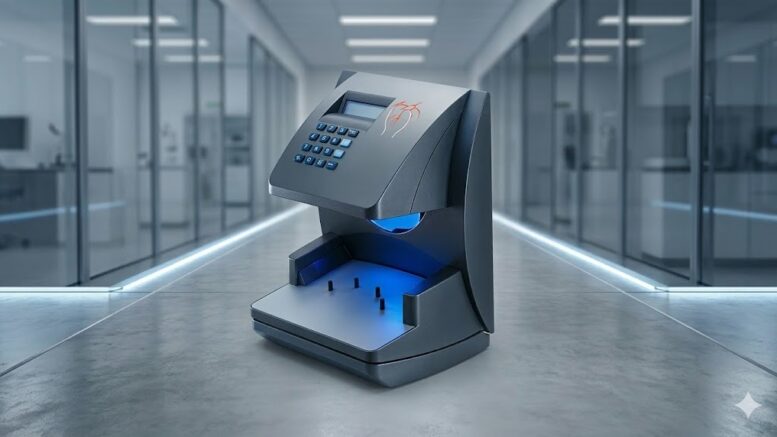
A Fingerprint Attendance System is a biometric time tracking solution that identifies employees using their registered fingerprints.
Instead of signing a paper attendance sheet or tapping a shared card, employees place their finger on the biometric reader.
The system verifies the employee and records the attendance transaction.
A typical process is:
Fingerprint → Employee Verification → Clock-In/Clock-Out → Attendance Record
The information can then be synchronised with the central attendance and HR system.
Why Multi-Location Retailers Need Centralised Attendance
A retailer with one store may be able to manage attendance relatively easily.
However, a company operating 10, 20, or 50 outlets has a much bigger challenge.
For example, a retail company may have:
- Outlet A – Johor Bahru
- Outlet B – Skudai
- Outlet C – Masai
- Outlet D – Kuala Lumpur
- Outlet E – Penang
Each outlet may have its own store manager and employees.
If every branch maintains its own spreadsheet, HR may need to collect and consolidate multiple files every month.
This creates opportunities for:
- Data Entry Errors
- Missing Attendance
- Incorrect Working Hours
- Delayed Payroll Processing
- Difficult Overtime Tracking
A centralised attendance system gives HR a single platform for monitoring employees across different locations.
How Fingerprint Attendance Works
Step 1: Register Employees
HR registers each employee’s fingerprint in the attendance system.
The fingerprint profile is associated with the employee’s HR record.
Step 2: Assign the Employee to a Location
The employee can be associated with the appropriate retail outlet or work location.
This helps management organise employees according to their assigned branch.
Step 3: Employee Clocks In
When the employee arrives at the outlet, they place their finger on the fingerprint reader.
The terminal verifies the employee and records the clock-in time.
Step 4: Employee Clocks Out
At the end of the shift, the employee records their clock-out.
The system stores the attendance transaction electronically.
Step 5: Attendance Is Synchronised
Attendance information can be transferred to the central attendance management system.
HR can then review records across different outlets.
Smart Touch’s SmartTime system supports synchronisation of attendance data and provides centralised attendance management. (smartouch.com.my)
Benefits of Fingerprint Attendance for Retailers
1. Reduce Buddy Punching
Physical attendance cards can potentially be passed between employees.
Fingerprint authentication links the attendance transaction to the employee’s registered biometric identity.
This makes it more difficult for employees to record attendance for one another.
2. No Attendance Cards to Manage
Retail businesses with many employees may need to issue and replace cards regularly.
Cards can be:
- Lost
- Forgotten
- Damaged
- Shared
Fingerprint attendance eliminates the need for employees to carry a physical attendance card for clocking in.
3. Faster Attendance Recording
Employees can record their attendance directly at the store’s biometric terminal.
This is particularly useful during busy periods when many retail employees arrive for the same shift.
4. Centralised Multi-Branch Monitoring
HR can manage attendance information from multiple retail locations through a central system.
Instead of collecting separate spreadsheets from each outlet, HR can access consolidated attendance information.
This provides management with better visibility across the retail network.
Managing Retail Shift Workers
Retail businesses rarely operate on a simple 9-to-5 schedule.
Employees may work:
- Morning Shift
- Afternoon Shift
- Evening Shift
- Weekend Shift
- Public Holiday Shift
- Rotating Shift
A suitable attendance system should therefore support different working schedules.
SmartTime supports multiple working patterns, rotation rosters, flexible hours, auto-shift assignment, and individual employee working-hour groups. (smartouch.com.my)
This makes it suitable for retailers with different outlet schedules.
Managing Overtime Across Retail Outlets
Retail employees may sometimes work beyond their scheduled hours because of:
- Stock Take
- Store Closing
- Promotional Events
- Inventory Deliveries
- Peak Shopping Periods
- Staff Shortages
A digital attendance system can record the actual clock-in and clock-out times.
HR can then review the recorded working hours and process overtime according to the company’s configured rules.
SmartTime provides configurable overtime settings covering different working scenarios and overtime limits. (smartouch.com.my)
Public Holiday Attendance
Retail stores often remain open during public holidays.
Employees may therefore work when office employees are off.
A retail attendance system should be able to distinguish between:
- Normal Working Days
- Rest Days
- Public Holidays
- Leave Days
- Scheduled Shifts
This helps HR review the correct attendance information before payroll is processed.
The final payroll treatment should always follow the applicable Malaysian employment requirements and the company’s approved policies.
Managing Employees Who Work at Different Outlets
Retail employees may occasionally be transferred between branches.
For example:
Employee A → Outlet 1
Later:
Employee A → Outlet 3
A centralised attendance system makes it easier for HR to maintain employee and location assignments.
This is particularly useful when retailers regularly move employees between branches.
Attendance and Payroll Integration
Attendance becomes even more valuable when it is connected directly to payroll.
The workflow can be:
Fingerprint Clock-In → Attendance → Working Hours → Overtime → Payroll → Payslip
Instead of manually transferring attendance information from every outlet into payroll, HR can use centralised attendance records.
Smart Touch provides payroll solutions that can be integrated with time attendance to support payroll processing for Malaysian businesses. (smartouch.com.my)
Leave and Attendance Integration
Retail businesses also need to manage annual leave, medical leave, and other employee leave.
A connected HRMS can link:
Leave Application → Approval → Attendance Calendar → Payroll
This prevents employees with approved leave from being incorrectly identified as absent.
It also gives managers better visibility into staffing levels at each outlet.
Mobile Attendance for Retail Employees
Fingerprint terminals work well for employees who regularly work at fixed retail outlets.
However, retailers may also have:
- Area Managers
- Sales Representatives
- Mobile Supervisors
- Maintenance Teams
- Regional Managers
These employees may travel between locations.
A mobile attendance solution can complement fixed fingerprint terminals for employees who need to record attendance away from their assigned outlet.
Smart Touch’s SmartGoGo mobile HR solution supports mobile attendance, GPS-based clock-in and clock-out, leave, claims, and other HR functions. (smartouch.com.my)
This allows a retailer to combine biometric attendance for store employees with mobile attendance for field-based staff.
Attendance Reports for Retail Management
A multi-location attendance system should provide useful reports rather than simply storing clock-in times.
Retail management may need to review:
- Daily Attendance
- Working Hours
- Late Arrivals
- Early Departures
- Absence
- Overtime
- Leave
- Attendance Exceptions
- Outlet Attendance
SmartTime provides multiple attendance reports, including consolidated attendance, individual attendance, lateness summaries, working-hour summaries, attendance ratios, and exception reports. (smartouch.com.my)
These reports can help HR identify attendance problems across the retail network.
How Fingerprint Attendance Helps Store Managers
Store managers can benefit from better visibility over their team’s attendance.
They can review whether employees:
- Arrived on Time
- Clocked Out
- Worked Their Scheduled Shift
- Were Absent
- Worked Overtime
This helps managers plan daily staffing more effectively.
How Fingerprint Attendance Helps HR
For HR teams, the main benefit is centralisation.
Instead of managing:
Outlet 1 Spreadsheet + Outlet 2 Spreadsheet + Outlet 3 Spreadsheet + Outlet 4 Spreadsheet
HR can work from:
One Centralised Attendance System
This reduces administrative work and makes it easier to prepare monthly payroll.
How Fingerprint Attendance Helps Payroll Teams
Payroll teams need reliable attendance information when processing salary.
A centralised attendance system provides structured records that can support:
- Working Hours
- Overtime
- Shift Allowances
- Attendance Allowances
- Leave Adjustments
- Payroll Processing
This can reduce manual calculations and data-entry mistakes.
Features to Look for in a Fingerprint Attendance System Malaysia
When choosing a Fingerprint Attendance System Malaysia for a multi-location retailer, businesses should consider:
- Fingerprint Recognition
- Facial Recognition
- RFID Attendance
- Mobile Attendance
- Multi-Branch Management
- Employee Location Assignment
- Shift Management
- Rotation Rosters
- Overtime Management
- Leave Management
- Public Holiday Configuration
- Attendance Reports
- Real-Time Synchronisation
- Payroll Integration
- Employee Self-Service
- GPS Attendance
- Cloud Deployment
- Local Installation
- Local Technical Support
The system should also be scalable enough to support additional outlets as the retailer expands.
Why Choose Smart Touch Attendance System Malaysia?
Smart Touch Technology provides integrated Time Attendance Solutions Malaysia designed for businesses managing employees across different locations.
SmartTime supports multiple attendance methods, including:
- Fingerprint
- Facial Recognition
- RFID
- Mobile Attendance
- GPS Attendance
It also supports working-hour configuration, shift management, overtime rules, attendance reports, and synchronisation with HRMS. (smartouch.com.my)
For retailers, this makes it possible to build an attendance environment that combines fixed biometric terminals with mobile attendance for employees who work across different locations.
Smart Touch’s wider HRMS ecosystem can also connect attendance with:
- Payroll
- Leave
- Overtime
- Claims
- Employee Self-Service
- Digital Payslips
This creates a more complete workforce management process.
Fingerprint Attendance vs Manual Timesheets
| Manual Timesheets | Fingerprint Attendance |
|---|---|
| Employees write attendance manually | Employees use biometric verification |
| Easy to make data-entry errors | Electronic attendance records |
| Difficult to consolidate branches | Centralised multi-location management |
| Can be manipulated | Employee identity is verified |
| Manual overtime calculations | Actual clocking records |
| HR collects spreadsheets | Centralised reporting |
| Separate payroll preparation | Can integrate with payroll |
For retailers with several outlets, the difference becomes increasingly significant as the workforce grows.
Build a Smarter Multi-Location Retail Workforce
Retail businesses need an attendance system that can keep up with changing schedules, multiple outlets, shift workers, and growing employee numbers.
A Fingerprint Attendance System for Multi-Location Retailers provides a practical way to automate employee clock-in and clock-out while maintaining centralised attendance records.
By combining fingerprint authentication with shift management, overtime tracking, leave management, mobile attendance, and payroll integration, retailers can reduce manual HR work and gain better visibility across their entire workforce.
Smart Touch Technology provides scalable attendance and HR solutions for Malaysian businesses, helping retailers move away from fragmented attendance spreadsheets toward a more connected workforce management system.
Conclusion
Managing attendance across multiple retail outlets can quickly become complicated when each branch uses separate attendance records.
A centralised Fingerprint Attendance System Malaysia allows employees to record attendance using biometric verification while HR teams can manage attendance information across multiple locations from one system.
For retailers, the benefits extend beyond clock-in and clock-out. Integration with shift management, overtime, leave, payroll, mobile attendance, and digital HR services can create a complete workforce management workflow.
Smart Touch Technology provides Malaysian businesses with integrated time attendance and HRMS solutions designed to support growing workforces and multi-location operations.
Click here to find out how the product works :https://www.smartouch.com.my/category/time-clock/biometric-fingerprint/
Smart Touch technology pte ltd , www.smartouch.com.sg +65-63964767, sales@smartouch.com.sg , www.smartouch.com.my +607-3889903 sales@smartouch.com.my