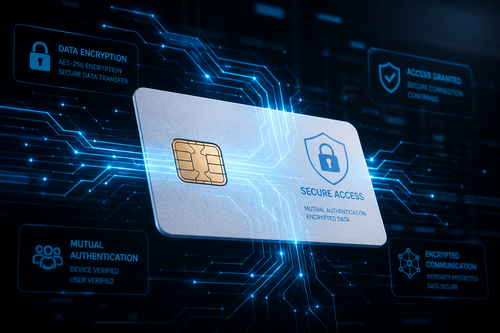
Access control is one of the most fundamental layers of building security, and the type of card technology a building uses directly affects both security strength and day-to-day convenience. Among the available options, high-frequency (HF) access cards have become a common choice for offices, condominiums, factories, and commercial buildings that need reliable, tamper-resistant entry control.
This guide explains how high-frequency access cards work, how they compare to other card technologies, and what businesses should consider when selecting a card-based access control system.
What Are High-Frequency Access Cards?
High-frequency access cards operate on the 13.56 MHz frequency band and communicate with a compatible reader over a short range, typically a few centimetres. This category includes widely used card standards such as MIFARE, which are commonly deployed in offices, condominiums, and transit systems.
Compared to low-frequency (125 kHz) cards, HF cards generally offer:
- Stronger Data Encryption
- Faster Read Speeds
- Higher Resistance to Cloning
- Support for Multiple Applications on One Card
How High-Frequency Access Cards Work
- Card Presentation — the user taps or holds the card near the reader.
- Radio Frequency Communication — the reader powers the card’s chip via electromagnetic induction and exchanges encrypted data.
- Credential Verification — the reader checks the card’s credential against the access control system’s database.
- Access Decision — if the credential is valid and permitted for that door, time, and zone, the door unlocks.
- Event Logging — the access event is recorded, including card ID, door, and timestamp.
Why High-Frequency Cards Are Preferred for Modern Buildings
- Better Security Than Low-Frequency Cards — HF cards use encrypted communication, making unauthorised duplication significantly harder than with older low-frequency cards.
- Fast Tap-and-Go Access — HF cards are read almost instantly, supporting smooth entry flow at busy building entrances.
- Multi-Application Support — a single HF card can potentially be used for door access, time attendance, and even cashless canteen payment within the same organisation.
- Compatibility with Modern Access Control Systems — most current access control platforms are designed around HF card standards as the default option.
Where High-Frequency Access Cards Are Commonly Used
- Corporate Office Entrances and Turnstiles
- Condominium and Residential Building Access
- Factory and Warehouse Employee Entrances
- Server Rooms and Restricted Areas
- Multi-Tenant Commercial Buildings
- Staff Car Park Barriers
Card Technology Comparison
| Feature | Low-Frequency (125 kHz) | High-Frequency (13.56 MHz) |
|---|---|---|
| Read Range | Short | Short to Medium |
| Data Encryption | Limited | Strong |
| Cloning Resistance | Lower | Higher |
| Read Speed | Slower | Faster |
| Multi-Application Support | Limited | Yes |
| Common Use Case | Basic door access | Offices, condos, multi-purpose access |
Choosing the Right Access Card System for a Building
Before selecting a card-based access control system, property owners and facility managers should consider:
1. Security Requirements
Higher-security zones such as server rooms or restricted floors benefit more from HF encryption than standard entrances.
2. Number of Access Points
Larger buildings with multiple doors, turnstiles, and car park barriers need a system that can centrally manage credentials across all entry points.
3. Integration Needs
Consider whether the access card should also work with time attendance, visitor management, or canteen payment systems.
4. Card Management and Issuance
A system that supports easy card issuance, deactivation, and replacement reduces administrative overhead when staff join or leave.
5. Future Scalability
Buildings expecting to add more doors, tenants, or access zones should choose a system that can scale without replacing the entire card infrastructure.
Why Choose Smart Touch Technology’s Access Control Solutions
Smart Touch Technology provides door access control systems and proximity card solutions as part of its broader security and workplace management offering across Malaysia, alongside face recognition, fingerprint, and barrier or turnstile access options. This allows building owners and facility managers to select the access method that fits each entry point — from high-traffic office doors to restricted server rooms — while managing credentials centrally.
For organisations already using Smartgogo systems such as attendance or visitor management, access control can be considered as part of the same connected environment, reducing the need to manage separate credential systems for entry, attendance, and visitor access.
Conclusion
High-frequency access cards offer a strong balance of security, speed, and flexibility for modern building entry, making them a common standard for offices, condominiums, and commercial properties across Malaysia. The right choice ultimately depends on the building’s security requirements, number of access points, and whether access control needs to integrate with other workplace systems. Smart Touch Technology helps Malaysian businesses and property owners design access control solutions suited to their actual site requirements.
Smart Touch Technology, 36-02 & 36-03, Jalan Permas 10, Bandar Baru Permas Jaya, 81750 Masai, Johor, Malaysia. +607-388 9903 / +6011-5354 9903, sales@smartouch.com.my, www.smartouch.com.my