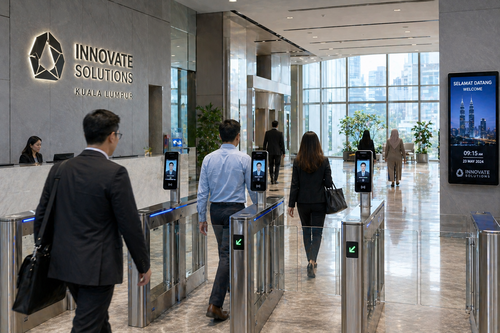
Managing attendance in schools, colleges, and universities has always been a time-consuming administrative task. From manual roll calls to printed sign-in sheets, traditional methods are prone to errors, manipulation, and inefficiencies. As Malaysian educational institutions continue to embrace digital transformation, face recognition attendance systems have emerged as a practical and reliable solution for modernising how student and staff attendance is tracked.
This article explores how face recognition attendance works, why it is well-suited for educational environments in Malaysia, and what institutions should consider when adopting this technology.
The Challenges Of Traditional Attendance Management In Schools And Universities
Educational institutions deal with large numbers of students and staff on a daily basis. Tracking attendance accurately across multiple classes, lecture halls, and departments is a logistical challenge that many schools and universities still struggle with.
Common problems associated with traditional attendance methods include:
- Proxy attendance – Students signing in on behalf of absent classmates, a practice difficult to prevent with manual systems.
- Administrative burden – Teachers and administrative staff spending significant time compiling and cross-checking attendance records.
- Data inaccuracies – Human errors in recording and transferring attendance data to central systems.
- Delayed reporting – Slow turnaround in identifying attendance trends or flagging students with poor attendance records.
- Card and PIN vulnerabilities – Swipe card or PIN-based systems can still be misused when cards are shared or forgotten.
These challenges affect institutional accountability, student performance monitoring, and overall operational efficiency. Face recognition technology directly addresses many of these pain points.
How Face Recognition Attendance Works
Face recognition attendance systems use biometric technology to identify individuals based on their unique facial features. The process is straightforward and contactless.
Enrolment
Each student or staff member is registered in the system by having their facial data captured and stored as a biometric template. This is typically done once during onboarding or registration.
Verification At Entry Or In Class
When a student or staff member approaches a face recognition terminal — whether at a gate, classroom entrance, or library — the device captures their face in real time and matches it against the stored template. The entire process takes only a fraction of a second.
Automatic Attendance Recording
Once a match is confirmed, attendance is automatically logged with a timestamp. The data is stored in a centralised system, making it available for reporting and analysis without any manual input from staff.
Reporting And Alerts
Administrators and teachers can access attendance reports through a management dashboard. Some systems also allow automated alerts to be sent to parents or guardians when a student is absent, improving communication between institutions and families.
Why Face Recognition Is Suited For Malaysian Educational Institutions
Malaysia’s educational landscape includes a diverse range of institutions — from national primary and secondary schools to private colleges and public universities. Each has its own operational structure, but all share a need for accurate, efficient attendance management.
Face recognition attendance offers several advantages that are particularly relevant to the Malaysian educational context:
- Eliminating proxy attendance – Since facial biometrics are unique to each individual, it is virtually impossible for one student to register attendance on behalf of another.
- Supporting large populations – Face recognition systems are designed to handle high volumes of users, making them suitable for institutions with hundreds or thousands of students and staff.
- Contactless operation – In line with heightened awareness of hygiene practices in recent years, contactless biometric systems reduce the need for shared surfaces.
- Reduced workload for educators – Teachers are freed from the administrative task of taking attendance manually, allowing them to focus more time on teaching.
- Accurate monitoring of student attendance – Institutions can more effectively identify students with attendance concerns and intervene early, supporting better academic outcomes.
- Integration with existing systems – Modern face recognition solutions can often be integrated with student management systems, payroll platforms, and access control infrastructure already in use.
Practical Considerations For Schools And Universities
Before implementing a face recognition attendance system, educational institutions should consider the following factors:
Data Privacy And Compliance
Biometric data is considered sensitive personal data under Malaysia’s Personal Data Protection Act (PDPA). Institutions should ensure that their chosen solution complies with applicable data protection requirements and that proper consent procedures are in place for collecting and storing facial data. It is advisable to consult with a legal or compliance advisor to ensure your institution meets current obligations, as regulations may evolve.
Infrastructure Readiness
Face recognition terminals require reliable power supply and network connectivity. Institutions should assess their existing IT infrastructure to ensure it can support the system’s requirements, particularly for campuses with multiple buildings or remote classrooms.
User Enrolment
A well-organised enrolment process is essential for system accuracy. Institutions should plan how they will collect and register facial data for students and staff, including provisions for new enrolments each academic year.
System Accuracy In Varied Conditions
Consider how the system performs in different lighting environments and whether it can accurately identify individuals wearing masks, glasses, or in different levels of natural light. Choosing a solution that is tested and proven in real-world conditions is important.
Scalability
As the institution grows, the system should be able to accommodate an increasing number of users without significant disruption or additional cost.
Comparing Attendance Methods For Educational Institutions
| Method | Proxy Attendance Risk | Administrative Effort | Accuracy | Scalability |
|---|---|---|---|---|
| Manual Roll Call | High | High | Low | Low |
| Swipe Card System | Medium | Medium | Medium | Medium |
| Fingerprint Biometric | Low | Low | High | High |
| Face Recognition | Very Low | Very Low | Very High | Very High |
How Smart Touch Technology Can Help
Smart Touch Technology provides face recognition solutions designed for organisations that require reliable, accurate, and scalable biometric attendance management. Our systems are suitable for educational institutions of varying sizes, from secondary schools to large university campuses across Malaysia.
Our face recognition attendance systems offer:
- Fast and accurate facial identification – Designed to process individuals quickly, even during peak entry times such as morning school arrivals or class transitions.
- Centralised attendance management – Attendance data is consolidated in a single platform, allowing administrators to generate reports and monitor attendance patterns with ease.
- Contactless operation – Hygienic and convenient for both students and staff without the need to carry cards or remember PINs.
- Integration capabilities – Our solutions can be integrated with access control systems and other institution management platforms to create a more connected campus environment.
- Local support in Malaysia – Smart Touch Technology operates in Malaysia, providing accessible technical support and consultation for institutions throughout the country.
Whether you are looking to upgrade an existing attendance system or implement a new solution across your institution, our team is ready to help you find the right approach for your needs.
Contact Smart Touch Technology today to speak with our consultants and learn more about how face recognition attendance can benefit your educational institution.
Conclusion
Face recognition attendance is no longer a futuristic concept — it is a practical, proven solution that is already helping organisations around the world manage their people more effectively. For Malaysian educational institutions, the technology offers a clear path to eliminating proxy attendance, reducing administrative workload, and gaining accurate, real-time visibility into student and staff attendance.
As institutions plan for the future of campus management, investing in a reliable biometric attendance system is a step that delivers both operational efficiency and meaningful improvements to the overall learning environment. With the right solution and a trusted technology partner, your institution can make the transition smoothly and confidently.