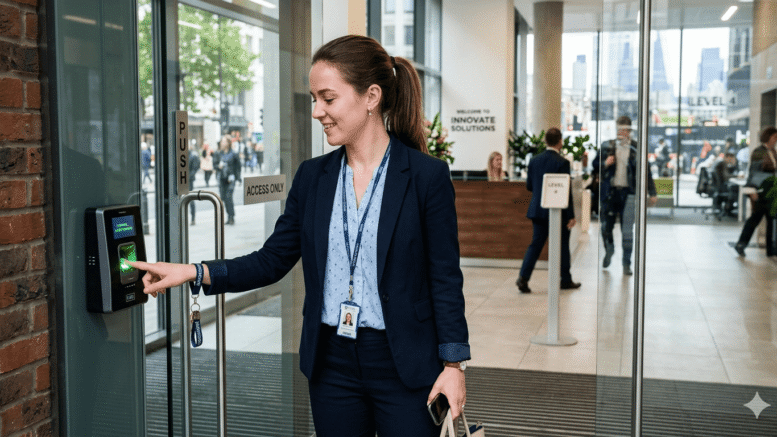
Sensitive areas require stronger protection than ordinary spaces. In many organizations, certain rooms, doors, facilities, and operational zones must be protected from unauthorized entry at all times. These areas may include server rooms, data centres, finance departments, research laboratories, document storage rooms, executive offices, control rooms, medical storage areas, production zones, warehouse inventory rooms, security offices, and restricted building facilities. When access is not controlled properly, businesses may face data loss, theft, operational disruption, safety risks, compliance issues, and serious security concerns.
High-precision fingerprint access control provides a smarter and more reliable way to secure sensitive areas. Instead of depending only on keys, PIN codes, or access cards, fingerprint access control uses biometric identification to verify a person’s unique fingerprint before granting entry. This helps ensure that only authorized individuals can access restricted zones.
For companies and property owners in Malaysia and Singapore, high-precision fingerprint access control is a practical solution for improving security, reducing unauthorized access, and strengthening accountability. It is suitable for offices, factories, warehouses, laboratories, clinics, schools, government facilities, commercial buildings, residential properties, and high-security environments where access must be carefully managed.
Why Sensitive Areas Need Stronger Access Control
Not every area in a building carries the same level of risk. A reception lobby, pantry, or general corridor may only require basic access control. However, sensitive areas contain important assets, confidential information, expensive equipment, operational systems, or safety-sensitive materials. These areas need stronger protection because unauthorized access can create major consequences.
For example, a server room may contain network equipment, backup systems, and business-critical data infrastructure. A finance office may contain payroll records, invoices, payment documents, and confidential financial files. A warehouse stockroom may contain valuable inventory. A laboratory may contain controlled equipment or sensitive research materials. A production control room may manage machinery or operational processes.
If access to these areas is controlled only by a physical key, there is always a risk that the key may be lost, copied, borrowed, or used by the wrong person. If access is controlled only by a PIN code, the code may be shared or guessed. If access depends only on a card, the card may be passed to another person or used after being stolen. Fingerprint access control helps reduce these risks by verifying the actual person, not just the item they carry or the code they know.
What Is High-Precision Fingerprint Access Control?
High-precision fingerprint access control is a biometric security system that uses fingerprint recognition to verify identity before allowing access to a protected area. Each authorized user’s fingerprint is enrolled into the system. When the user places their finger on the scanner, the system compares the live fingerprint scan with the stored template. If the identity matches and the user has permission, the door lock, turnstile, lift access, or security point is released.
The word “high-precision” is important because sensitive areas require accurate verification. A good fingerprint access control system should identify authorized users reliably while preventing unauthorized users from gaining access. It should be fast, stable, and suitable for daily operation.
Fingerprint access control may be used as a standalone system for a single door or as part of a larger access control network. It can also be integrated with time attendance, alarm systems, CCTV, visitor management, lift control, and centralized security software. For sensitive areas, integration provides stronger monitoring and better control.
Benefits of Fingerprint Access Control for Sensitive Areas
High-precision fingerprint access control offers several important benefits. The first benefit is stronger identity verification. A fingerprint is linked to the individual user, making it much harder for someone to enter by borrowing another person’s card or using a shared password.
The second benefit is improved accountability. Every successful or failed access attempt can be recorded in the system. Management can review who entered a sensitive area and when. This is useful for internal audits, incident investigations, compliance reviews, and operational monitoring.
The third benefit is convenience. Authorized users do not need to carry keys or remember passwords. They only need to use their fingerprint. This reduces the chance of lost credentials and helps daily access become faster.
The fourth benefit is better control. Administrators can assign access rights based on user roles, departments, schedules, and security levels. If an employee changes position or leaves the company, access can be updated or removed from the system.
The fifth benefit is reduced security weakness. Since fingerprints cannot be casually passed to another person like cards or keys, the organization can maintain stronger control over sensitive zones.
Protect Server Rooms and IT Facilities
Server rooms are among the most important areas in many businesses. They may contain servers, network switches, routers, storage devices, backup systems, security systems, and internet infrastructure. Unauthorized access to a server room can cause serious problems, including data exposure, system downtime, hardware damage, and business interruption.
High-precision fingerprint access control helps protect server rooms by allowing only approved IT staff and authorized management personnel to enter. Access records can show exactly who entered the room and at what time. This creates a clear audit trail and supports better IT security management.
For added protection, fingerprint access control can be combined with door sensors, CCTV cameras, motion sensors, and alarm systems. If someone tries to force the door open or access the room outside approved hours, the system can trigger alerts. This creates a stronger security layer for critical technology infrastructure.
Secure Finance and HR Departments
Finance and HR departments often handle confidential information. Finance teams manage payment records, banking details, invoices, tax documents, supplier contracts, and company financial data. HR teams manage employee records, salary information, personal details, performance documents, and employment contracts.
These departments should not be accessible to everyone in the company. High-precision fingerprint access control helps ensure that only authorized personnel can enter. This protects confidential documents and reduces the risk of information leakage.
Unlike a shared office key or access card, fingerprint access provides individual-level verification. If a finance manager enters the finance room, the system records that specific user. If someone without permission attempts to enter, the system can deny access and record the attempt. This improves internal control and supports a more professional security policy.
Control Access to Laboratories and Research Areas
Laboratories, testing rooms, research facilities, and technical rooms may contain specialized equipment, confidential research, chemicals, instruments, prototypes, or sensitive materials. Access must be controlled carefully to protect safety, intellectual property, and operational integrity.
Fingerprint access control can help laboratory managers restrict entry to trained and approved personnel. This is especially important when certain areas require safety knowledge or handling procedures. The system can also support time-based access, allowing users to enter only during approved working hours.
For research and development teams, biometric access control helps protect confidential projects. It reduces the risk of unauthorized people entering restricted areas and helps management maintain accurate access records.
Improve Warehouse and Inventory Security
Warehouses and stockrooms often contain valuable goods, spare parts, tools, electronics, documents, raw materials, finished products, and company assets. Unauthorized access can lead to inventory loss, internal theft, misplaced items, or operational disruption.
High-precision fingerprint access control helps warehouse managers protect restricted storage areas. Only approved employees can enter high-value stock zones, tool rooms, spare parts rooms, or inventory cages. Every access event can be recorded, helping management review entry history when stock discrepancies occur.
For logistics and manufacturing companies, fingerprint access control can be combined with CCTV and inventory procedures to create stronger accountability. When access records are linked with operational processes, companies can reduce risk and improve asset protection.
Protect Production and Control Rooms
Factories, manufacturing facilities, utilities, and industrial sites often have areas that must be accessed only by trained personnel. Production control rooms, machine rooms, electrical rooms, maintenance rooms, and safety equipment areas may contain systems that affect operations and employee safety.
Fingerprint access control helps prevent unauthorized or untrained personnel from entering these areas. This can reduce safety risks and protect machinery from improper use. Access permissions can be assigned according to job role, department, shift, or authorization level.
For industrial environments, a reliable access control system helps management maintain proper control over critical zones. It also supports audit requirements and internal safety procedures.
Access Control for Medical and Healthcare Facilities
Clinics, hospitals, laboratories, pharmacies, and healthcare facilities may need to protect medicine storage rooms, patient records, treatment rooms, staff areas, and equipment rooms. These spaces require controlled access because they may contain private information, medical supplies, or restricted equipment.
Fingerprint access control supports healthcare security by allowing only approved staff to enter sensitive rooms. For example, a medicine storage area can be restricted to pharmacists and authorized medical personnel. A records room can be limited to administrative staff with proper clearance.
By keeping access records, healthcare organizations can improve accountability and support safer internal management.
Multi-Factor Access for Higher Security
For highly sensitive areas, fingerprint access control can be combined with another credential method. This is known as multi-factor access. For example, a user may need to scan a fingerprint and use an access card. Another setup may require fingerprint verification and a PIN code. This creates stronger protection because access depends on more than one verification factor.
Multi-factor access is useful for server rooms, data centres, vault rooms, research labs, finance rooms, and executive offices. It reduces the chance of unauthorized access even if a card is lost or a PIN is exposed.
A professional access control provider can help determine whether single-factor fingerprint access is sufficient or whether multi-factor authentication is recommended for the site.
Real-Time Access Records and Audit Trails
One of the biggest advantages of fingerprint access control is the ability to maintain detailed access records. The system can record who entered, which door was used, and what time the event occurred. Failed access attempts can also be recorded.
These records are useful for management reviews and investigations. If a sensitive file is missing, an equipment room was accessed after hours, or a security incident occurred, administrators can check access logs to understand who entered the area during the relevant period.
Audit trails also support better internal governance. Companies can review whether access rights are still appropriate, whether former employees have been removed, and whether unusual access patterns are occurring.
Centralized Management for Multiple Doors and Locations
Many organizations have more than one sensitive area. A company may need to secure the server room, finance office, warehouse, and executive office at the same time. A factory may need to control access to production zones, store rooms, maintenance rooms, and administrative offices. A multi-branch company may need consistent security across several locations.
High-precision fingerprint access control systems can be centrally managed. Administrators can add users, remove users, assign access levels, and review records from a centralized platform. This makes it easier to maintain consistent security policies across the organization.
Centralized management is especially useful when employees change departments, resign, or require temporary access. Instead of collecting physical keys or replacing locks, administrators can update permissions in the system.
Integration with Attendance and HR Systems
Fingerprint access control can also support attendance and workforce management when integrated with HR systems. Employees may use biometric verification for both access and attendance recording, depending on company policy and system design.
This can help reduce buddy punching, where one employee clocks in for another. Since fingerprint verification identifies the actual person, attendance records become more accurate. For companies that need strong attendance control, biometric systems can be useful.
However, access control and attendance should be designed carefully. Sensitive area access should focus on security, while attendance tracking should support HR requirements. A professional solution can help configure both functions properly.
Integration with CCTV, Alarms, and Building Security
Fingerprint access control becomes more powerful when connected with other building security systems. CCTV cameras can capture video when someone enters a restricted area. Alarm systems can trigger alerts if access is attempted after hours or if a door is forced open. Door sensors can detect whether a door is left open for too long.
For example, when an authorized person enters a server room, the access event can be recorded and CCTV footage can support visual verification. If someone tries to force the door, the alarm can notify security personnel. If a door remains open too long, the system can send an alert.
This integrated approach creates a more complete security environment. It helps organizations detect, verify, and respond to security events more effectively.
User-Friendly Access for Authorized Employees
Security should be strong, but it should also be practical. Employees who are authorized to enter sensitive areas need a system that works quickly and reliably. A high-precision fingerprint access control system should verify users in seconds and allow smooth daily operation.
Fast verification is important for busy environments. IT staff may need to enter the server room several times a day. Warehouse supervisors may need quick access to stockrooms. Finance employees may need regular access to document rooms. If the system is slow or unreliable, users may become frustrated.
A quality fingerprint system should balance security with convenience. It should provide accurate recognition, stable operation, and an easy user experience.
Reducing Dependence on Keys and Cards
Traditional keys create security challenges. Keys can be lost, copied, or kept by former employees. When a key is missing, companies may need to change locks, which can be costly and inconvenient. Access cards are more flexible than keys, but they can still be lost, shared, or used by someone else.
Fingerprint access control reduces dependence on physical credentials. Since the user’s fingerprint is used for verification, there is no need to carry a key for every restricted room. This reduces the risk of lost keys and shared cards.
For sensitive areas, reducing credential sharing is especially important. The system should confirm that the person entering is truly authorized. Fingerprint access control provides this extra layer of assurance.
Important Considerations Before Installation
Before installing fingerprint access control, organizations should assess their security needs carefully. The first step is to identify which areas require biometric protection. Not every door needs fingerprint access. The system should be applied where stronger identity verification is necessary.
The second step is to define user access levels. Management should decide who can enter each sensitive area, during what hours, and under what conditions. Access rights should be based on job role and actual operational needs.
The third step is to choose suitable hardware. Fingerprint devices should be reliable, durable, and appropriate for the environment. Indoor offices, factories, warehouses, and outdoor areas may have different installation requirements.
The fourth step is data protection. Biometric systems should be managed responsibly, with proper access controls and secure handling of user data. Only authorized administrators should manage fingerprint enrollment and access permissions.
The fifth step is training. Employees should understand how to use the system, how access rights are managed, and who to contact if they experience issues.
Maintaining a Fingerprint Access Control System
A fingerprint access control system should be maintained regularly to ensure reliable performance. Devices should be cleaned according to proper guidelines, especially if used frequently. Door locks, power supply, network connections, and backup systems should also be checked.
User records should be reviewed periodically. Former employees should be removed. Employees who changed roles should have their access rights updated. Temporary access should be cancelled when no longer needed.
Regular maintenance helps prevent operational problems and keeps the access control system secure. A system that is not maintained properly may lose effectiveness over time.
Why Professional Installation Matters
Fingerprint access control is a security investment. Professional installation is important because the system must be correctly positioned, wired, configured, tested, and integrated with door hardware. Poor installation may lead to unreliable access, weak door security, false rejection, or system downtime.
A professional provider can assess the site, recommend suitable devices, install electric locks or magnetic locks, configure access levels, test the system, train administrators, and provide after-sales support. This ensures that the system works properly and meets the organization’s security needs.
For sensitive areas, professional installation is especially important. The goal is not only to install a device on the wall. The goal is to create a reliable access control process that protects the area every day.
Smart Touch Fingerprint Access Control Solutions
Smart Touch provides practical access control and smart building technology solutions for businesses and properties in Malaysia and Singapore. Our high-precision fingerprint access control systems help organizations secure sensitive areas with stronger identity verification, better accountability, and improved access management.
Smart Touch solutions can be used for server rooms, finance offices, HR departments, warehouses, factories, laboratories, clinics, schools, commercial buildings, condominiums, and restricted facilities. Depending on the requirement, the system can support fingerprint access, card access, PIN access, multi-factor access, centralized management, attendance integration, CCTV integration, alarm integration, lift access, turnstile control, and car park access systems.
With professional consultation, installation, configuration, and support, Smart Touch helps companies move from basic door control to a more secure and intelligent access control environment.
Secure Sensitive Areas with Confidence
Sensitive areas need more than ordinary locks and basic access cards. They require strong identity verification, accurate access records, flexible permission control, and reliable security performance. High-precision fingerprint access control gives organizations a practical and professional way to protect critical rooms and restricted zones.
By verifying the actual person before granting access, fingerprint technology reduces the risk of shared credentials, lost cards, copied keys, and unauthorized entry. It helps protect confidential information, valuable assets, operational systems, and safety-sensitive areas.
For companies and property managers in Malaysia and Singapore, high-precision fingerprint access control is a smart investment in better security and stronger accountability. With the right system, proper installation, and professional support, organizations can secure sensitive areas more effectively while giving authorized users fast and convenient access.
For more information about the product, please click here: https://www.smartouch.com.my/category/time-clock/biometric-fingerprint/
Smart Touch technology pte ltd , www.smartouch.com.sg +65-63964767, sales@smartouch.com.sg , www.smartouch.com.my +607-3889903 sales@smartouch.com.my