Professional project management depends on one essential truth: a project is only truly under control when its cost, progress, resources, and profitability can be seen clearly. Many companies work hard to win projects, assign teams, purchase materials, manage subcontractors, track labour hours, and meet deadlines. However, without accurate and timely cost visibility, even a busy project can become unprofitable before management realises what has happened.
This is why real-time job costing reports have become an important tool for modern project-based businesses. They help project managers, finance teams, business owners, and department heads understand exactly how much a job is costing while the work is still in progress. Instead of waiting until the end of the month or the end of the project to discover overspending, companies can monitor costs as they happen and take action earlier.
For businesses in construction, engineering, renovation, manufacturing, installation, maintenance, field service, IT projects, event management, professional services, and contract-based work, real-time job costing is no longer just a reporting feature. It is a practical management advantage.
What Are Real-Time Job Costing Reports?
Real-time job costing reports are digital reports that show the latest cost information for each project, job, contract, work order, or cost centre. These reports collect and organise cost data such as labour, materials, equipment, subcontractor fees, claims, overtime, transport, purchases, overhead allocation, and other project-related expenses.
The goal is simple: to help management compare actual costs against budgets, estimates, quotations, and expected profit margins.
A basic project report may show whether a job is completed or still ongoing. A real-time job costing report goes further. It shows how much has already been spent, which cost categories are increasing, whether the project is within budget, and how much margin remains.
This gives project teams the information they need to manage costs before problems become serious.
Why Job Costing Matters in Project Management
Every project has a financial story. A company may quote a customer RM100,000 for a project, but the final profit depends on how well costs are controlled. If labour hours increase, materials become more expensive, subcontractor charges exceed expectations, or rework happens, the profit margin can shrink quickly.
Without job costing, management may only see total sales revenue. That is not enough. A project with high revenue can still produce low profit or even a loss if costs are not monitored properly.
Job costing helps answer important questions:
How much labour has been spent on this project?
Are material costs higher than planned?
Is the project still profitable?
Which job is consuming too many resources?
Which department or team is performing efficiently?
Which customer projects produce the best margins?
These questions are essential for professional project management. Real-time reporting makes the answers available faster.
The Problem with Delayed Cost Reports
Many companies still depend on manual reports, spreadsheets, paper timesheets, delayed invoices, and month-end accounting summaries. This creates a common problem: management receives project cost information too late.
By the time the finance team completes the monthly report, the project may already be over budget. By the time supplier invoices are entered, the project manager may have already approved more purchases. By the time labour hours are calculated, the team may have already spent excessive overtime.
Delayed reporting creates delayed decisions. Delayed decisions create avoidable losses.
Real-time job costing reports reduce this risk by updating cost information more quickly. When project managers can see current costs during the project, they can adjust manpower, review purchases, control overtime, renegotiate scope, or improve scheduling before the damage becomes too large.
Better Budget Control for Every Project
A professional project manager must always know whether the project is within budget. Real-time job costing reports provide this visibility by comparing budgeted costs with actual costs.
For example, a project budget may allocate RM30,000 for labour, RM40,000 for materials, RM15,000 for subcontractors, and RM5,000 for transport and other expenses. A real-time report can show how much has already been used in each category.
If labour costs reach 80% of the budget when the project is only halfway completed, management can investigate immediately. If material costs exceed the estimate, purchasing teams can review supplier pricing or usage. If subcontractor costs are rising, project managers can check whether the scope has changed.
This level of control helps companies protect profitability and reduce unexpected losses.
Real-Time Labour Cost Tracking
Labour is one of the most important cost components in many projects. Employees may work on different jobs, different sites, different customers, or different tasks. If their hours are not tracked accurately, job costing becomes unreliable.
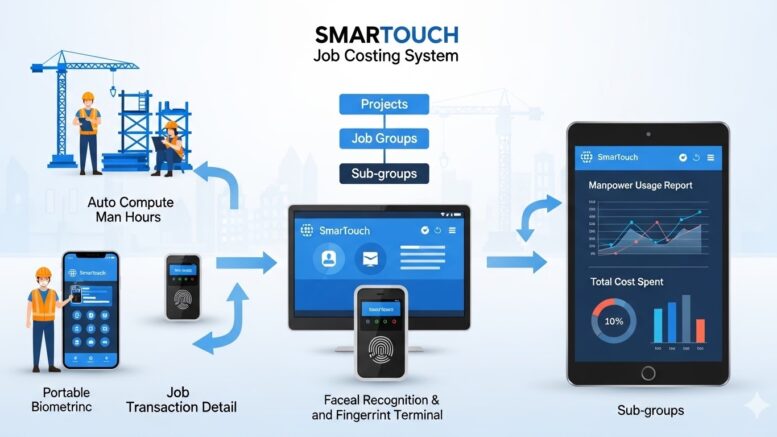
Real-time job costing reports can connect employee attendance, timesheets, overtime, job assignments, and payroll data to specific projects. This allows management to see how many hours were spent on each job and how much those hours cost.
For companies with field teams, technicians, installers, site workers, consultants, or service staff, this is extremely valuable. Labour cost visibility helps management understand productivity, manpower utilisation, and project efficiency.
It also helps identify jobs that require too much time compared with the original estimate.
Material and Purchase Cost Visibility
Materials can significantly affect project profitability. Prices may change, usage may exceed estimates, wastage may occur, or urgent purchases may increase cost.
Real-time job costing reports help track material costs by project. When purchase orders, goods received notes, supplier invoices, or stock issues are linked to a job, management can see the true material cost of each project.
This prevents the common problem of treating material purchases as general expenses without understanding which project consumed them. Accurate material costing helps companies quote future jobs more realistically and manage inventory more responsibly.
For construction, renovation, engineering, manufacturing, and installation businesses, this visibility can make a major difference.
Subcontractor and External Service Cost Control
Many projects involve subcontractors, freelancers, consultants, transport providers, equipment rental companies, and specialist service providers. These costs must be tracked carefully because they can grow quickly if project scope changes or if work is not monitored.
A real-time job costing system can record subcontractor commitments, progress claims, invoices, and approved payments under the correct project. This helps management compare subcontractor cost against the agreed budget.
If subcontractor charges are higher than expected, management can review the contract, verify work completion, and check whether variations were approved.
This creates stronger financial control and better accountability.
Monitoring Project Profitability While Work Is Still Ongoing
One of the most powerful benefits of real-time job costing reports is the ability to monitor profitability before a project is completed.
Traditional accounting may only reveal profit after all invoices and expenses are processed. By then, management can only learn from the result. Real-time job costing allows management to influence the result while there is still time.
A project profitability report may show contract value, budgeted cost, actual cost, committed cost, invoiced amount, outstanding cost, and estimated margin. With this information, project managers can make smarter decisions.
If profit margin is falling, management can reduce unnecessary spending, improve work planning, control rework, or discuss variation claims with the customer.
Better Decision-Making for Business Owners
Business owners need accurate information to make confident decisions. Without real-time job costing, they may depend on rough estimates, verbal updates, or delayed accounting reports.
Real-time job costing reports provide a clearer view of business performance. Owners can see which projects are profitable, which projects are risky, which teams are efficient, and which customers require more resources than expected.
This supports better decisions on pricing, project selection, resource allocation, staffing, procurement, and business strategy.
A company should not only ask, “How much sales did we make?” It should also ask, “Which jobs actually made money?”
Reducing Cost Overruns and Project Losses
Cost overruns are one of the biggest risks in project management. They may happen because of poor estimation, weak monitoring, scope changes, excessive overtime, material wastage, supplier price increases, rework, poor scheduling, or incomplete records.
Real-time job costing reports help reduce overruns by making cost movement visible. When cost increases are noticed early, project managers can investigate the cause and respond quickly.
This does not eliminate every project risk, but it gives management a stronger chance to control the outcome. Visibility is the first step toward control.
Improving Quotation Accuracy for Future Projects
Accurate job costing does not only help current projects. It also improves future quotations.
When companies know the true cost of past projects, they can prepare better estimates for new jobs. They can identify realistic labour hours, material usage, subcontractor costs, overhead allocation, and margin requirements.
This prevents underquoting, which is a common reason for poor profitability. It also helps sales teams quote with more confidence.
A good job costing report becomes a learning tool. Every completed project provides data that can improve the next project.
Connecting Project Management with Accounting
Project teams and finance teams often look at work from different angles. Project managers focus on progress, deadlines, resources, and customer requirements. Finance teams focus on cost, billing, cash flow, and profitability.
Real-time job costing reports help connect these two perspectives. When project information and financial information are linked, both teams can work from the same data.
This reduces misunderstanding and improves coordination. Project managers can see the financial impact of their decisions. Finance teams can understand project status more clearly. Management can make decisions based on complete information.
Better Control Over Work-in-Progress
Work-in-progress is important for project-based companies. If projects continue for weeks or months, costs may build up before final billing is completed. Without proper tracking, management may not understand how much money is tied up in ongoing work.
Real-time job costing reports show the cost status of active projects. This helps management monitor work-in-progress, billing progress, and cash flow impact.
For companies that handle long-term contracts, staged payments, progress claims, or milestone billing, this visibility is especially important.
Supporting Project Accountability
A professional project management environment requires accountability. Each project should have clear budgets, assigned managers, approved expenses, recorded labour hours, and measurable outcomes.
Real-time job costing reports support accountability by showing what has been spent and where. When project managers can see their cost performance, they can take ownership of the financial result.
This encourages better planning, more careful approvals, and stronger cost discipline.
It also helps senior management review performance fairly based on actual data.
Job Costing for Different Industries
Real-time job costing reports are useful across many industries.
In construction and renovation, they help track labour, materials, machinery, subcontractors, and site expenses.
In engineering and installation, they help monitor project hours, equipment, travel, and technical service costs.
In manufacturing, they help calculate production job costs, material usage, labour hours, and overhead.
In maintenance and field service, they help measure technician time, spare parts, transport, and customer service profitability.
In professional services, they help track consultant hours, project deliverables, billable time, and margin.
In event management, they help control venue, manpower, logistics, materials, supplier, and setup costs.
Any company that works by project, job, order, contract, or assignment can benefit from real-time job costing.
Why Spreadsheets Are Not Enough for Professional Job Costing
Spreadsheets are common because they are flexible and familiar. However, they are not always reliable for real-time job costing.
Spreadsheets often depend on manual updates. They may contain formula errors. They may not reflect the latest purchases, attendance records, payroll costs, or invoices. Different departments may maintain different versions of the same report.
As the number of projects increases, spreadsheet control becomes difficult. Management may spend more time checking data than making decisions.
A proper job costing system provides a more structured and reliable approach. It helps standardise data, reduce manual entry, and generate reports more quickly.
Key Features of a Strong Real-Time Job Costing System
A good real-time job costing solution should support project setup, budget allocation, labour costing, material costing, purchase tracking, subcontractor cost tracking, expense claims, overhead allocation, progress billing, and profitability reporting.
It should allow project managers to view current cost status easily. It should help finance teams reconcile expenses accurately. It should provide management with summary reports and detailed drill-down information.
The system should also be user-friendly. A complicated system that employees avoid using will not provide accurate data. The best solution is one that supports real business workflows and makes reporting easier, not harder.
Smart Touch Solutions for Real-Time Job Costing and Project Management
Smart Touch provides practical business software solutions designed to help companies improve project management, job costing, payroll, attendance, HR, billing, and operational control.
With Smart Touch solutions, companies can connect important business data and generate clearer reports for better decision-making. For project-based businesses, this means stronger visibility over labour costs, project expenses, employee time, job progress, and profitability.
Smart Touch helps businesses move away from scattered spreadsheets and manual reports toward a more organised digital workflow. By using real-time job costing reports, companies can manage projects more professionally, control costs earlier, and improve long-term profitability.
Building a More Profitable Project-Based Business
Professional project management is not only about completing work. It is about completing work on time, within budget, and with a healthy profit margin.
Real-time job costing reports give companies the visibility needed to manage projects with confidence. They help project managers detect cost problems early, help finance teams maintain accurate records, help business owners understand profitability, and help teams improve future planning.
Companies that invest in real-time job costing can make faster decisions, reduce waste, improve quotations, control labour costs, and protect project margins.
In today’s competitive market, businesses cannot afford to manage project costs blindly. Real-time job costing reports provide the clarity needed to build a stronger, smarter, and more profitable organisation.
Need more information about the product? Click here: http://www.smartouch.com.my/job-costing/
Smart Touch technology pte ltd , www.smartouch.com.sg +65-63964767, sales@smartouch.com.sg , www.smartouch.com.my +607-3889903 sales@smartouch.com.my