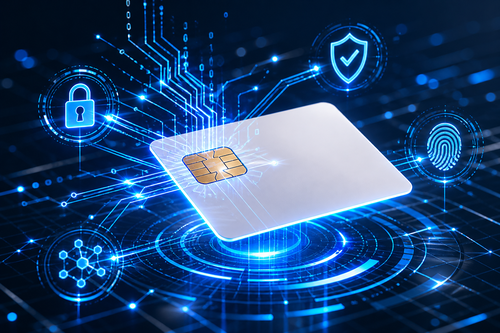
RFID (Radio-Frequency Identification) access cards are one of the most widely used door access control technologies in Malaysia and around the world. They offer a fast, convenient, and secure way to manage entry and exit in offices, factories, hospitals, data centres, and residential properties.
How Does an RFID Access Card Work?
An RFID access card contains a microchip and an antenna embedded within the card. When held near an RFID reader, the reader emits a radio frequency signal that powers the chip and reads the unique ID stored within it. The access control system verifies whether this ID is authorised to access the specific door, and if so, triggers the door lock to open.
Types of RFID Access Cards
There are several types of RFID cards commonly used for door access. Low-Frequency (LF) cards (125 kHz) such as EM4100 and HID Prox are widely used in older systems and offer moderate security. High-Frequency (HF) cards (13.56 MHz) such as Mifare Classic, Mifare DESFire, and HID iCLASS offer higher security with encryption. Ultra-High-Frequency (UHF) cards are used for long-range access applications.
Key Benefits of RFID Access Cards
- Keyless and Convenient
- RFID cards eliminate the need for traditional keys. Employees simply tap or wave their card near the reader for instant access. This is more convenient and faster than fumbling with physical keys.
2. Centralised Access Management
Access rights for all cardholders can be managed from a central software system. Administrators can grant, modify, or revoke access for individual cards without physically changing locks.
3. Audit Trail and Reporting
Every card transaction is logged with a timestamp and door location. This creates a complete audit trail of who entered or exited which area and when, which is invaluable for security investigations and compliance reporting.
4. Easy Card Replacement
If a card is lost or stolen, it can be deactivated immediately in the system. A replacement card with new credentials can be issued without the expense or downtime of changing physical locks.
5. Multi-Application Capability
Modern RFID cards can serve multiple functions on a single card: door access, time attendance, canteen management, car park access, and even cashless payments within a facility.
RFID Card Duplication and Security Concerns
One concern with basic RFID cards is the potential for card duplication with cheap cloning devices. For high-security applications, organisations should use encrypted RFID cards such as Mifare DESFire which use mutual authentication and rolling codes to prevent cloning.
Conclusion
RFID access cards remain the preferred door access solution for organisations in Malaysia due to their convenience, scalability, and integration capabilities. Whether for a small office or a large enterprise campus, the right RFID card system delivers reliable, secure, and manageable access control.
For more information about the product, please click here: https://www.smartouch.com.my/access-card-duplication/
Smart Touch technology pte ltd , www.smartouch.com.sg +65-63964767, sales@smartouch.com.sg , www.smartouch.com.my +607-3889903 sales@smartouch.com.my