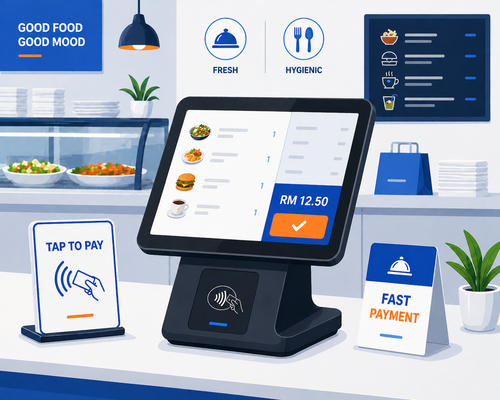
Running a food court in Malaysia is no small feat. Whether you’re managing a bustling hawker-style center in Kuala Lumpur, a modern food hall in Johor Bahru, or a suburban food court in Penang, the challenges are real — long queues, multiple stalls, cashflow tracking, and keeping customers happy all at once. That’s where a reliable food court POS system in Malaysia becomes an absolute game-changer.
The food and beverage (F&B) industry in Malaysia is thriving, with food courts remaining one of the most popular dining formats across the country. From corporate office complexes to shopping malls and community hubs, food courts serve thousands of hungry customers daily. Managing this kind of volume without the right technology can lead to errors, revenue leakages, and frustrated customers.
A point-of-sale (POS) system designed specifically for food courts does much more than just process payments. It streamlines operations, tracks sales across multiple stalls, manages inventory, and generates reports that help business owners make smarter decisions. In short, it’s the backbone of a well-run food court operation.
In this comprehensive guide, we’ll walk you through everything you need to know about food court POS systems in Malaysia — from what they are and why you need one, to key features, top benefits, and how to choose the right solution for your business. Let’s dive in!
What Is a Food Court POS System?
A food court POS system is a specialized point-of-sale software and hardware solution designed to handle the unique operational needs of a food court environment. Unlike a standard retail POS, a food court POS is built to manage multiple vendors or stalls under one roof, with centralized billing, payment collection, and reporting.
In a typical food court setup in Malaysia, you might have 10 to 30 different stalls — each selling different types of food. Customers browse, order from various stalls, and may settle their bill at a central cashier counter or through a self-order kiosk. A food court POS system ties all of this together seamlessly.
Key components of a food court POS system typically include:
- Central cashier terminal — where all payments are collected
- Stall terminals or tablets — for individual vendor order management
- Kitchen Display Systems (KDS) — to relay orders to the kitchen
- Self-order kiosks — for customer-facing ordering
- Cloud-based backend dashboard — for owners to monitor all stalls remotely
- Receipt printers and cash drawers — for transaction management
Why Malaysian Food Courts Need a Modern POS System
Malaysia’s food court scene is unique. Customers expect speed, variety, and convenience. Many food courts still rely on manual ordering systems or outdated cash registers, which simply can’t keep up with today’s demands. Here’s why upgrading to a modern food court POS system in Malaysia is essential:
- High transaction volume: Food courts handle hundreds or thousands of transactions daily. A modern POS processes these quickly and accurately.
- Multiple stall management: Managing revenue across 10–30 stalls manually is error-prone. A POS automates this entirely.
- Cashless payment adoption: Malaysians increasingly use e-wallets like Touch ‘n Go, GrabPay, Boost, and DuitNow QR. A modern POS supports all of these.
- GST/SST compliance: Malaysian F&B operators need accurate tax reporting. A good POS system handles this automatically.
- Tenant revenue settlement: Food court operators need to split and settle revenue among individual stall tenants accurately and fairly.
- Real-time reporting: Business owners want to know which stalls are performing best — at any time, from anywhere.
Key Features to Look for in a Food Court POS System
Not all POS systems are created equal. When evaluating a food court POS system for your Malaysian business, here are the most important features to prioritize:
Multi-Stall Management
The system should allow you to manage multiple stalls independently while consolidating all data at the food court operator level. Each stall should have its own menu, pricing, and sales tracking.
Centralized Payment Collection
A central cashier system that collects payment on behalf of all stalls and then settles revenue with each tenant is a hallmark of a proper food court POS. This reduces cash handling risks and simplifies accounting.
Multiple Payment Methods
Your POS must support:
- Cash payments
- Credit and debit cards
- QR code payments (DuitNow, WeChat Pay, Alipay)
- E-wallets (Touch ‘n Go eWallet, GrabPay, Boost)
- Prepaid food court cards or RFID tokens
Real-Time Sales Reporting
Cloud-based dashboards allow food court owners to monitor stall performance, peak hours, and top-selling items in real time — even remotely via smartphone.
Inventory Management
Track ingredients and stock levels per stall to minimize waste and prevent stockouts during peak hours.
Tenant Revenue Splitting
Automatically calculate each stall’s earnings after commission or service charges — reducing disputes and saving time on manual calculations.
Kitchen Display System (KDS) Integration
Orders placed at the counter or kiosk are instantly displayed at the relevant stall’s kitchen screen, speeding up food preparation and reducing miscommunication.
Benefits of Implementing a Food Court POS System in Malaysia
Investing in the right POS system delivers measurable returns for food court operators. Here’s a breakdown of the core benefits:
| Benefit | Impact on Business |
|---|---|
| Faster order processing | Reduced queue times, higher customer satisfaction |
| Accurate revenue tracking | Eliminates revenue leakage and manual errors |
| Cashless payment support | Appeals to modern Malaysian consumers |
| Automated tenant settlement | Saves hours of manual calculation per week |
| Cloud-based reporting | Anytime, anywhere access to business data |
| Inventory control | Reduces waste and over-ordering costs |
| SST/tax compliance | Simplifies tax filing and audits |
| Scalability | Easily add new stalls or locations |
Types of Food Court POS Systems Available in Malaysia
Malaysian food court operators can choose from several types of POS setups depending on their size, budget, and operational model:
1. Traditional Counter-Based POS
This involves fixed terminals at a central cashier counter. It’s reliable, robust, and ideal for large food courts with high transaction volumes. Staff operate the terminals and manage all billing on behalf of customers.
2. Tablet-Based POS
Affordable and flexible, tablet POS systems are popular among smaller food courts and food halls. They’re easy to use, mobile, and often cloud-connected for remote management.
3. Self-Order Kiosk Systems
Self-order kiosks allow customers to browse menus, place orders, and pay — all without staff assistance. This reduces labor costs and speeds up the ordering process. They’re growing in popularity in Malaysian shopping malls and corporate food courts.
4. QR Code Ordering Systems
Customers scan a QR code at their table, browse the menu on their phone, and place orders directly. This contactless approach became widely popular post-COVID and remains a preferred option for many modern food courts in Malaysia.
5. Hybrid Systems
Many food courts combine multiple approaches — for example, using counter POS for peak hours alongside self-order kiosks and QR ordering for table service. The best food court POS systems in Malaysia are flexible enough to support all these modes.
How to Choose the Right Food Court POS System in Malaysia
With so many options available, choosing the right system can be overwhelming. Here’s a practical checklist to guide your decision:
- Assess your stall count: How many stalls do you manage? Ensure the system can scale accordingly.
- Check local payment integrations: Verify that the POS supports Malaysian e-wallets and QR payment standards.
- Look for local support: Choose a vendor with a strong local presence and after-sales support in Malaysia.
- Evaluate reporting capabilities: Can you access reports remotely? Are the dashboards intuitive?
- Ask about SST compliance: Ensure the system is compliant with Malaysian tax regulations.
- Request a demo: Always test the system before committing. A reputable vendor will offer a live demonstration.
- Consider total cost of ownership: Factor in hardware, software licenses, setup fees, and ongoing support costs.
- Check integration capabilities: Can it integrate with accounting software, loyalty programs, or delivery platforms?
Common Challenges Solved by a Food Court POS System
Many food court operators in Malaysia face operational challenges that a good POS system directly addresses. Here are some real-world problems and how POS technology solves them:
- Long queues during lunch rush: Self-order kiosks and faster payment processing reduce wait times significantly.
- Cash handling discrepancies: Centralized cashless payment systems eliminate cash theft and counting errors.
- Tenant disputes over revenue: Automated settlement reports provide transparent, auditable data for all parties.
- Menu updates across stalls: Cloud-based POS allows instant menu changes across all terminals simultaneously.
- No visibility into performance: Real-time dashboards give operators instant insight into which stalls and items are performing best.
- Staff turnover and training issues: Modern POS systems are designed to be intuitive, making staff training quick and easy.
Frequently Asked Questions (FAQ)
What is the best POS system for a food court in Malaysia?
The best food court POS system in Malaysia is one that supports multi-stall management, cashless payments (including Malaysian e-wallets), real-time reporting, and local after-sales support. Solutions from established vendors with a proven track record in the Malaysian F&B industry are generally the safest choice.
How much does a food court POS system cost in Malaysia?
Pricing varies depending on the number of terminals, features, and vendor. Basic setups may start from a few thousand ringgit, while comprehensive multi-stall systems for larger food courts can range from RM10,000 to RM50,000 or more, including hardware. Many vendors also offer monthly subscription plans for the software component.
Do food court POS systems support e-wallet payments in Malaysia?
Yes. Modern food court POS systems in Malaysia are designed to support popular e-wallets such as Touch ‘n Go eWallet, GrabPay, Boost, and DuitNow QR, as well as credit/debit card payments via integrated payment terminals.
Can a POS system manage multiple food stalls separately?
Absolutely. This is one of the core functions of a food court POS system. Each stall can have its own menu and pricing, while the central system tracks revenue separately and provides individual settlement reports for each tenant.
Is a food court POS system suitable for hawker centers in Malaysia?
Yes. While hawker centers tend to be more casual in setup, modern POS solutions offer scalable, affordable options suitable for both upscale food courts and traditional hawker-style environments. Tablet-based and QR ordering systems are particularly popular for hawker center digitalization in Malaysia.
How long does it take to set up a food court POS system?
Setup timelines depend on the size and complexity of the food court. A straightforward setup for a 10-stall food court can typically be completed within 1 to 3 days, including hardware installation, software configuration, menu input, and staff training.
Conclusion: Upgrade Your Food Court Operations Today
The Malaysian food court industry is evolving rapidly. Customer expectations are higher, competition is fiercer, and operational efficiency is no longer optional — it’s essential. A robust food court POS system in Malaysia is one of the smartest investments you can make for your business.
From managing multiple stalls and processing cashless payments to generating real-time reports and automating tenant settlements, a modern POS system transforms how you run your food court. It saves time, reduces errors, increases transparency, and ultimately helps you grow your business with confidence.
Whether you’re setting up a brand new food court or looking to upgrade your existing system, now is the perfect time to explore your options. Look for a vendor with strong local expertise, proven technology, and reliable after-sales support in Malaysia. The right POS system won’t just manage your transactions — it will power your entire operation.
Don’t let outdated systems hold your food court back. Embrace smart technology, delight your customers, and take full control of your business with a purpose-built food court POS system.
Get in Touch with Our Food Court POS Experts
Ready to find the perfect food court POS system for your Malaysian business? Our team of F&B technology specialists is here to help you evaluate your needs, recommend the right solution, and support you every step of the way — from installation to ongoing maintenance. Contact us today for a free consultation and live demo tailored to your food court’s unique requirements.
You can read more about our compliance features by https://www.smartouch.com.my/canteen-management-system-2/.
Smart Touch technology pte ltd , www.smartouch.com.sg +65-63964767, sales@smartouch.com.sg , www.smartouch.com.my +607-3889903 sales@smartouch.com.my