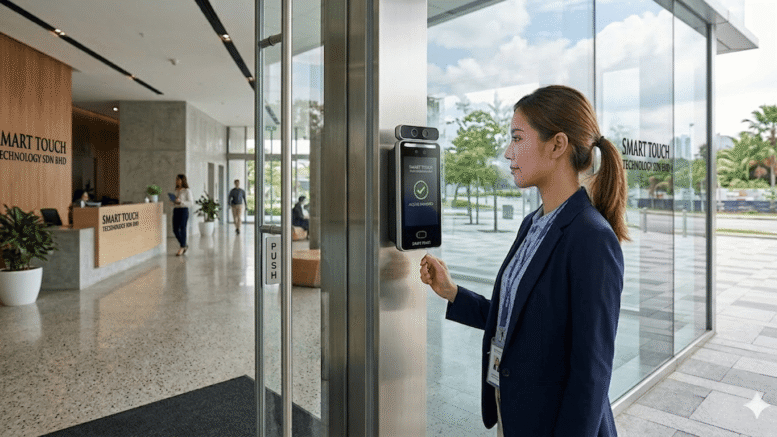
Security expectations in Malaysian workplaces, commercial buildings, and residential complexes have risen sharply over the past decade. Traditional keys can be copied, access cards can be lost, and PINs can be shared — but a human face is unique, non-transferable, and impossible to forget. Face recognition door access systems are now one of the most sought-after security solutions in Malaysia, delivering contactless, highly accurate identity verification at every entry point.
This article explains how face recognition door access systems work, what makes them valuable for Malaysian organisations, and what you should look for when selecting the right solution for your premises.
How Face Recognition Door Access Works
A face recognition door access system uses a camera and embedded artificial intelligence to capture and analyse a person’s facial geometry. When an enrolled user stands in front of the device, the system extracts unique facial landmarks — the distance between the eyes, the shape of the jaw, the depth of the nose bridge — and converts them into a mathematical template. This template is compared against the stored database in milliseconds. If the match confidence exceeds a set threshold, the door unlocks.
Modern systems use liveness detection (also called anti-spoofing technology) to prevent someone from using a photograph or a video on a phone screen to trick the camera. Infrared sensors and 3D depth mapping ensure the system only accepts a live, physically present face.
Key Benefits of Face Recognition Door Access in Malaysia
Contactless and Hygienic
Face recognition requires no physical contact with a reader. This is especially relevant in high-traffic environments such as factories, clinics, food production facilities, and shared office buildings where hygiene is a priority. Users simply walk up to the device — no tapping, no swiping, no touching.
Eliminates Card and Key Management
Issuing, tracking, and deactivating access cards is a significant administrative burden, particularly for organisations with high staff turnover. Face recognition removes this overhead entirely. Enrolment takes under a minute per person, and revoking access is as simple as deleting a record from the management software — there is nothing physical to retrieve.
Accurate Attendance Records
In Malaysian workplaces where the Employment Act 1955 requires accurate record-keeping of working hours, face recognition systems provide a tamper-proof attendance log. Because the credential is biometric, buddy punching — where one employee clocks in on behalf of another — is eliminated. The data integrates directly with HR and payroll software, reducing errors and saving administrative time.
Fast Throughput
High-performance face recognition devices can process a verification in under one second, making them suitable for high-traffic entry points such as factory gates or office lobby turnstiles where queues must be minimised during peak hours.
Face Recognition vs Other Biometric Technologies
| Technology | Contact Required | Speed | Spoofing Risk | Best Use Case |
|---|---|---|---|---|
| Face Recognition | No | Very Fast (<1 sec) | Low (with liveness) | Offices, factories, lobbies |
| Fingerprint | Yes | Fast | Low | General access, attendance |
| Palm Vein | Near-contact | Fast | Very Low | High-security, clean rooms |
| Iris Scan | No | Moderate | Very Low | Very high-security areas |
| Card/Fob | Near-contact | Fast | Medium | General access |
What to Look for in a Face Recognition System
Recognition Accuracy and Liveness Detection
Look for a system with a false acceptance rate (FAR) below 0.0001% and a false rejection rate (FRR) below 1%. Confirm that the device uses active or passive liveness detection and that it has been tested against presentation attacks including printed photos, screen replays, and 3D masks.
Performance in Variable Lighting and Mask Conditions
Malaysian buildings range from brightly lit lobbies to dimly lit car park entrances. The device should perform reliably across a wide range of ambient light conditions. If your workforce wears face masks or other PPE, check whether the system supports mask recognition — many modern units can identify users even with a mask covering the lower half of the face.
Database Capacity and Matching Speed
For larger organisations, confirm the device’s onboard capacity. Entry-level units may store 1,000 to 3,000 face templates, while enterprise-grade devices can handle 50,000 or more. In multi-door or multi-site deployments, a centralised server architecture allows all devices to share a single, synchronised user database.
Integration Capabilities
The system should support standard integration protocols such as Wiegand output (for connecting to existing access control panels), TCP/IP connectivity (for centralised management), and SDK or API access (for integration with third-party HR, payroll, or visitor management platforms). Confirm compatibility with your existing infrastructure before purchase.
Data Privacy Compliance
Under Malaysia’s Personal Data Protection Act 2010 (PDPA), biometric data is classified as sensitive personal data. Organisations must obtain informed consent before collecting facial data, state the purpose clearly, and ensure the data is securely stored and not transferred without authorisation. Choose a vendor that provides documented data handling practices and stores templates in an encrypted format that cannot be reverse-engineered.
Typical Installation and Setup Process
- Site survey — Identify entry points, lighting conditions, and cabling requirements.
- Hardware installation — Mount the face recognition terminal at the door, connect to the electric lock, and wire to the access controller or network switch.
- Software setup — Install the management platform, configure access levels, time zones, and reporting settings.
- User enrolment — Capture face templates for all users, either at the device or via a centralised enrolment station.
- Testing and commissioning — Verify recognition performance, test fail-safe/fail-secure modes, and confirm alarm and reporting functions.
- Staff training — Brief administrators on user management and brief end users on how to use the system correctly.
Frequently Asked Questions
Will the system still work if the internet goes down?
Yes. Face recognition terminals store templates and access rules locally. Door access continues to function normally during an internet or network outage. Cloud-based features such as real-time remote monitoring or remote credential updates will be suspended until connectivity is restored.
How long does enrolment take?
Enrolment typically takes under 30 seconds per user. The system captures multiple angles of the face to build a robust template that remains accurate under varying lighting and angle conditions.
Can the system recognise staff who have changed their appearance significantly?
Most systems handle gradual changes such as haircuts, ageing, or the addition of glasses without issue. Significant changes — such as growing a full beard after enrolment with a clean-shaven face — may require re-enrolment to maintain optimal accuracy.
Is face recognition more expensive than fingerprint access?
Face recognition devices typically cost more than fingerprint terminals at the hardware level, but the total cost of ownership can be lower when you factor in the elimination of card issuance, card replacement, and the hygiene benefits of a contactless system. Prices in Malaysia range from approximately RM 1,500 for basic units to RM 5,000 or more for premium enterprise-grade terminals.
Conclusion
Face recognition door access systems represent the current pinnacle of accessible, practical biometric security for Malaysian organisations. They combine the highest level of identity assurance with the convenience of a completely contactless experience, while delivering reliable attendance data that streamlines HR and payroll processes.
When selecting a system, prioritise accuracy, liveness detection, integration flexibility, and PDPA compliance. Work with a supplier who can provide professional installation, commissioning, and ongoing support to ensure the system delivers on its promise from day one and continues to perform reliably for years to come.
To see what makes this product unique, click here :https://www.smartouch.com.my/category/time-clock/biometric-facial/
Smart Touch technology pte ltd , www.smartouch.com.sg +65-63964767, sales@smartouch.com.sg , www.smartouch.com.my +607-3889903 sales@smartouch.com.my