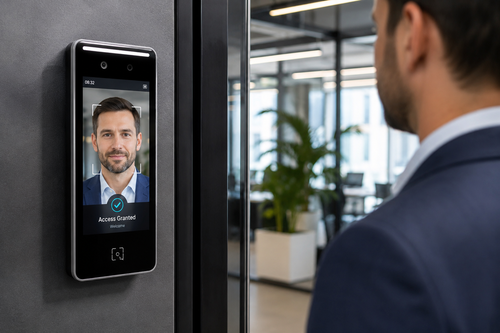
Whether you are managing a corporate office tower, a manufacturing plant, a school, or a residential condominium in Malaysia, choosing the right door access system is one of the most important security decisions you will make. The wrong choice can leave your building vulnerable to unauthorised entry, while the right one gives you full control over who enters, when, and where — all while keeping records for compliance and auditing purposes.
This guide walks you through the main types of door access systems available in Malaysia, the key factors you should evaluate, and practical tips to help you make the best decision for your building.
What Is a Door Access System?
A door access system is an electronic security solution that controls and monitors entry and exit points within a building. Instead of relying on traditional mechanical locks and keys — which are easily duplicated and difficult to track — a door access system uses credentials such as cards, PIN codes, biometric data, or mobile apps to grant or deny access.
Modern door access systems in Malaysia go beyond simple entry control. They can integrate with CCTV surveillance, attendance management, alarm systems, and visitor management platforms, giving building managers a comprehensive security ecosystem.
Types of Door Access Systems Available in Malaysia
Before choosing a system, it helps to understand the main categories available in the Malaysian market today.
1. Card or Fob-Based Access Control
This is one of the most widely adopted technologies in Malaysian offices and commercial buildings. Users are issued proximity cards or key fobs that communicate with a card reader via RFID or NFC technology. It is cost-effective, easy to manage, and cards can be deactivated instantly if lost or stolen.
Best for: Medium to large offices, corporate buildings, and staff areas.
2. PIN or Keypad Access Control
Users enter a numerical PIN code to gain access. PIN systems are simple to install and do not require physical credentials, making them suitable for smaller premises or lower-security zones. However, PIN codes can be shared or observed by others, which limits their security level.
Best for: Small offices, server rooms, storage areas, and low-traffic entry points.
3. Biometric Access Control
Biometric systems use unique physical characteristics — such as fingerprints, palm veins, or facial recognition — to verify identity. Because biometric data cannot be shared or duplicated the way a card or PIN can, these systems offer the highest level of security. They are also commonly integrated with attendance tracking in Malaysian workplaces.
Best for: High-security environments, manufacturing plants, research facilities, and organisations that need combined access and attendance records.
4. Mobile or Smartphone-Based Access
The latest generation of access control uses Bluetooth or NFC on smartphones as credentials. Users simply tap their phone or wave it near a reader to unlock a door. This eliminates the need to carry physical cards and is increasingly popular among tech-forward organisations in Malaysia.
Best for: Modern offices, co-working spaces, and buildings with a younger workforce.
Key Factors to Consider When Choosing a Door Access System
Selecting the right door access system for your building involves evaluating several important factors:
| Factor | Questions to Ask |
|---|---|
| Building Size | How many entry points do you need to control? |
| Number of Users | How many employees or residents will use the system? |
| Security Level | Are there restricted or high-value areas that need stronger authentication? |
| Integration | Does the system need to connect with CCTV, HR software, or alarm panels? |
| Budget | What are the upfront hardware costs and ongoing maintenance expenses? |
| Scalability | Can the system expand easily if your building grows? |
Building Size and Layout
A small office with three doors has very different requirements from a multi-floor corporate building with dozens of access points. Larger buildings benefit from centralised access control software that manages all doors from a single dashboard, allowing administrators to add or remove users and generate access reports without visiting each door physically.
Security Level Required
Not all areas of a building need the same level of protection. A tiered approach — using basic card access for general areas and biometric authentication for server rooms or executive floors — gives you strong security where it matters most without inflating costs unnecessarily.
Integration with Existing Systems
Many Malaysian organisations want their door access system to feed data into their HR or payroll software automatically. When employees swipe in, the system logs their attendance in real time, eliminating manual timesheets. Confirm that the system you choose supports standard integration protocols (such as Wiegand or OSDP) and can connect with your existing infrastructure.
Door Access Compliance and Standards in Malaysia
Organisations handling sensitive data in Malaysia — including those covered by the Personal Data Protection Act 2010 (PDPA) — have an obligation to protect physical access to data storage areas. A properly implemented door access system with audit logs demonstrating who accessed restricted areas and at what time can help demonstrate compliance during audits.
For fire safety, ensure that your door access system complies with Malaysia’s Uniform Building By-Laws (UBBL) and that electric locks are connected to your fire alarm system so that doors automatically release during an emergency.
Top Features to Look for in a Quality Door Access System
- Real-time monitoring — View live access events and receive alerts for unauthorised attempts.
- Detailed audit trails — Full logs of every access event, exportable for compliance reports.
- Remote management — Add or revoke user credentials from anywhere via web or mobile app.
- Anti-passback — Prevents credential sharing by requiring the same user to exit before re-entering.
- Time zone scheduling — Restrict access to specific hours or days per user or group.
- Fail-safe and fail-secure modes — Define whether doors unlock or lock when power is lost.
- Visitor management — Issue temporary credentials to guests and track their movement.
Frequently Asked Questions
How much does a door access system cost in Malaysia?
The cost varies widely depending on the type of technology and number of doors. A basic single-door card access system starts from around RM 800 to RM 1,500 installed, while a multi-door biometric system with centralised software can range from RM 5,000 to well above RM 20,000 for larger deployments. Always factor in ongoing software licensing, maintenance contracts, and potential expansion costs.
Can a door access system work without an internet connection?
Yes. Most door access controllers store user credentials and access rules locally on the device, so the doors continue to operate normally during an internet outage. Cloud-based management features — such as remote credential updates — will be temporarily unavailable until connectivity is restored.
Is biometric data stored securely?
Reputable biometric systems do not store a full image of a fingerprint or face. Instead, they store a mathematical template that cannot be reverse-engineered back into the original biometric. Under Malaysia’s PDPA, biometric data is classified as sensitive personal data and must be handled with appropriate safeguards.
What happens to access during a power failure?
Professional door access systems are connected to an uninterruptible power supply (UPS) or battery backup so they continue functioning during brief outages. Longer outages will depend on whether the lock is configured as fail-safe (unlocks on power loss, preferred for fire exits) or fail-secure (remains locked on power loss, preferred for high-security doors).
Conclusion
Choosing the right door access system for your building in Malaysia is not a one-size-fits-all decision. The best system depends on your building’s size, security requirements, budget, and integration needs. By understanding the different technologies available — from basic card readers to advanced biometric and mobile-based solutions — and by evaluating the factors outlined in this guide, you can make a confident, well-informed investment that protects your people, assets, and data for years to come.
Working with a reliable local supplier who can provide professional installation, training, and after-sales support is equally important. A technically sound system is only as effective as the team behind it.
Want to know more about the product? Check it out here :https://www.smartouch.com.my/door-access-system/
Smart Touch technology pte ltd , www.smartouch.com.sg +65-63964767, sales@smartouch.com.sg , www.smartouch.com.my +607-3889903 sales@smartouch.com.my