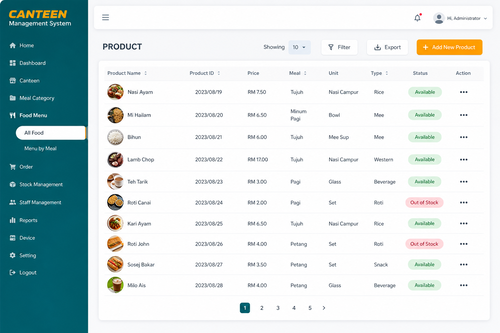
Food waste is one of the biggest hidden costs in workplace canteens and food service operations across Malaysia. Between over-ordering, spoilage, improper storage, and untracked consumption, canteens regularly lose thousands of ringgit every month without realising it. A canteen inventory management system addresses this problem head-on by giving food service operators real-time visibility into stock levels, usage patterns, and ordering cycles.
Whether you manage a corporate cafeteria, school canteen, hospital food service, or factory canteen, this guide explains how the right system can stop the waste and protect your bottom line.
What Is a Canteen Inventory Management System?
A canteen inventory management system is a software solution that tracks all food items, beverages, and supplies from the moment they arrive at your canteen to the point they are served or consumed. It records stock quantities, monitors expiry dates, tracks usage, and generates alerts when items run low or approach expiry.
Unlike spreadsheets or manual logbooks, a digital inventory system updates in real time, integrates with ordering processes, and provides data-driven insights that help canteen managers make smarter purchasing decisions.
The Real Cost of Food Waste in Malaysian Canteens
Food waste in Malaysian institutional canteens is a serious operational issue. According to various studies, food service operations in Malaysia waste between 10% and 30% of purchased food through overproduction, spoilage, and improper stock rotation. For a canteen serving 200 employees daily, this can translate into losses of RM2,000 to RM5,000 per month or more.
Common Sources of Waste
- Over-purchasing — ordering more stock than can be used before it expires
- Poor stock rotation — newer stock used before older items, causing the latter to spoil
- Lack of visibility — not knowing what’s already in storage before placing new orders
- Menu imbalance — preparing dishes that don’t sell, leading to daily leftovers
- Untracked breakage and pilferage — missing items that are never accounted for
A canteen inventory management system addresses each of these problems by providing full traceability of every item in your stock.
How a Canteen Inventory Management System Works
The system works by recording every stock movement — inbound deliveries, usage per meal service, returns, and wastage. Here is a simplified flow:
- Goods Received — When supplies arrive, they are logged into the system with quantity, supplier, and expiry information.
- Storage Tracking — Stock is assigned to specific storage locations (cold room, dry store, etc.) for easy retrieval.
- Usage Recording — As items are used during food preparation, quantities are deducted from the inventory.
- Low Stock Alerts — When stock falls below a preset threshold, the system generates an alert to reorder.
- Wastage Logging — Any discarded or expired items are recorded as waste, giving visibility into waste patterns over time.
- Reports and Analytics — Managers review consumption trends, waste rates, and spending to optimise purchasing.
Key Features to Look For
- Real-time stock tracking with expiry date monitoring
- Supplier management and purchase order generation
- Integration with point-of-sale (POS) systems for automatic deduction
- Waste and spoilage recording
- Multi-location support for canteens with multiple serving counters or stores
- Reporting dashboards showing cost per meal, stock turnover, and waste percentage
- Mobile access for on-the-go stock checks and receiving
Benefits of Using Canteen Inventory Management Software
The advantages go well beyond simply knowing what is in your storeroom. Here is how a proper canteen inventory system adds value across your operation:
Reduced Food Costs
By knowing exactly what you have in stock before ordering, you avoid over-purchasing. Over time, this can reduce food procurement costs by 10% to 20% through better planning and fewer impulse orders.
Less Spoilage
Expiry tracking and FIFO (First In, First Out) alerts ensure that older stock is used first, significantly reducing spoilage. The system flags items approaching their expiry date so they can be prioritised in the day’s menu planning.
Better Menu Planning
With data on which dishes sell well and which ingredients go unused, canteen managers can refine their menus to align purchasing with actual demand. This reduces both overproduction and the frustration of running out of popular items.
Faster and More Accurate Audits
Stock audits that previously took hours with clipboards and spreadsheets can be completed in minutes with a digital inventory system. Discrepancies are flagged automatically, making it easier to investigate pilferage or recording errors.
Canteen Inventory Management: Manual vs System-Based
| Feature | Manual (Spreadsheet/Logbook) | Canteen Inventory System |
|---|---|---|
| Real-time tracking | No | Yes |
| Expiry date alerts | Manual checking only | Automated alerts |
| Waste tracking | Inconsistent | Full traceability |
| Stock accuracy | Subject to human error | High accuracy |
| Reporting | Time-consuming | Instant dashboards |
| Scalability | Difficult with growth | Scales easily |
Key Takeaways
- Canteen food waste is a significant and often overlooked cost for Malaysian businesses
- A canteen inventory management system tracks all stock movements from delivery to service
- Key benefits include reduced food costs, less spoilage, better menu planning, and faster audits
- Automated alerts for low stock and expiring items prevent costly last-minute purchases and waste
- Data-driven insights help managers make smarter purchasing and menu decisions over time
Frequently Asked Questions
Is a canteen inventory system suitable for small canteens?
Yes. Even small canteens benefit from digital inventory tracking. The system scales to the size of the operation, and the cost savings from reduced waste often offset the cost of the software quickly.
Can it integrate with our existing POS system?
Most modern canteen inventory management systems are designed to integrate with POS systems so that stock deductions happen automatically with every sale. Check with your software provider about available integrations.
How long does it take to implement?
Implementation timelines vary depending on the size of the canteen and the complexity of the menu. Typically, a basic setup can be completed within a few days, with staff fully trained within a week.
Conclusion
Food waste is not just an environmental concern — it is a direct drain on your canteen’s profitability. A canteen inventory management system gives you the tools to monitor stock in real time, reduce spoilage, plan menus smarter, and run a leaner operation. For Malaysian businesses looking to tighten operational costs without compromising food quality, this is one investment that pays for itself.
You can read more about our compliance features by https://www.smartouch.com.my/canteen-management-system/.
Smart Touch technology pte ltd , www.smartouch.com.sg +65-63964767, sales@smartouch.com.sg , www.smartouch.com.my +607-3889903 sales@smartouch.com.my