How to Read the Official 2026 PERKESO Contribution Schedule Without Making Mistakes
Reading the official 2026 PERKESO contribution schedule may look simple at first, but many payroll mistakes happen because employers read the wrong category, choose the wrong wage bracket, overlook the wage ceiling, or confuse SOCSO contributions with EIS contributions. For businesses in Malaysia, accurate PERKESO contribution calculation is not just a payroll routine. It is an important compliance responsibility that protects employees, supports proper statutory reporting, and helps companies avoid unnecessary corrections at the end of the month.
PERKESO, also known as SOCSO, sets contribution rates according to official schedules under the Employees’ Social Security Act 1969 and the Employment Insurance System Act 2017. Employers are required to pay monthly contributions for each eligible employee based on the correct contribution category and salary bracket. According to PERKESO’s official contribution information, the First Category contribution covers the Employment Injury Scheme and Invalidity Scheme, while the Second Category contribution covers the Employment Injury Scheme only. The First Category comprises 1.75% employer share and 0.5% employee share based on the contribution schedule, while the Second Category is 1.25% of monthly wages and is paid by the employer only.
For 2026 payroll processing, employers should also pay close attention to the current wage ceiling. PERKESO states that, effective from 1 October 2024, the wage ceiling for contributions increased from RM5,000 to RM6,000 per month, and for employees earning more than RM6,000, the contribution amount is subject to the RM6,000 ceiling. This means payroll teams should not calculate SOCSO endlessly above RM6,000. Instead, they must use the highest official bracket when the monthly wage exceeds the ceiling.
Understanding What the 2026 PERKESO Contribution Schedule Is
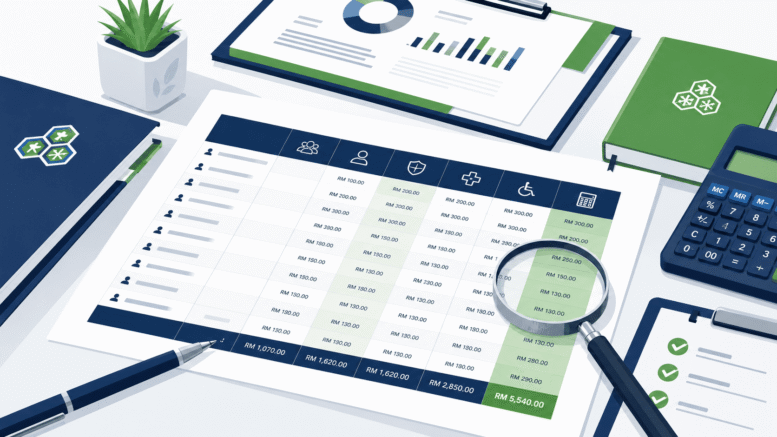
The official PERKESO contribution schedule is a structured table that helps employers determine the exact amount of contribution payable for each employee. It is not a simple flat percentage table that should be calculated manually with a calculator for every salary. Instead, it is a bracket-based schedule. Each row represents a range of monthly wages, and each row provides the corresponding employer contribution, employee contribution, total contribution, or employer-only contribution depending on the applicable category.
This is the first point many businesses misunderstand. When an employee earns a particular wage, the payroll officer should locate the correct wage range in the schedule, then read across the same row. The amount stated in the schedule is the amount to pay. Employers should not randomly round up, round down, or apply their own calculation method if the official schedule already provides a fixed amount for that wage bracket.
For example, the official Act 4 contribution schedule shows wage rows starting from “wages up to RM30,” followed by ranges such as wages exceeding RM30 but not exceeding RM50, and continuing upward until the wage ceiling. It also separates First Category columns from Second Category columns. A mistake in any of these steps can create inaccurate deductions, underpayment, overpayment, or mismatched statutory records.
Step One: Identify Whether the Employee Falls Under the First Category or Second Category
Before looking at the salary bracket, the employer must first identify the correct PERKESO contribution category. This is the foundation of accurate reading.
The First Category generally applies to employees who are below 60 years of age and covers both the Employment Injury Scheme and the Invalidity Scheme. Under this category, both the employer and employee contribute. PERKESO states that the rate under this category comprises 1.75% from the employer and 0.5% from the employee according to the contribution schedule.
The Second Category applies where coverage is for the Employment Injury Scheme only. Under this category, the employer pays the contribution, and there is no employee deduction. PERKESO states that all employees who have reached the age of 60 must be covered under this category, and eligible new employees aged 55 are also covered under the Second Category under the stated conditions.
A common mistake is deducting employee SOCSO from a worker who should be under the Second Category. Another common mistake is reading only the employer contribution column under the First Category and forgetting the employee share. Payroll teams should always confirm the employee’s age, contribution history, and eligibility before selecting the table column.
Step Two: Use the Actual Monthly Wage of the Month
The contribution schedule is based on the actual monthly wage of the month. This means the employer should first confirm the wage amount that falls within PERKESO’s contribution rules before selecting the row. Payroll teams should not simply use a standard basic salary without checking whether the monthly wage for that month has changed due to unpaid leave, allowances, salary adjustment, or other payroll items that may affect the statutory wage basis.
The key phrase in the schedule is “actual monthly wage of the month.” This reminds employers to use the relevant monthly wage figure for the contribution month. Once the correct wage is identified, the payroll officer should match it to the correct bracket. For example, a wage that exceeds RM2,500 but does not exceed RM2,600 belongs to that specific row, not the row below or the row above. The word “exceed” and the phrase “not exceed” must be read carefully.
Many mistakes occur at the boundary between two brackets. If the table says “exceed RM2,500 but not exceed RM2,600,” then RM2,600 is still inside that row. RM2,600.01 would move into the next applicable bracket. In practical payroll processing, employers should carefully check salary values at the exact bracket limits because one small interpretation error can produce the wrong contribution amount.
Step Three: Read Across the Same Row, Not Down the Wrong Column
After finding the correct wage bracket, the next step is to read across the same row. The official schedule separates information by category and contribution type. Under the First Category, the table contains employer share, employee share, and total contribution. Under the Second Category, the table shows the employer-only contribution.
The correct method is simple: find the wage bracket first, stay on the same row, then move horizontally to the correct column. Do not jump to another row. Do not mix the First Category employer amount with the Second Category employer-only amount. Do not treat the total contribution as an employee deduction. Do not deduct the full total from the employee’s salary.
For First Category employees, the employer pays the employer share, the employee pays the employee share through payroll deduction, and the total contribution is the combined amount. For Second Category employees, the amount is paid by the employer only. Understanding this difference prevents one of the most frequent payroll errors.
Step Four: Apply the RM6,000 Wage Ceiling Correctly
The RM6,000 wage ceiling is one of the most important points in reading the 2026 PERKESO contribution schedule. PERKESO confirms that the wage ceiling is RM6,000 per month and that employees earning more than RM6,000 are subject to the contribution amount based on the RM6,000 ceiling.
In the official Act 4 schedule, the final rows show wages exceeding RM5,900 but not exceeding RM6,000, followed by wages exceeding RM6,000. The contribution amount for wages exceeding RM6,000 remains at the ceiling amount. The screenshot of the official Act 4 schedule shows that for wages exceeding RM6,000, the First Category employer share is RM104.15, the employee share is RM29.75, and the total contribution is RM133.90, while the Second Category employer-only contribution is RM74.40.
The mistake to avoid is calculating contributions as if RM7,000, RM8,000, RM10,000, or higher salaries continue to increase the SOCSO amount. For contribution schedule purposes, the wage ceiling controls the maximum contribution. Payroll systems should be updated to recognize this ceiling automatically, and manual payroll users should double-check high-income employees carefully.
Step Five: Do Not Confuse SOCSO Act 4 with EIS Act 800
Another major source of mistakes is mixing SOCSO and EIS. PERKESO provides information for both Act 4 and Act 800, but they are not the same schedule. SOCSO under Act 4 relates to employee social security protection, while EIS under Act 800 relates to the Employment Insurance System.
According to PERKESO’s official contribution information, EIS applies to private sector employers on behalf of each employee, with exemptions stated for government employees, domestic workers, and the self-employed. PERKESO states that EIS contribution rates are capped at an assumed monthly salary of RM6,000. It also states that EIS contributions are set at 0.4% of the employee’s assumed monthly salary, with 0.2% paid by the employer and 0.2% deducted from the employee’s monthly salary.
The correct practice is to read the SOCSO Act 4 schedule for SOCSO contributions and the Act 800 schedule for EIS contributions. Do not use the SOCSO table to calculate EIS, and do not use the EIS rate to calculate SOCSO. They may both involve PERKESO, but they are separate statutory contribution items.
Step Six: Check 2026 Updates and the 24-Hour Protection Scheme Carefully
For 2026, employers should also be aware of updates relating to the expansion of protection. PERKESO’s Employer Circular No. 2 of 2026 refers to the Employees’ Social Security Act 1969 and the expansion of 24-hour coverage under the protection scheme. The circular explains that the expanded 24-Hour Protection Scheme, also known as Skim LINDUNG 24 Jam or the Non-Occupational Accident Scheme, is implemented from the perspectives of registration, contributions, and enforcement.
The circular also states that employees covered under Act 4 / LINDUNG Pekerja are mandatory to be registered and contributed under the 24-Hour Protection Scheme, subject to the monthly wage ceiling limit of RM6,000. It further states that there is no age limit imposed under the 24-Hour Protection Scheme, and coverage continues as long as the employee remains in employment, including after the age of 60.
Employers should read official circulars carefully because contribution requirements may involve more than the standard table alone. Payroll teams should always ensure that payroll software, attendance systems, HR records, and employee master data are updated when PERKESO introduces new contribution-related requirements.
Common PERKESO Contribution Schedule Mistakes Employers Should Avoid
One of the most common mistakes is selecting the wrong wage bracket. This usually happens when the payroll officer reads “exceed” and “not exceed” too quickly. The correct bracket must match the exact monthly wage range.
Another mistake is using old wage ceiling rules. Since PERKESO has already stated that the wage ceiling increased to RM6,000 effective 1 October 2024, businesses should not continue using the older RM5,000 ceiling for 2026 payroll.
A third mistake is deducting the total contribution from the employee. Under the First Category, the total contribution is the combination of employer and employee shares. Only the employee share should be deducted from wages. The employer share is the company’s responsibility.
A fourth mistake is applying First Category contributions to every employee without checking age and eligibility. Employees under the Second Category are handled differently because the contribution is paid by the employer only.
A fifth mistake is assuming that SOCSO and EIS are the same because both are administered through PERKESO. They must be calculated separately according to the proper Act and schedule.
A Practical Example of Reading the Schedule Correctly
Let us say an employee’s actual monthly wage falls within the bracket “exceeding RM3,000 but not exceeding RM3,100.” The payroll officer should find that exact row in the schedule and then decide which category applies.
If the employee is under the First Category, the employer should read the employer share, employee share, and total contribution from the First Category columns. If the employee is under the Second Category, the employer should ignore the First Category employee deduction and use only the Second Category employer-only amount.
This example shows why reading the schedule requires sequence. The correct order is category first, wage bracket second, column third, and final payroll posting fourth. When payroll officers follow this structure consistently, the risk of mistakes becomes much lower.
Why Businesses Should Use a Reliable Payroll and Attendance System
Reading the PERKESO contribution schedule manually is possible, but it becomes harder as employee headcount grows. A company with ten employees may still manage with spreadsheets. A company with hundreds of employees, multiple salary levels, overtime, unpaid leave, shift allowances, branch transfers, and new joiners will need a more reliable process.
A good payroll and attendance system helps businesses reduce manual errors by capturing attendance data, calculating payable wages, applying statutory contribution rules, and generating reports for payroll processing. When employee attendance, salary data, leave records, overtime, and statutory contributions are connected, HR teams can work faster and with greater confidence.
For Malaysian businesses, accurate PERKESO contribution handling is especially important because payroll compliance affects employee protection and company responsibility. A modern HR system should help employers identify contribution categories, apply updated ceilings, separate SOCSO and EIS, and prepare contribution reports without relying entirely on manual checking.
Best Practice Checklist for Reading the Official 2026 PERKESO Schedule
Before finalizing monthly payroll, employers should check that each employee is correctly registered, the correct contribution category is selected, the actual monthly wage is used, the correct salary bracket is chosen, and the RM6,000 ceiling is applied where relevant. They should also confirm that SOCSO and EIS are calculated separately, employee deductions are not overstated, employer-only contributions are not wrongly deducted from employees, and payroll software is updated according to the latest PERKESO information.
Existing employees should be maintained based on current records where applicable, while new employees should be registered through the official PERKESO-prescribed method. PERKESO’s 2026 circular states that existing employees are not required to be re-registered for the 24-Hour Protection Scheme because registration is based on current records, while new employees commencing employment after the effective date must be registered through the ASSIST 2.0 Portal.
This checklist is useful for HR managers, payroll executives, finance teams, business owners, and outsourced payroll providers who need to ensure that each monthly contribution is accurate before submission.
Conclusion: Read the PERKESO Schedule by Category, Bracket, Ceiling, and Act
The official 2026 PERKESO contribution schedule can be read correctly when employers follow a clear method. First, identify whether the employee is under the First Category or Second Category. Second, determine the actual monthly wage of the month. Third, match the wage to the correct bracket. Fourth, read across the same row under the correct column. Fifth, apply the RM6,000 wage ceiling. Sixth, keep SOCSO Act 4 and EIS Act 800 separate.
The most reliable payroll process is not based on guesswork. It is based on official schedules, updated statutory information, accurate employee records, and consistent checking. Businesses that take the time to read the PERKESO contribution schedule properly can avoid payroll mistakes, protect employees correctly, and maintain smoother monthly HR operations.
For companies that want to reduce payroll errors and improve workforce management, a dependable attendance and HR technology solution can make the entire process more organized. By connecting attendance records, employee profiles, payroll data, and statutory contribution preparation, businesses can achieve better accuracy, better compliance, and better control.
Want to know more about this product? Click here:
Smart Touch technology pte ltd , www.smartouch.com.sg +65-63964767, sales@smartouch.com.sg , www.smartouch.com.my +607-3889903 sales@smartouch.com.my