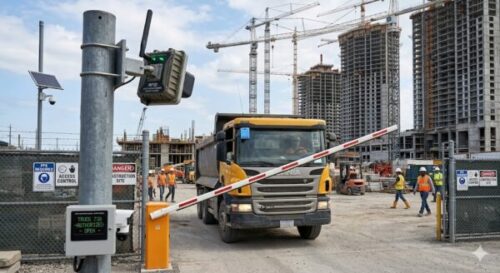
Long range RFID is one of the most valuable technologies for businesses that need fast, accurate, and contactless identification over long distances. It is widely used in vehicle access control, warehouse management, asset tracking, and industrial automation.
This guide explains what long range RFID is, how it works, its benefits, applications, and how to choose the right system for your business.
What Is Long Range RFID?
Long range RFID (Radio Frequency Identification) is a system that can read RFID tags from a distance without direct contact or line of sight.
Unlike barcode systems, RFID uses radio waves to automatically identify and track objects.
A typical long range RFID system includes:
- RFID Tags – Attached to vehicles, products, or assets
- RFID Readers – Detect and read tag data
- Antennas & Software – Extend coverage and manage data
Most long range systems use UHF (Ultra-High Frequency), allowing reading distances of several meters or more.
How Long Range RFID Works
The process is simple and fully automated:
- The RFID reader sends out radio signals
- The tag receives the signal and responds with stored data
- The reader captures the data and sends it to software
This happens instantly without human interaction, making it ideal for fast-paced environments.
Types of RFID Tags
- Passive Tags
No battery, powered by the reader signal
Lower cost and commonly used - Active Tags
Battery-powered
Longer range and continuous tracking
RFID Frequency and Read Range
Different frequencies affect performance:
- LF (Low Frequency) – Short range, used for simple tracking
- HF (High Frequency) – Used for NFC, payments, ticketing
- UHF (Ultra-High Frequency) – Best for long range RFID
Factors Affecting Read Distance
- Tag size and design
- Reader power
- Antenna quality
- Environment (metal, water, interference)
- Installation setup
Why Long Range RFID Is Better Than Traditional Systems
Compared to barcodes or manual logs, RFID offers major advantages:
- No line of sight required
- Faster processing (no manual scanning)
- Automation of operations
- Multiple tag reading at once
- Higher accuracy
- Improved security
Common Applications of Long Range RFID
1. Vehicle Access Control
RFID allows automatic vehicle entry at gates.
- No stopping required
- Faster traffic flow
- Improved security
- Automatic access records
2. Warehouse & Inventory Management
RFID improves tracking of goods in real time.
- Faster receiving and dispatch
- Better stock accuracy
- Reduced manual scanning
- Real-time inventory visibility
3. Asset Tracking
Track valuable equipment and items easily.
- IT equipment
- Medical devices
- Industrial tools
- Containers and assets
4. Manufacturing & Industrial Use
RFID helps monitor production and material movement.
- Track raw materials
- Monitor work-in-progress
- Manage yard operations
- Improve workflow efficiency
5. Smart Parking & Residential Systems
Used in condos, offices, and gated areas.
- Seamless vehicle entry
- Better parking control
- Reduced unauthorized access
- Automated logging system
Key Components of an RFID System
A complete system includes:
- RFID Reader – Main device for reading tags
- Antenna – Controls signal range and direction
- RFID Tags – Attached to objects or vehicles
- Middleware/Controller – Manages communication
- Software – Stores data and generates reports
Factors That Affect RFID Performance
Proper setup is critical. Performance can be affected by:
- Metal surfaces
- Water or moisture
- Tag positioning
- Signal interference
- Poor installation
How to Choose the Right RFID System
Before selecting a solution, consider:
- What you want to track (vehicles, assets, inventory)
- Required reading distance
- Indoor or outdoor use
- Tag placement (metal, glass, etc.)
- Number of tags to read at once
- Software integration needs
- Security requirements
Benefits of Long Range RFID
Implementing RFID can deliver strong business value:
- Increased efficiency
- Reduced labor costs
- Better accuracy
- Improved security
- Enhanced user experience
- Real-time tracking and reporting
- Long-term cost savings
Common Challenges
Some challenges to avoid:
- Choosing the wrong tag
- Poor reader placement
- Environmental interference
- Weak system integration
- Lack of proper testing
Working with experienced providers can prevent these issues.
Future of Long Range RFID
RFID technology is evolving rapidly and is now integrated with:
- Cloud systems
- IoT platforms
- Data analytics
- Smart automation
It is becoming a key part of digital transformation strategies.
Final Thoughts
Long range RFID is a powerful solution for modern businesses. It improves efficiency, accuracy, and security across many applications.
From vehicle access to inventory and asset tracking, RFID helps automate processes and reduce manual work. With the right setup, it can deliver long-term value and scalability.
More details about the system can be found in this product solution. Click here: https://www.smartouch.com.my/long-range-rfid-content/
Smart Touch technology pte ltd , www.smartouch.com.sg +65-63964767, sales@smartouch.com.sg , www.smartouch.com.my +607-3889903 sales@smartouch.com.my