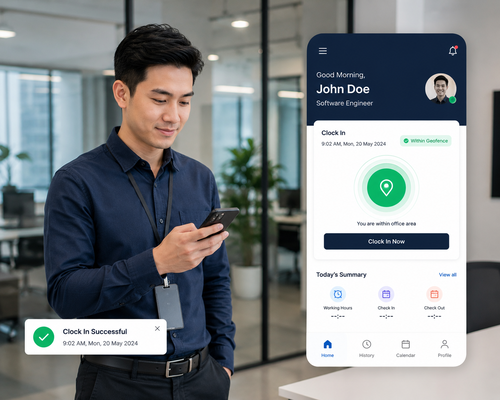
Buddy punching, where one employee clocks in on behalf of another, quietly costs businesses thousands of ringgit each year in unearned wages. Traditional card and PIN-based clocking systems make this kind of time theft easy. Facial clocking for time attendance closes this loophole entirely by verifying the actual person present at the point of check-in.
This article explains what buddy punching costs businesses, how facial clocking eliminates it, and what to look for when adopting the technology.
What Is Buddy Punching?
Buddy punching occurs when an employee clocks in or out for a coworker who is late, absent, or leaving early. It is one of the most common forms of time theft in workplaces that rely on cards, PINs, or basic swipe systems.
The Real Cost of Buddy Punching
1. Inflated Payroll Costs
Every fraudulent clock-in results in wages paid for time not actually worked, adding up significantly across a large workforce.
2. Inaccurate Attendance Records
Buddy punching distorts attendance data, making it harder for HR to identify genuine attendance or punctuality issues.
3. Unfair Treatment of Honest Employees
When time theft goes unchecked, it creates unfairness among employees who follow proper clock-in procedures.
How Facial Clocking Solves the Problem
Facial clocking for time attendance requires a live facial scan matched against registered employee data before a clock-in is accepted. Since a face cannot be shared like a card or PIN, buddy punching becomes virtually impossible.
Key Benefits of Facial Clocking
| Benefit | Description |
|---|---|
| Eliminates Buddy Punching | Only the registered employee’s face can clock in |
| Accurate Payroll Data | Attendance records reflect actual hours worked |
| Contactless Convenience | Faster and more hygienic than card or fingerprint systems |
| Real-Time Monitoring | Attendance updates instantly for HR visibility |
| Simplified Audits | Clear, verifiable records for compliance reviews |
Comparison: Traditional Clocking vs Facial Clocking
| Criteria | Card / PIN Clocking | Facial Clocking |
|---|---|---|
| Buddy Punching Risk | High | Virtually eliminated |
| Hygiene | Moderate | Contactless |
| Setup Cost | Low | Moderate, with long-term savings |
| Data Accuracy | Prone to manipulation | Highly accurate |
Best Practices for Adopting Facial Clocking
- Register clear, well-lit facial data for every employee during onboarding
- Position clocking terminals in well-lit, accessible entry points
- Communicate the change transparently to build employee trust
- Integrate facial clocking data directly with payroll systems
- Monitor system accuracy regularly and update hardware as needed
Calculating the Real Cost of Buddy Punching for Your Business
Many businesses underestimate how much buddy punching actually costs until they calculate it directly. Even a few minutes of fraudulent clock-in time per employee per week, multiplied across a large workforce over a full year, can add up to a significant unearned wage expense. Facial clocking closes this gap almost entirely, and many businesses recover the cost of implementation within the first year through these savings alone.
Change Management: Getting Employee Buy-In
Introducing facial clocking for time attendance is as much a change management exercise as it is a technology rollout. Employees may have questions about how their facial data is used and stored. Clear communication, along with visible enforcement of the same rules for all staff including management, helps build trust and reduces resistance during the transition period.
Combining Facial Clocking With Shift Scheduling
Many organizations pair facial clocking systems with shift scheduling software, allowing automatic flags for late arrivals, early departures, or missed shifts. This integration gives HR teams a complete, accurate view of attendance patterns without needing to manually cross-reference schedules against clocking data.
Why Consistency Across All Employee Levels Matters
One of the fastest ways to undermine trust in a new attendance system is applying it inconsistently. When facial clocking is required for all staff, including supervisors and senior management, employees are far more likely to accept the change as a fair, company-wide policy rather than a tool used only to monitor junior staff. This consistency also produces more reliable data for HR reporting, since attendance records are no longer skewed by exceptions granted to certain roles.
Businesses that roll out facial clocking with this level of fairness in mind typically see faster adoption and fewer complaints during the transition period.
Over time, this fairness becomes a quiet but powerful driver of overall workplace trust in HR systems more broadly.
That trust, once established, tends to extend naturally to other digital HR tools introduced afterward, making future technology rollouts noticeably smoother.
For HR leaders weighing whether to make the switch, this ripple effect on trust is often just as valuable as the direct payroll savings.
Combined, the financial and cultural benefits make a compelling case for facial clocking as a long-term investment rather than a short-term fix.
Businesses that delay this switch often find the cost of inaction grows quietly larger each payroll cycle.
Acting sooner rather than later is almost always the more cost-effective choice.
Key Takeaways
- Buddy punching is a costly and common form of time theft in traditional systems
- Facial clocking verifies the actual employee present, eliminating this risk
- Accurate time attendance data leads to fairer payroll and better workforce insights
- Contactless clocking also improves hygiene and speed at entry points
Frequently Asked Questions
Can facial clocking completely eliminate buddy punching?
Yes, since each clock-in requires a live facial match, one employee cannot clock in for another.
Is facial clocking data secure?
Reputable systems encrypt facial data and follow strict data protection standards to protect employee privacy.
Does facial clocking work for large workforces?
Yes, these systems are designed to scale and handle high volumes of employees clocking in during shift changes.
How does facial clocking integrate with payroll?
Attendance data is typically synced automatically with payroll systems, reducing manual reconciliation work.
Conclusion
Buddy punching quietly drains payroll budgets and creates unfair treatment among employees. Facial clocking for time attendance eliminates this problem by verifying the actual person clocking in, resulting in accurate records and fair payroll processing. As businesses look for reliable ways to protect against time theft, facial clocking offers a practical, contactless, and highly effective solution.
Read the product overview here: http://www.smartouch.com.my/tms-time-management-system-singapore-malaysia/
Smart Touch technology pte ltd , www.smartouch.com.sg +65-63964767, sales@smartouch.com.sg , www.smartouch.com.my +607-3889903 sales@smartouch.com.my