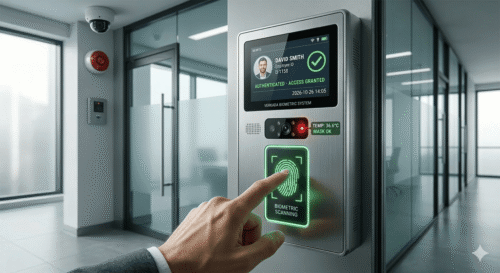
A fingerprint time attendance system has become the standard choice for Malaysian businesses that want accurate clock-in records without the hassle of buddy punching or lost access cards. As labour compliance rules tighten and payroll accuracy becomes a bigger priority for HR teams, more companies are moving away from manual registers and card-based clocking toward biometric verification. This article explains how a secure fingerprint time attendance system works, why it matters for Malaysian employers, and what to look for before you invest in one.
Why Businesses in Malaysia Are Switching to Fingerprint Time Attendance
Traditional attendance methods such as punch cards, sign-in sheets, or even RFID cards are easy to manipulate. An employee can clock in for a colleague who is running late, and a lost or shared card can quietly distort your entire payroll record. A fingerprint time attendance system removes this loophole because a fingerprint cannot be borrowed, forgotten at home, or duplicated the way a card can.
For HR and finance teams, this translates into cleaner data. Overtime claims, late-coming penalties, and payroll calculations are all built on the same trusted attendance log, which reduces disputes and manual corrections at the end of each month.
How a Fingerprint Time Attendance System Works
Enrollment and Template Storage
When a new employee joins, their fingerprint is scanned and converted into an encrypted digital template rather than a stored image. This template is what the system compares against every time the employee clocks in, which keeps the actual fingerprint data secure and non-reversible.
Daily Clock-In and Clock-Out Process
Each time an employee places their finger on the scanner, the device matches the live scan against the stored template in milliseconds. Once verified, the timestamp is logged automatically to the attendance database, which can then sync with payroll, leave management, or HR software without any manual data entry.
Key Benefits of a Secure Fingerprint Time Attendance System
Beyond stopping buddy punching, a well-implemented biometric system offers several practical advantages for Malaysian SMEs and larger organisations alike.
| Feature | Manual Register | Card-Based System | Fingerprint System |
|---|---|---|---|
| Buddy punching risk | High | Medium | Very Low |
| Data accuracy | Low | Medium | High |
| Setup cost | Low | Medium | Medium |
| Payroll integration | Manual | Semi-automatic | Automatic |
| Hygiene concerns | None | Low | Managed via touchless options |
Key takeaways: a fingerprint system delivers the highest accuracy, integrates directly with payroll, and largely eliminates time theft, making it a strong long-term investment compared to manual or card-based alternatives.
Choosing the Right Fingerprint Time Attendance System for Your Company
Not every biometric device suits every workplace. Consider the following best practices when evaluating vendors:
- Check matching speed and accuracy, especially for larger headcounts during peak clock-in hours.
- Confirm the system supports Malaysian public holidays, shift patterns, and overtime rules out of the box.
- Look for cloud backup so attendance records are not lost if a device fails.
- Ensure the vendor offers local support and warranty coverage in Malaysia.
- Verify integration with your existing payroll or HR software to avoid duplicate data entry.
For factories, warehouses, and outdoor sites, ask about dust and moisture resistance, since these environments can affect scanner reliability over time.
Step-by-Step: Rolling Out a Fingerprint Time Attendance System
A smooth rollout typically follows these steps:
- Step 1: Audit your current attendance process and identify pain points such as late submissions or payroll disputes.
- Step 2: Shortlist vendors that offer Malaysian compliance features and local technical support.
- Step 3: Enroll employees in batches, starting with a pilot department before a full rollout.
- Step 4: Integrate the system with payroll and leave management software.
- Step 5: Monitor reports for the first month and adjust shift rules as needed.
Common Challenges When Adopting Biometric Attendance
While the benefits are significant, some Malaysian employers hesitate to adopt fingerprint systems due to a few common concerns. Understanding these upfront helps you plan a smoother implementation.
Employee Privacy Concerns
Some staff may worry about how their biometric data is stored and used. Employers should communicate clearly that fingerprint templates are encrypted, cannot be reverse-engineered into an actual fingerprint image, and are used solely for attendance verification rather than any other tracking purpose.
Initial Setup and Change Management
Switching from a familiar manual process to a digital system requires a short adjustment period. Providing simple training sessions and clear instructions during the first week significantly reduces confusion and resistance from employees who are less comfortable with technology.
Hardware Placement and Environment
Scanner placement matters. Devices installed in direct sunlight, high humidity, or dusty environments may experience reduced accuracy over time. Selecting industrial-grade scanners for factories or outdoor entrances helps maintain consistent performance.
Fingerprint Attendance and Malaysian Labour Compliance
Under Malaysian employment regulations, accurate working hour records are essential for calculating overtime, public holiday pay, and statutory contributions correctly. A fingerprint time attendance system creates a verifiable audit trail that protects both employers and employees during any labour dispute or audit. Because each entry is tied to a unique biometric match, businesses can demonstrate that attendance records were not altered or falsified, which is particularly valuable during inspections by the Labour Department.
This level of accuracy also supports better workforce planning. Managers can review real-time attendance dashboards to identify patterns such as chronic lateness or excessive overtime, allowing HR teams to address issues proactively rather than reactively at month-end.
Integrating Fingerprint Attendance With Your Broader HR Ecosystem
A fingerprint time attendance system delivers the most value when it does not operate in isolation. Modern platforms allow attendance data to flow directly into payroll software, eliminating the need for HR staff to manually re-enter hours worked. This integration reduces errors, speeds up monthly payroll processing, and gives managers a single source of truth for workforce data.
Many systems also connect with leave management modules, so approved leave is automatically reflected in attendance reports without requiring separate reconciliation. For companies with multiple branches, centralised cloud dashboards let HR teams monitor attendance across all locations from one place, which is especially useful for businesses expanding across Malaysia.
Conclusion
A secure fingerprint time attendance system gives Malaysian businesses a reliable, tamper-resistant way to track working hours while simplifying payroll and compliance. By replacing manual registers or card-based clocking with biometric verification, companies reduce time theft, cut down on administrative errors, and gain accurate data they can trust. Choosing a system with strong local support and payroll integration ensures the transition is smooth and the long-term benefits are fully realised.
Frequently Asked Questions
Is fingerprint data safe from misuse?
Yes. Reputable systems store an encrypted mathematical template of the fingerprint rather than an actual image, making it extremely difficult to reverse-engineer or misuse.
Can a fingerprint time attendance system work without internet access?
Most devices can log attendance offline and sync data automatically once the connection is restored, so daily operations are not disrupted.
How long does enrollment take per employee?
Enrollment usually takes under a minute per employee, including scanning multiple fingers as a backup in case one finger is temporarily unreadable.
Is this system suitable for small businesses?
Yes. Many providers offer scalable packages, making fingerprint attendance systems practical for small teams as well as large enterprises.
What happens if an employee’s fingerprint cannot be read due to injury?
Most systems support backup verification methods such as a PIN or card so operations are not interrupted.
Click here to find out how the product works: https://www.smartouch.com.my/category/time-clock/biometric-fingerprint/
Smart Touch technology pte ltd , www.smartouch.com.sg +65-63964767, sales@smartouch.com.sg , www.smartouch.com.my +607-3889903 sales@smartouch.com.my