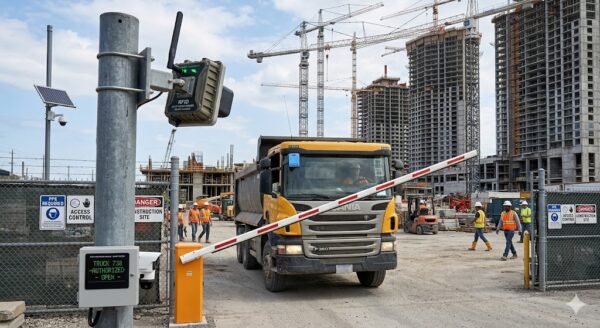
Construction sites in Malaysia are busy, high-risk, and constantly changing environments. Every day, workers, subcontractors, engineers, supervisors, machinery, vehicles, delivery trucks, equipment, tools, materials, and visitors move in and out of the site. Without a reliable tracking and access control system, it becomes difficult to know who is on site, which vehicle has entered, where assets are located, and whether only authorised personnel are accessing restricted areas.
This is why long range RFID tags and readers are becoming an essential solution for construction workforce management, vehicle access control, equipment tracking, and site security. The best long range RFID system allows construction companies to identify people, vehicles, and assets quickly from a distance, without requiring direct contact, manual scanning, or slow verification.
For contractors, developers, project managers, site supervisors, safety officers, and security teams in Malaysia, long range RFID tags and readers provide a smarter way to improve productivity, strengthen safety, reduce losses, and manage construction operations more professionally.
What Is Long Range RFID for Construction?
Long range RFID is a wireless identification technology that allows RFID readers to detect RFID tags from a longer distance compared with normal short-range access cards. In construction, this technology is commonly used to identify vehicles, workers, equipment, machinery, tools, materials, and site assets.
A long range RFID system usually includes RFID tags, RFID readers, antennas, controllers, software, and integration with access control, barriers, turnstiles, attendance systems, or asset management platforms. When an RFID tag comes within the reading range, the reader detects the tag and sends the information to the system. The system then verifies the tag and performs the required action, such as opening a barrier, recording attendance, updating asset movement, or alerting security.
This makes long range RFID especially useful for construction sites where speed, distance, durability, and automation are important.
Why Construction Sites Need Long Range RFID
Construction sites are not like office buildings. Workers do not sit at desks all day. Vehicles move in and out continuously. Heavy machinery operates across large areas. Materials arrive by lorry. Subcontractors change frequently. Tools and equipment are moved from one zone to another. Site conditions can be dusty, wet, hot, rough, and unpredictable.
Manual tracking is often too slow and inaccurate for this environment. Paper records can be damaged. Security guards may miss details during busy hours. Workers may forget to sign in. Vehicles may enter without proper verification. Tools may be misplaced. Equipment may be moved without documentation.
Long range RFID helps solve these problems by automating identification and tracking. It gives site management better visibility and improves control over daily activity.
Best Uses of Long Range RFID Tags and Readers in Construction
Long range RFID can be used in many areas of construction site management. It is not limited to one function. A properly designed RFID system can support site access, worker attendance, vehicle control, asset tracking, tool management, safety monitoring, and project reporting.
For construction companies in Malaysia, the most common applications include worker identification, site entry control, vehicle gate automation, machinery tracking, equipment movement monitoring, material logistics, subcontractor management, and restricted area access.
This flexibility makes long range RFID one of the most practical technologies for modern construction projects.
Long Range RFID for Worker Attendance
Worker attendance is one of the most important parts of construction workforce management. Construction companies need accurate records to calculate wages, verify subcontractor claims, manage manpower, monitor punctuality, and support safety reporting.
Long range RFID tags can be issued to workers as ID cards, badges, helmet tags, or wearable tags. When workers pass through a controlled entrance, the RFID reader can detect their tag and record their entry. This helps reduce manual attendance work and speeds up the morning site entry process.
For stronger security, long range RFID can also be combined with biometric verification, face recognition, or turnstile access. This helps prevent misuse and improves identity confirmation.
Long Range RFID for Site Access Control
Site access control is critical for construction safety and security. Only authorised workers, approved subcontractors, registered visitors, and permitted vehicles should enter the project site.
Long range RFID readers can be installed at site gates, turnstiles, guardhouses, loading zones, and restricted access points. When a registered tag is detected, the system can allow access. If the tag is invalid, expired, blocked, or unregistered, access can be denied.
This helps security teams control entry more effectively and reduces the risk of unauthorised access. It also creates a digital record of movement, which is useful for audits, investigations, payroll checks, and emergency headcounts.
Long Range RFID for Construction Vehicles
Construction sites usually have many vehicles entering and leaving every day. These may include staff cars, motorcycles, lorries, concrete trucks, cranes, excavators, forklifts, delivery vans, subcontractor vehicles, and supplier vehicles.
Long range RFID vehicle tags can be attached to windscreens, headlamps, or suitable vehicle surfaces. RFID readers at the gate can detect authorised vehicles from a distance and automatically open the barrier. This reduces waiting time and improves traffic flow.
For busy construction sites, vehicle RFID access is especially valuable during peak hours, material delivery periods, and shift changes. It helps the site avoid gate congestion and keeps vehicle movement more organised.
Long Range RFID for Machinery and Heavy Equipment Tracking
Heavy machinery is expensive and important to project progress. Excavators, cranes, generators, compressors, loaders, scissor lifts, welding machines, and other equipment must be monitored carefully.
RFID tags can be attached to machinery and equipment to help identify and track movement. When equipment passes a checkpoint or enters a zone with RFID readers, the system can update its location or movement record.
This helps prevent unauthorised movement, improves equipment utilisation visibility, and supports maintenance planning. For construction companies managing many machines across multiple sites, RFID tracking can reduce confusion and improve asset accountability.
Long Range RFID for Tool and Asset Management
Tools and smaller assets are often lost on construction sites. Power tools, cables, meters, safety equipment, testing devices, pumps, ladders, and site instruments may be moved between workers, subcontractors, storage areas, and project zones.
Long range RFID tags can help identify these assets more efficiently. By tagging valuable tools and using RFID readers at store entrances or checkout points, companies can monitor asset movement and reduce losses.
This is especially useful for contractors who frequently move equipment between project sites. Better asset tracking means fewer missing items, less replacement cost, and better control over company property.
Long Range RFID for Material Tracking
Construction materials such as steel, precast components, pipes, panels, cables, fittings, and high-value supplies may need tracking from delivery to installation. RFID can help improve material visibility by identifying tagged items when they arrive, move to storage, or transfer to work zones.
For large projects, material tracking is important because missing or misplaced materials can delay progress. Long range RFID helps create a more systematic process for receiving, storing, and issuing materials.
When combined with project management or inventory software, RFID can support better material planning and reduce unnecessary downtime.
What Makes the Best Long Range RFID Tags for Construction?
The best long range RFID tags for construction must be strong, reliable, and suitable for harsh site conditions. Construction environments can expose tags to dust, rain, sunlight, vibration, impact, metal surfaces, rough handling, and outdoor weather.
A good construction RFID tag should have strong read performance, durable housing, suitable mounting options, resistance to weather, compatibility with the reader, and enough memory or identification capability for the intended use.
For worker identification, lightweight card tags or helmet tags may be suitable. For vehicles, windscreen tags or headlamp tags are commonly used. For machinery and assets, rugged industrial tags or anti-metal tags may be required. For materials, label tags or hard tags may be selected depending on the item type.
Choosing the correct RFID tag is important because not every tag performs well in every environment.
RFID Tags for Workers
Worker RFID tags should be easy to carry, durable, and suitable for daily use. They may come in the form of ID cards, lanyard cards, wristbands, helmet stickers, or hard tags attached to safety helmets.
For construction sites, helmet-based RFID tags can be practical because workers must wear helmets in active areas. This helps ensure the tag stays with the worker and supports fast identification at access points.
However, for higher-security attendance, RFID alone may not be enough because cards or tags can be shared. In such cases, combining RFID with biometric verification or face recognition can provide stronger identity control.
RFID Tags for Vehicles
Vehicle RFID tags are designed for long range reading at entrance and exit points. They are usually attached to the windscreen, headlamp, or other approved vehicle area. These tags help automate gate access and identify authorised vehicles.
The best vehicle RFID tags should be tamper-resistant, difficult to transfer, and readable at a suitable distance. For construction sites, vehicle tags are useful for staff cars, subcontractor vehicles, delivery vehicles, machinery transport, and approved suppliers.
With the right setup, vehicle RFID tags reduce manual checking and improve gate security.
RFID Tags for Machinery and Equipment
Machinery and equipment tags must be more rugged than normal ID cards. They may need to withstand heat, outdoor exposure, rough handling, and vibration. If the tag is attached to a metal surface, an anti-metal RFID tag may be required because metal can interfere with RFID performance.
The best RFID tags for machinery should be firmly mounted, resistant to damage, and readable at the required distance. These tags can help identify machinery quickly and support asset records, maintenance schedules, movement logs, and project allocation.
RFID Tags for Tools and Small Assets
Small asset tags must be compact but durable. Some tools have limited space for mounting, so the tag must fit without disturbing usage. For expensive power tools or testing instruments, RFID tagging can reduce loss and improve accountability.
The right tag depends on the tool material, size, usage environment, and reading requirement. For metal tools, anti-metal tags may be needed. For plastic or non-metal assets, standard RFID labels or hard tags may be suitable.
What Makes the Best Long Range RFID Readers for Construction?
The best long range RFID readers for construction must deliver strong performance in challenging environments. They should be able to read tags accurately, support the required reading distance, handle outdoor conditions, integrate with access systems, and operate reliably under heavy daily use.
A good RFID reader for construction should have stable read accuracy, adjustable reading range, weather-resistant housing, support for multiple antennas if needed, reliable communication options, and compatibility with the selected RFID tags.
Reader placement is also very important. Even a good reader may perform poorly if installed at the wrong angle, wrong height, or wrong distance from the tag path. Professional site assessment helps ensure the reader is positioned correctly.
Fixed RFID Readers for Construction Gates
Fixed RFID readers are commonly installed at site entrances, exits, guardhouses, loading bays, and vehicle lanes. They are ideal for automatic detection when workers or vehicles pass through a defined point.
For vehicle gates, fixed readers can identify vehicle tags and trigger parking barriers, boom gates, sliding gates, or access controllers. For worker entrances, fixed readers can be connected to turnstiles or attendance systems.
Fixed readers are suitable when the site needs continuous monitoring at specific checkpoints.
Handheld RFID Readers for Construction Inventory
Handheld RFID readers are useful for asset checking, tool inventory, material verification, and equipment audits. Staff can walk around the site, scan tagged items, and update records more efficiently than manual counting.
This is especially useful for construction companies that need regular asset audits or manage many tools across large storage areas. Handheld readers can help locate items faster and reduce paperwork.
RFID Antennas and Reading Range
The reading range of an RFID system depends on several factors, including tag type, reader power, antenna design, installation angle, environment, interference, and mounting surface.
For construction sites, the reading range must be planned carefully. Too short, and the system may not detect tags early enough. Too long, and the system may detect tags from the wrong lane or unintended area. The best RFID setup uses a controlled reading zone that matches the actual workflow.
Professional configuration helps avoid false reads, missed reads, and cross-lane detection.
Long Range RFID and Parking Barrier Integration
One of the most popular uses of long range RFID in construction is parking barrier and gate integration. When authorised vehicles approach the entrance, the RFID reader detects the tag and opens the barrier automatically.
This is useful for controlling staff parking, project vehicle access, delivery lorries, subcontractor vehicles, and restricted site entrance points. It also improves traffic flow because vehicles do not need to stop for manual checking.
For construction sites with limited road space or busy delivery schedules, barrier integration can reduce congestion and improve safety near the gate.
Long Range RFID and Turnstile Integration
Turnstiles are commonly used at construction site entrances to control worker access. When integrated with long range RFID or standard RFID, workers can be identified before entering the site.
Turnstile integration helps prevent uncontrolled entry and supports accurate attendance records. It also creates a physical control point that ensures workers enter one by one, reducing the risk of crowding and unauthorised access.
For large construction projects, RFID turnstile access is one of the best ways to improve workforce control.
Long Range RFID and Biometric Integration
For stronger workforce verification, long range RFID can be integrated with biometric systems such as fingerprint or face recognition. RFID can identify the worker record quickly, while biometric verification confirms the person’s identity.
This is useful because RFID cards or tags can sometimes be shared. Combining RFID with biometrics helps prevent buddy punching and improves attendance accuracy.
For Malaysian construction companies that need reliable payroll and subcontractor verification, RFID plus biometric integration provides a stronger solution than RFID alone.
Long Range RFID and CCTV Integration
RFID systems can also be integrated with CCTV. When a vehicle or worker enters the site, CCTV can capture video footage at the same time. This creates a stronger security record.
For example, if a vehicle tag is detected at the gate, the system can open the barrier while CCTV records the vehicle image. If an unauthorised entry attempt occurs, CCTV can support investigation. This is valuable for site security, incident review, and access verification.
Long Range RFID for Safety and Emergency Headcount
Knowing who is on site is critical during an emergency. Long range RFID can help maintain entry and exit records so safety teams have a clearer idea of who may still be inside the site.
This supports emergency headcount, evacuation management, and safety accountability. While RFID should be part of a complete safety process, it provides valuable data that manual logbooks may not capture accurately.
Long Range RFID for Subcontractor Accountability
Subcontractor management is one of the biggest challenges in construction. A main contractor must often verify whether subcontractors send the correct number of workers, arrive on time, and remain on site during working hours.
RFID records can help track subcontractor attendance and vehicle movement. Reports can be filtered by subcontractor company, project team, or work trade. This creates better accountability and reduces disputes over manpower claims.
For project managers, this data supports stronger performance monitoring and labour cost control.
Long Range RFID for Multi-Site Construction Companies
Construction companies that operate multiple projects need a centralised way to manage workers, vehicles, and assets across different sites. Long range RFID can support multi-site operations by giving each worker, vehicle, or asset a unique identity.
When combined with cloud-based software or centralised reporting, management can monitor movement across various projects. This helps prevent asset loss, improve worker deployment, and maintain better records across all active sites.
For contractors working in Kuala Lumpur, Selangor, Johor Bahru, Penang, Melaka, Perak, Sabah, Sarawak, and other Malaysian regions, this is a major advantage.
Choosing the Right RFID Frequency
RFID systems may operate at different frequencies, and the correct choice depends on the application. For long range construction use, UHF RFID is commonly preferred because it supports longer reading distances and faster tag detection.
UHF RFID is suitable for vehicle access, asset tracking, gate monitoring, and large-scale identification. For short-range access control, other RFID technologies may also be used. The best solution depends on whether the goal is long-distance reading, secure door access, equipment tracking, or worker identification.
A professional RFID provider can recommend the correct frequency, tag type, and reader setup based on the site requirement.
Challenges of RFID in Construction Environments
RFID is powerful, but it must be designed properly. Construction sites have many challenges, including metal structures, moving vehicles, heavy machinery, dust, rain, temporary site layouts, electrical interference, and changing access points.
Metal surfaces can affect tag performance if the wrong tag is used. Poor reader placement can cause missed reads. Wide gates may require multiple antennas. Harsh weather may damage unsuitable equipment. Tags may be removed if not mounted properly.
This is why professional planning and installation are essential. The best RFID system is not only about buying strong readers. It is about choosing the right tags, installing readers correctly, configuring the system properly, and testing performance on site.
Professional Site Survey for RFID Installation
Before installing long range RFID tags and readers, a professional site survey should be conducted. The survey should review entrance layout, traffic direction, gate width, worker flow, vehicle flow, power supply, network availability, mounting locations, environmental conditions, and security requirements.
A site survey helps determine how many readers are needed, where antennas should be placed, what type of tags should be used, and how the system should integrate with barriers, turnstiles, attendance software, or asset management systems.
This prevents unnecessary mistakes and ensures the RFID solution performs reliably in real construction conditions.
How to Select the Best Long Range RFID Solution
To select the best long range RFID solution for construction, we should focus on the actual purpose. If the goal is vehicle access, we need strong vehicle tags, suitable reader range, and barrier integration. If the goal is worker attendance, we need worker tags, access control points, and possibly biometric verification. If the goal is asset tracking, we need rugged tags, handheld readers, and asset management software.
The best solution should be reliable, scalable, durable, easy to manage, and suitable for the construction environment. It should also support reporting, access logs, user management, and future expansion.
A complete RFID system should not only detect tags. It should help management make better decisions.
Benefits of Using the Best Long Range RFID Tags and Readers
Using the right RFID system brings many benefits to construction companies. It improves access control, speeds up vehicle entry, reduces manual checking, strengthens worker attendance, supports payroll accuracy, improves asset tracking, reduces equipment loss, improves safety visibility, supports subcontractor accountability, and creates better site records.
It also helps the company operate more professionally. Clients, developers, consultants, and project stakeholders can see that workforce and site access are managed with modern technology and strong control.
Why Long Range RFID Is a Smart Investment for Construction
Long range RFID is a smart investment because construction companies lose time and money when records are inaccurate, vehicles are delayed, workers are unverified, and assets are missing. RFID helps reduce these problems by creating automated identification and better visibility.
Over time, the system can help reduce labour disputes, improve project reporting, lower equipment loss, strengthen security, and support smoother daily operations. For growing construction companies, RFID technology is not just a security upgrade. It is a productivity and management tool.
Conclusion: The Best Long Range RFID Tags and Readers for Construction in Malaysia
The best long range RFID tags and readers for construction are those that match the real needs of the site. A good system must be durable, accurate, scalable, and properly integrated with site operations. It should support worker attendance, vehicle access, equipment tracking, asset control, subcontractor monitoring, and safety management.
For Malaysian construction companies, long range RFID provides a powerful way to improve site visibility, reduce manual work, strengthen security, and manage daily operations more professionally. Whether we need RFID for workers, vehicles, machinery, tools, materials, or restricted areas, the right solution can make construction workforce and site management much more efficient.
With proper planning, high-quality tags, reliable readers, professional installation, and strong software integration, long range RFID becomes a valuable foundation for smarter construction management.
For contractors, developers, project managers, and construction site operators who want better control, faster access, and stronger accountability, long range RFID tags and readers are one of the best technologies to adopt.
For more information about the product, please click here: https://www.smartouch.com.my/long-range-rfid-content/
Smart Touch technology pte ltd , www.smartouch.com.sg +65-63964767, sales@smartouch.com.sg , www.smartouch.com.my +607-3889903 sales@smartouch.com.my