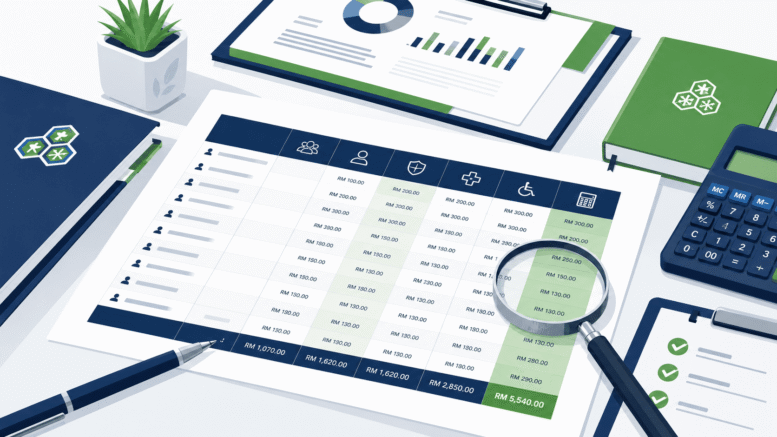
Payroll penalties are not just costly, they are becoming increasingly common as labor regulations grow more complex. The evolution of HRMS over the past decade has been driven largely by this exact problem: businesses need a smarter way to stay compliant while managing an ever-growing list of statutory contributions, tax deductions, and reporting requirements.
Today’s AI-powered payroll systems do far more than calculate salaries. They actively flag compliance risks before they become costly penalties. This article traces the evolution of HRMS from basic payroll calculators to intelligent compliance partners, and explains how AI is changing the way Malaysian businesses manage regulatory risk.
From Spreadsheets to Smart Systems: The Evolution of HRMS
Early HR management systems were little more than digital spreadsheets. They calculated basic salary, EPF, and SOCSO contributions, but left compliance monitoring entirely to the HR team. As regulations became more frequent and complex, this manual approach became a significant liability, with even small errors resulting in fines or back-payments.
Modern HRMS platforms have evolved into full compliance ecosystems. They automatically update statutory rates, validate contribution calculations, and generate audit-ready reports, removing much of the guesswork from payroll administration.
How AI-Powered Payroll Prevents Costly Regulatory Penalties
Key AI-Driven Capabilities
- Automatic rate updates: statutory contribution rates are updated in the system as soon as regulations change.
- Error detection: AI flags inconsistencies, such as incorrect deductions or missing contributions, before payroll is finalized.
- Predictive compliance alerts: the system warns HR teams of upcoming filing deadlines or policy changes that may affect payroll.
- Audit trail generation: every payroll run is logged with a clear record, ready for inspection at any time.
Key Benefits of a Modern, AI-Powered HRMS
| Benefit | Description |
|---|---|
| Reduced compliance risk | Automatic checks catch errors before they result in penalties. |
| Time savings | HR teams spend less time manually verifying calculations each month. |
| Improved accuracy | AI-driven validation reduces the chance of human error in payroll processing. |
| Better decision-making | Centralized HR data supports more informed workforce planning. |
Best Practices for Adopting a Modern HRMS
Step-by-Step Adoption Guide
- Audit your current payroll process: identify manual steps that are prone to error or delay.
- Choose a system with compliance automation: prioritize platforms that automatically update statutory rates.
- Migrate historical data carefully: ensure past payroll records are accurately imported for continuity.
- Train HR staff on new workflows: even automated systems require staff to understand how to review flagged issues.
- Monitor compliance reports monthly: use built-in reporting to catch potential issues early.
Traditional Payroll vs AI-Powered HRMS
| Feature | Traditional Payroll | AI-Powered HRMS |
|---|---|---|
| Rate updates | Manually tracked | Automatically applied |
| Error detection | Discovered after the fact | Flagged before submission |
| Compliance reporting | Manually compiled | Generated automatically |
| Risk of penalties | Higher | Significantly reduced |
Key Takeaways
- The evolution of HRMS has shifted payroll from manual spreadsheets to intelligent compliance systems.
- AI-powered payroll actively prevents regulatory penalties by catching errors before submission.
- Adopting a modern HRMS requires careful data migration and staff training to maximize its benefits.
Conclusion
The evolution of HRMS reflects a broader shift in how businesses approach compliance: from reactive fixes after penalties are issued, to proactive prevention built directly into payroll software. By adopting an AI-powered HRMS, Malaysian businesses can reduce regulatory risk, save valuable HR hours, and gain the confidence that comes with accurate, audit-ready payroll every month.
Frequently Asked Questions
What makes an HRMS “AI-powered”?
An AI-powered HRMS uses machine learning and rule-based automation to detect anomalies, predict compliance risks, and continuously update statutory calculations without manual intervention.
Can AI-powered payroll completely eliminate compliance risk?
While no system can guarantee zero risk, AI-powered payroll significantly reduces the likelihood of errors that lead to regulatory penalties by catching issues before submission.
Is switching to a modern HRMS disruptive for existing HR teams?
With proper planning and training, the transition is generally smooth. Most modern systems are designed with intuitive interfaces to minimize the learning curve.
How often are statutory rates updated in a modern HRMS?
Reputable HRMS providers update statutory rates as soon as government regulations change, often before the new rates take effect.
Is an AI-powered HRMS suitable for small businesses?
Yes, many providers offer scalable plans that make AI-powered compliance features accessible to small and medium businesses, not just large enterprises.
Smart Touch technology pte ltd , www.smartouch.com.sg +65-63964767, sales@smartouch.com.sg , www.smartouch.com.my +607-3889903 sales@smartouch.com.my