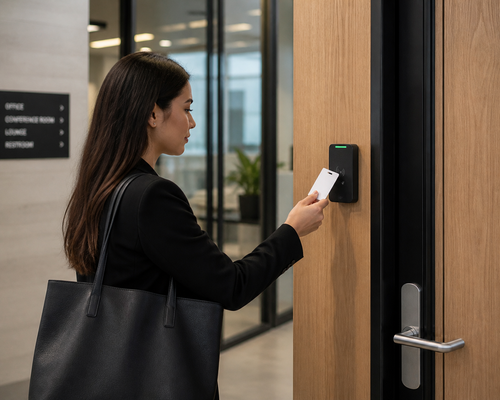
Traditional lock-and-key systems offer almost no visibility into who enters your building and when. Lost keys create ongoing security risks, and there is no easy way to restrict access to sensitive areas. A smart door access control system solves these problems with digital credentials, detailed access logs, and centralized control across every entry point.
This article explains how modern door access control works, why businesses are upgrading from traditional locks, and what features matter most when choosing a system.
What Is a Smart Door Access Control System?
A smart door access control system replaces physical keys with digital credentials such as key cards, mobile app access, PIN codes, or biometric verification. Every entry attempt is logged, and administrators can grant or revoke access instantly from a central dashboard.
Why Businesses Are Upgrading From Traditional Locks
1. No Visibility With Traditional Locks
Physical keys leave no record of who entered a space or when, making it difficult to investigate security incidents.
2. Costly Rekeying After Lost Keys
A single lost key can require rekeying entire door systems. Digital credentials can simply be deactivated instantly at no extra cost.
3. Difficulty Restricting Sensitive Areas
Traditional locks make it hard to grant different access levels to different employees. Smart systems allow granular, role-based permissions.
4. No Integration With Other Security Systems
Modern access control integrates with visitor management, CCTV, and attendance systems for a unified security approach.
Key Features of a Smart Door Access Control System
| Feature | Benefit |
|---|---|
| Card / Mobile / Biometric Access | Flexible, secure entry methods |
| Centralized Management | Control all doors from one dashboard |
| Real-Time Access Logs | Full visibility into every entry event |
| Instant Credential Revocation | Immediately disable lost or stolen credentials |
| Role-Based Permissions | Restrict sensitive areas to authorized staff only |
| Integration Capability | Connects with CCTV, visitor management, and attendance systems |
Comparison: Traditional Locks vs Smart Access Control
| Criteria | Traditional Locks | Smart Access Control |
|---|---|---|
| Access Logs | None | Full digital audit trail |
| Lost Key Response | Costly rekeying | Instant deactivation |
| Access Restrictions | Difficult to customize | Role-based, fully flexible |
| System Integration | Not possible | Integrates with security ecosystem |
Step-by-Step Implementation Guide
- Assess entry points and identify areas requiring restricted access
- Select suitable credential types such as cards, mobile access, or biometrics
- Install access control hardware at each designated entry point
- Configure role-based permissions for different employee groups
- Integrate with existing CCTV and visitor management systems where possible
Cost Considerations for Smart Access Control
Businesses often assume smart access control is significantly more expensive than traditional locks, but the total cost of ownership tells a different story. Traditional locks carry hidden costs such as rekeying fees after lost keys, locksmith call-outs, and the inability to track misuse. Smart access control eliminates most of these recurring costs, and many providers offer scalable pricing based on the number of doors and users, making it accessible for businesses of varying sizes.
Choosing Between Cloud-Based and On-Premise Access Control
Modern smart door access control systems are typically offered as either cloud-based or on-premise solutions. Cloud-based systems allow remote management from anywhere, automatic software updates, and easier scaling across multiple locations. On-premise systems may appeal to businesses with strict data residency requirements or limited internet reliability. Understanding which model fits your operational needs is an important step before selecting a vendor.
Planning for System Downtime and Failover
No system is immune to occasional technical issues, so it is important to ask vendors how their access control system behaves during network outages or power failures. Look for fail-safe or fail-secure configurations appropriate to each door, along with backup power options to ensure entry points remain functional during emergencies.
Scaling Access Control Across Multiple Sites
For businesses with more than one office or warehouse, managing access consistently across all locations can be a challenge with traditional locks. A cloud-based smart access control system allows a single administrator to configure and monitor permissions across every site from one dashboard, ensuring consistent security policies regardless of location. This is particularly valuable for businesses planning to expand, since new sites can be added to the same system without needing an entirely separate security setup.
This kind of centralized control is one of the clearest advantages smart access control holds over traditional locks, especially as a business grows beyond a single location.
Businesses evaluating vendors should also confirm ongoing support availability, since fast response times matter most during a security incident rather than during routine day-to-day use.
A well-planned rollout, backed by responsive vendor support, ensures that a smart door access control system delivers on its security promise from day one.
Getting these fundamentals right from the start pays off in fewer headaches down the road.
Security, after all, is only as strong as the weakest overlooked detail.
Key Takeaways
- Smart access control eliminates the security blind spots of traditional locks
- Lost credentials can be deactivated instantly without rekeying costs
- Centralized dashboards simplify management across multiple entry points
- Integration with other security systems creates a stronger overall defense
Frequently Asked Questions
What credential types are supported by smart access control?
Most systems support key cards, mobile app credentials, PIN codes, and biometric verification such as fingerprints or facial recognition.
Can access permissions be changed remotely?
Yes, administrators can grant or revoke access instantly through a centralized management dashboard.
Does the system keep a record of every entry?
Yes, all entry and exit events are logged in real time for security review and audit purposes.
Can this system integrate with visitor management software?
Most smart access control systems can integrate with visitor management platforms to grant temporary access to guests.
Conclusion
A smart door access control system gives businesses the visibility, flexibility, and security that traditional locks simply cannot match. From instant credential management to detailed access logs, this technology strengthens overall building security while simplifying daily operations. As security expectations continue to rise, upgrading to a smart access control solution is a practical step for any organization.
Want to know more about the product? Check it out here : https://www.smartouch.com.my/door-access-system/
Smart Touch technology pte ltd , www.smartouch.com.sg +65-63964767, sales@smartouch.com.sg , www.smartouch.com.my +607-3889903 sales@smartouch.com.my