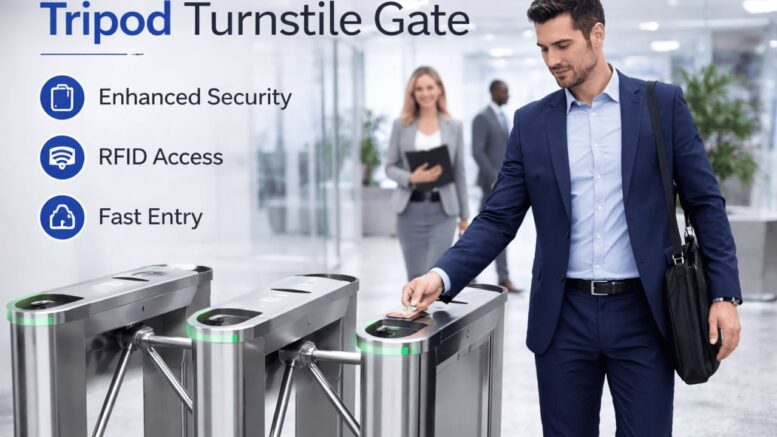
Lobbies and building entrances often struggle to balance smooth pedestrian flow with strict access control. Security guards alone cannot verify every entry, and open entrances leave buildings vulnerable to unauthorized access. Tripod turnstile gates solve this by combining physical barriers with automated credential verification at every entry point.
This article covers how tripod turnstile gates work, why they are widely used for access control, and what to consider before installing one.
What Are Tripod Turnstile Gates?
Tripod turnstile gates are mechanical barriers with rotating arms that allow only one person to pass at a time after valid credential verification, such as a card tap, QR code scan, or biometric check. They are commonly installed at office lobbies, factories, and transportation hubs.
Why Businesses Choose Tripod Turnstile Gates
1. Controlled Pedestrian Flow
Turnstiles ensure only one authorized person enters per verified credential, preventing tailgating and unauthorized entry.
2. Reduced Dependence on Manual Security Checks
Automated verification reduces the workload on security personnel while maintaining strict access control.
3. Durable and Low Maintenance
Tripod turnstiles are built for high-traffic environments and require minimal maintenance compared to more complex access systems.
4. Seamless Integration With Access Control Systems
These gates typically integrate with card access, facial recognition, or mobile credential systems for a complete access control solution.
Key Features to Look For
| Feature | Benefit |
|---|---|
| Anti-Tailgating Mechanism | Prevents multiple entries per single credential |
| Integration With Access Control | Works with cards, biometrics, or mobile credentials |
| Durable Build Quality | Withstands high foot traffic environments |
| Fail-Safe or Fail-Secure Modes | Ensures safe operation during power outages or emergencies |
| Fast Passage Speed | Minimizes queues during peak entry times |
Common Use Cases for Tripod Turnstiles
- Corporate office lobbies requiring controlled employee access
- Factories and warehouses managing large workforce entry points
- Residential buildings and gated communities
- Transportation hubs and public facilities
Step-by-Step Installation Guide
- Assess entry points and expected daily foot traffic
- Select a turnstile model suited to your security and flow requirements
- Integrate the turnstile with your existing access control credentials
- Configure fail-safe settings for emergency situations
- Train security staff on monitoring and troubleshooting the system
Selecting the Right Turnstile Type for Your Facility
Not all tripod turnstiles are built the same. Some facilities benefit from waist-height tripod arms that balance security with quick passage, while others, such as data centers or high-security facilities, may require full-height turnstiles for stronger physical deterrence. Understanding your facility’s specific risk profile helps determine which configuration strikes the right balance between security and convenience.
Turnstile Placement and Traffic Flow Planning
Where a turnstile is physically positioned matters as much as the technology behind it. Poor placement can create bottlenecks during shift changes or peak hours, undermining the very efficiency the system is meant to provide. Facilities teams should map expected foot traffic patterns before finalizing turnstile placement, ensuring enough units are installed to handle peak entry and exit volumes smoothly.
Maintenance Requirements for Long-Term Reliability
Like any mechanical security equipment, tripod turnstiles require periodic maintenance to continue operating reliably in high-traffic environments. Businesses should establish a maintenance schedule with their vendor, covering mechanical inspections, software updates for connected access control systems, and prompt repairs for any wear that develops over time.
Integrating Turnstiles With Visitor and Employee Access Rules
Tripod turnstiles work best when configured with different access rules for employees, visitors, and contractors. Employees might use permanent access cards, while visitors are issued temporary QR codes valid only for their scheduled visit window. This layered approach ensures the same physical barrier can serve multiple user groups securely without requiring separate entry points for each.
Balancing Security With Employee Convenience
While the primary purpose of a turnstile is security, an overly restrictive setup can frustrate employees and slow down daily operations. The best implementations strike a balance, using fast credential recognition and clear signage to keep entry smooth while still enforcing strict verification. Regularly gathering feedback from employees and security staff after installation helps identify adjustments that improve both flow and security over time.
This ongoing feedback loop is what ultimately turns a good turnstile installation into a great long-term security investment.
Facilities that treat turnstile deployment as an evolving process, rather than a one-time installation, consistently report higher satisfaction from both security teams and everyday employees.
Ultimately, the goal is a physical security layer that employees barely notice on a normal day, yet one that reliably stops unauthorized entry the moment it matters.
That kind of quiet reliability is exactly what makes tripod turnstiles such a widely trusted choice across industries.
When evaluated properly, the return on investment speaks for itself over the equipment’s lifespan.
Facilities managers who plan ahead for these factors rarely regret the decision to invest in quality turnstile equipment.
The peace of mind alone often justifies the cost.
Security should feel invisible on a normal day and unbreakable the moment it is truly tested.
Key Takeaways
- Tripod turnstile gates prevent tailgating and unauthorized entry effectively
- They reduce reliance on manual security checks at busy entrances
- Integration with access control systems creates a complete security solution
- Durable construction makes them suitable for high-traffic environments
Frequently Asked Questions
What credential types work with tripod turnstile gates?
Most turnstiles support card access, QR code scanning, mobile credentials, and biometric verification.
Are tripod turnstiles suitable for high-traffic buildings?
Yes, they are specifically designed to handle continuous, high-volume foot traffic reliably.
What happens to tripod turnstiles during a power outage?
Most systems offer fail-safe or fail-secure configuration options to ensure safe operation during emergencies.
Can tripod turnstiles prevent tailgating?
Yes, the rotating arm mechanism only allows one verified person to pass per valid credential.
Conclusion
Tripod turnstile gates provide a reliable, durable, and effective way to manage access control at busy entry points. By combining physical barriers with credential verification, they prevent unauthorized entry while keeping pedestrian flow smooth and efficient. For businesses looking to strengthen entrance security without slowing down daily operations, tripod turnstile gates remain a proven solution.
For more information about the product, please click here: https://www.smartouch.com.my/category/time-clock/barrier/
Smart Touch technology pte ltd , www.smartouch.com.sg +65-63964767, sales@smartouch.com.sg , www.smartouch.com.my +607-3889903 sales@smartouch.com.my