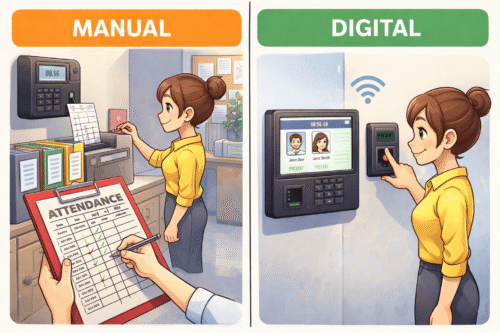
Buddy punching, where one employee clocks in or out on behalf of a colleague, remains one of the most common forms of time theft affecting Malaysian businesses today. Learning how to eliminate buddy punching with facial clocking and e attendance technology can save companies significant money while restoring trust in payroll accuracy. This article explains why buddy punching happens, how facial recognition solves the problem, and what to look for when choosing an e attendance system.
Understanding the Real Cost of Buddy Punching
Buddy punching might seem like a minor issue, but across an entire workforce, even a few minutes of falsified time per employee per day adds up to significant payroll losses over a year. Beyond the direct financial cost, it also creates unfair discrepancies between employees who honestly log their hours and those who exploit the system, which can quietly damage workplace morale over time.
Traditional card-based or PIN-based attendance systems are particularly vulnerable, since cards can be shared and PINs can be given to a colleague without much effort. This is exactly the gap that facial clocking and e attendance systems are designed to close.
How to Eliminate Buddy Punching With Facial Clocking
Biometric Verification Removes the Loophole
Facial clocking requires the employee’s actual face to be present and verified at the point of clocking in or out. Unlike a card or PIN, a face cannot be handed to a colleague, which closes the loophole that makes buddy punching possible in the first place.
Instant Digital Records With E Attendance
Once verified, attendance data is logged instantly into a digital system, removing the need for manual timesheets that are easier to manipulate or backdate. This creates a transparent, tamper-resistant record for payroll and compliance purposes.
Facial Clocking vs Traditional Attendance Methods
| Method | Buddy Punching Risk | Data Accuracy | Payroll Integration |
|---|---|---|---|
| Manual Sign-In Sheet | Very High | Low | Manual |
| Card or PIN System | Medium to High | Medium | Semi-automatic |
| Facial Clocking / E Attendance | Very Low | High | Automatic |
Key takeaway: facial clocking combined with e attendance software offers the strongest protection against time theft while streamlining payroll processing at the same time.
Choosing the Right Facial Clocking and E Attendance System
- Check recognition speed to avoid long queues during peak clock-in times.
- Confirm the system works reliably in your specific lighting and environmental conditions.
- Look for seamless integration with payroll and leave management software.
- Ensure the vendor offers local support and warranty coverage in Malaysia.
- Evaluate reporting tools that help HR identify attendance patterns and anomalies quickly.
Step-by-Step: Rolling Out Facial Clocking to Stop Buddy Punching
- Step 1: Audit current attendance data to estimate the scale of potential buddy punching.
- Step 2: Select a facial clocking vendor with strong accuracy and local compliance support.
- Step 3: Enroll employees in phases, starting with a pilot department.
- Step 4: Communicate clearly with staff about how the new system protects fair payroll practices.
- Step 5: Review attendance reports after the first month to confirm improved accuracy.
Addressing Employee Concerns About Facial Recognition
Some employees may initially feel uneasy about facial recognition technology, often due to misunderstandings about how the data is used. Employers should clearly explain that facial clocking systems store an encrypted mathematical template rather than an actual photo, and that the data is used solely for attendance verification. Transparent communication, combined with visible fairness once buddy punching is eliminated, typically leads to strong acceptance once employees see the system in daily use.
Beyond Time Theft: Additional Benefits of E Attendance
While stopping buddy punching is often the main driver for adoption, facial clocking and e attendance systems deliver broader value as well. Real-time attendance dashboards help managers spot chronic lateness or unusual patterns early, while automatic payroll integration reduces the administrative burden on HR teams at the end of each month. For companies with multiple branches, centralised cloud reporting also allows management to monitor attendance trends across all locations from a single dashboard, supporting more consistent workforce management company-wide.
Common Challenges When Deploying Facial Clocking
Environmental Factors Affecting Accuracy
Poor lighting, direct sunlight glare, or scanners positioned at awkward angles can reduce recognition accuracy. Working with an installer to test the system under real daily conditions before full rollout helps prevent frustration once employees begin using it regularly.
Managing a Large, Distributed Workforce
Companies with multiple sites need to ensure attendance data from every location syncs reliably to a central system. Cloud-based e attendance platforms are generally better suited for this than standalone, on-premise devices that require manual data consolidation.
Employee Onboarding for New Hires
Enrolling new employees quickly is important to avoid attendance gaps during their first days. Building facial enrollment into the standard onboarding checklist ensures no new hire is left using a manual fallback process for longer than necessary.
Building a Culture of Fairness Through Accurate Attendance
Eliminating buddy punching is not just a financial or compliance matter, it also reinforces a culture of fairness within the workplace. Employees who consistently arrive on time and follow proper attendance procedures often feel demotivated when they see colleagues exploiting loopholes without consequence. By implementing facial clocking, companies send a clear signal that attendance policies apply equally to everyone, which can meaningfully improve trust and morale across teams over time.
As labour costs continue to rise across Malaysia, ensuring every ringgit of payroll spending reflects actual hours worked becomes increasingly important for maintaining healthy margins. Facial clocking and e attendance technology give businesses a reliable, low-maintenance way to protect that accuracy without placing additional administrative burden on HR teams.
Conclusion
Understanding how to eliminate buddy punching with facial clocking and e attendance technology gives Malaysian businesses a practical, effective way to protect payroll accuracy and workplace fairness. By replacing easily manipulated cards or PINs with biometric verification, companies close the loophole that enables time theft while gaining accurate, real-time attendance data. Choosing a reliable system with strong payroll integration ensures the benefits extend well beyond simply stopping buddy punching.
Frequently Asked Questions
Can facial clocking completely eliminate buddy punching?
Yes, since facial recognition requires the actual employee to be present, it effectively removes the ability for colleagues to clock in on someone else’s behalf.
Is facial recognition data secure?
Reputable systems store encrypted templates rather than actual images, making the data extremely difficult to misuse.
Does facial clocking work for large workforces?
Yes, modern systems are designed to handle high volumes of employees efficiently, even during peak clock-in periods.
What if an employee’s face cannot be recognised due to injury?
Most systems offer backup verification methods such as a PIN to ensure attendance can still be logged without disruption.
Does e attendance integrate with existing payroll software?
Yes, most e attendance platforms are built to integrate directly with payroll systems, reducing manual data entry significantly.
Read the product overview here: http://www.smartouch.com.my/tms-time-management-system-singapore-malaysia/
Smart Touch technology pte ltd , www.smartouch.com.sg +65-63964767, sales@smartouch.com.sg , www.smartouch.com.my +607-3889903 sales@smartouch.com.my