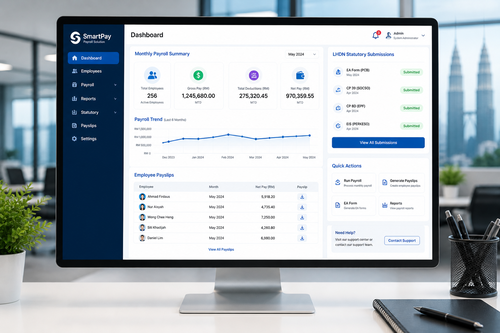
SmartPay: EPF And SOCSO Payroll Automation A Practical Buyer’s Guide
Managing payroll in Malaysia involves navigating multiple regulatory requirements, including contributions to the Employees Provident Fund (EPF) and the Social Security Organisation (SOCSO). For many businesses, whether small startups or larger organisations, these obligations can become time-consuming and error-prone when managed manually.
This guide explores how EPF and SOCSO payroll automation can streamline your business operations, reduce compliance risks, and free up valuable resources for more strategic work.
Understanding EPF And SOCSO In Malaysian Payroll
EPF and SOCSO are fundamental components of Malaysia’s social security system. Employers are legally required to contribute to these schemes on behalf of their employees, and managing these contributions accurately is essential for compliance.
EPF (Employees Provident Fund) is a retirement savings scheme where both employers and employees contribute a percentage of the employee’s salary. The current contribution rates depend on the employee’s age and salary level, and these rates can be subject to change.
SOCSO (Pertubuhan Keselamatan Sosial) provides protection for employees against employment injury and occupational diseases. Employers are required to register all employees and make monthly contributions based on their wages.
Both schemes involve detailed record-keeping, regular calculations, and timely submissions. Manual management of these processes creates multiple points where errors can occur, from calculation mistakes to missed deadlines.
Common Challenges With Manual Payroll Processing
Organisations that rely on spreadsheets or manual processes often encounter significant operational challenges:
- Calculation errors: Manual calculation of EPF and SOCSO contributions is prone to mistakes, which can lead to under or overpayment and compliance issues.
- Time consumption: Payroll staff spend considerable hours on calculations, data entry, and verification instead of focusing on strategic HR functions.
- Compliance risks: Missing deadlines for EPF or SOCSO submissions can result in penalties and complications with regulatory authorities.
- Poor visibility: Manual systems make it difficult to track payroll history, audit trails, and employee contribution records quickly.
- Scalability problems: As your organisation grows, manual payroll processes become increasingly difficult to manage without significant additional resources.
- Data security: Spreadsheets stored locally or shared via email pose risks to sensitive employee information.
What Payroll Automation Achieves
Automating your EPF and SOCSO payroll processes addresses these challenges by centralising calculations, reducing human error, and ensuring timely compliance.
Accurate Contribution Calculations
Payroll automation software automatically calculates EPF and SOCSO contributions based on current employee data, salary information, and the latest contribution rates. This eliminates the risk of manual calculation errors and ensures every employee record is accurate.
Improved Compliance
Automated systems maintain detailed records of all contributions and ensure that submissions are made on time. This reduces the risk of penalties and keeps your organisation in good standing with regulatory authorities.
Time And Resource Efficiency
By automating routine payroll calculations and record-keeping, your team can focus on higher-value activities such as employee relations, benefits administration, and strategic HR planning. This also reduces the need to expand your payroll team as the organisation grows.
Better Data Management
Centralised payroll systems provide easy access to historical records, contribution summaries, and audit trails. This makes it simpler to respond to employee queries and prepare for audits.
Enhanced Security
Modern payroll solutions store sensitive employee data securely with role-based access controls and encryption, reducing the risk of data breaches associated with email and local file storage.
Key Considerations When Choosing A Payroll Automation Solution
Before implementing a payroll automation system, consider the following factors to ensure the solution aligns with your business needs:
- Compliance with Malaysian regulations: Verify that the solution is designed to comply with current EPF and SOCSO requirements and is updated regularly as regulations change.
- Ease of use: The system should be intuitive for your payroll team and require minimal training.
- Integration capabilities: Check whether the solution integrates with your existing HR, accounting, or time and attendance systems to avoid manual data transfers.
- Scalability: Choose a solution that can grow with your organisation without requiring significant reconfiguration.
- Reporting and analytics: Look for strong reporting features that help you understand payroll costs, contribution breakdowns, and employee data trends.
- Support and maintenance: Ensure the vendor provides reliable customer support and regularly updates the system to reflect regulatory changes.
- Data security: Verify that the solution employs industry-standard security measures to protect sensitive employee information.
Implementation Best Practices
A successful payroll automation implementation requires careful planning and execution:
Assess Your Current Process
Before moving to automation, document your current payroll workflow. Identify pain points, understand the data you collect, and clarify your organisation’s specific needs. This assessment will help you evaluate solutions more effectively.
Plan Your Data Migration
Ensure you have accurate employee records, salary information, and historical contribution data ready for import into the new system. Clean data from the start prevents ongoing problems with calculations and reporting.
Train Your Team
Provide thorough training for your payroll team and HR staff who will use the system. Include training on how to input data correctly, generate reports, and troubleshoot common issues.
Test Thoroughly Before Go-Live
Run test payrolls to verify that the system calculates contributions correctly and that outputs match your expectations. Test with a small group of employees first if possible.
Maintain Regular Updates
Keep the system updated with any changes to contribution rates, employee information, or regulatory requirements. Establish a routine for reviewing and updating payroll data.
How Smart Touch Technology Can Help
Smart Touch Technology offers SmartPay, a payroll solution designed to streamline EPF and SOCSO management for Malaysian organisations. SmartPay automates contribution calculations, maintains compliance records, and integrates with your existing business systems to create a cohesive payroll workflow.
By using SmartPay, organisations can reduce manual payroll work, minimise calculation errors, and ensure their EPF and SOCSO submissions are accurate and timely. The solution is designed with Malaysian employment regulations in mind, helping businesses of all sizes manage payroll more efficiently.
Conclusion
EPF and SOCSO payroll automation is no longer a luxury—it’s a practical investment in operational efficiency and compliance. Whether you’re managing a small team or a large workforce, automating these processes eliminates manual errors, saves time, and reduces regulatory risk.
When evaluating solutions, prioritise systems that are compliant with Malaysian requirements, easy to use, and able to integrate with your existing tools. A well-implemented payroll automation solution can transform how your organisation handles this critical function.
Ready to simplify your payroll management? Contact Smart Touch Technology to learn how SmartPay can work for your organisation.
Smart Touch Technology Pte Ltd
Singapore: www.smartouch.com.sg | +65-63964767 | sales@smartouch.com.sg
Malaysia: www.smartouch.com.my | +607-3889903 | sales@smartouch.com.my